Drug Interaction Checker for Statins and Antifungals
Check Your Medication Safety
This tool helps you understand potential dangerous interactions between your statin and antifungal medications. Based on the article, some combinations can cause severe muscle damage.
When you’re taking a statin to lower cholesterol and then get a serious fungal infection, your doctor might reach for an azole antifungal like fluconazole or itraconazole. Sounds straightforward, right? But here’s the catch: combining these drugs can turn a routine treatment into a life-threatening situation. The real danger isn’t the infection itself-it’s what happens when these medications collide inside your body.
Why Azole Antifungals Are So Risky With Statins
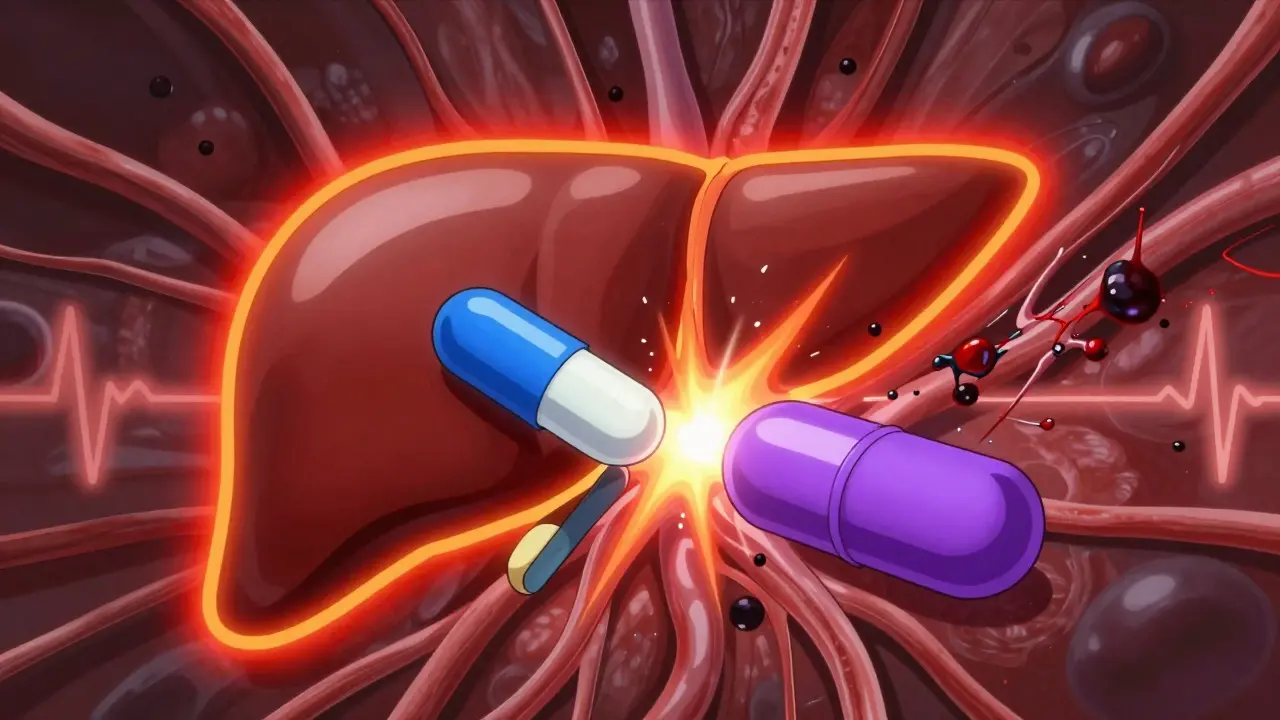
Azole antifungals-like ketoconazole, itraconazole, voriconazole, and posaconazole-work by blocking a fungal enzyme called lanosterol 14-alpha-demethylase. But here’s the problem: that same enzyme is part of a family called cytochrome P450, which your liver uses to break down dozens of common drugs, including statins. When azoles block CYP3A4-the most abundant enzyme in this system-they slow down how fast your body clears statins from your blood.This isn’t a small bump in levels. With strong inhibitors like ketoconazole or posaconazole, statin concentrations can spike by 10 to 20 times. That’s not just a warning label-it’s a red alert. The result? Muscle damage. Mild cases feel like unexplained soreness or weakness. Severe cases lead to rhabdomyolysis, where muscle tissue breaks down, floods your bloodstream with toxins, and can shut down your kidneys.
Not all statins are created equal. Atorvastatin, simvastatin, and lovastatin are metabolized almost entirely by CYP3A4, making them the most vulnerable. If you’re on one of these and get prescribed an azole antifungal, your doctor should stop the statin immediately. Pravastatin and rosuvastatin are safer choices because they’re cleared mostly by the kidneys, not the liver. Even then, ketoconazole can still raise their levels by blocking the OATP1B1 transporter-a backup pathway that moves statins into liver cells. So even "safer" statins aren’t risk-free.
Immunosuppressants Make Things Even Worse
If you’ve had a kidney, liver, or heart transplant, you’re likely on cyclosporine, tacrolimus, or sirolimus. These drugs keep your immune system from attacking your new organ-but they also block the same liver enzymes and transporters that statins rely on. The combination is a perfect storm.Studies show that when cyclosporine is added to a statin regimen, statin levels can jump 3 to 20 times higher than normal. That’s why up to 25% of transplant patients on statins develop muscle pain or damage. And when you add an azole antifungal on top? The risk doesn’t just double-it multiplies. Case reports show creatine kinase (CK) levels over 10,000 U/L in patients with rhabdomyolysis, compared to a normal range of under 200 U/L. That’s muscle breakdown on a massive scale.
Doctors know this. Guidelines from the American College of Cardiology and the Infectious Diseases Society of America say clearly: monitor CK levels closely. If CK rises more than 10 times the upper limit of normal, stop the statin. But here’s the scary part: despite all the warnings, these dangerous combinations are still prescribed. A 2012 study found that even with clear labels warning against it, doctors kept writing prescriptions for simvastatin with azoles. Why? Because fungal infections don’t wait. Patients need treatment fast. And sometimes, the safest option isn’t obvious in the moment.

What Should You Do If You Need Both?
If you’re on a statin and need an antifungal, here’s what actually works in real clinical practice:- Stop high-risk statins. If you’re on simvastatin, lovastatin, or atorvastatin, pause them entirely during azole treatment. Don’t just lower the dose-stop completely.
- Switch to pravastatin or rosuvastatin. These are your best bets. Use the lowest effective dose-10 mg of pravastatin or 5 mg of rosuvastatin daily. Avoid higher doses unless absolutely necessary.
- Watch for muscle symptoms. Unexplained fatigue, muscle pain, dark urine? Call your doctor right away. Don’t wait. Early detection can prevent kidney failure.
- Ask about timing. Posaconazole sticks around in your system for over 24 hours after your last dose. Don’t restart your statin until at least 3 days after finishing the antifungal.
- Consider twice-weekly dosing. For patients who absolutely need to stay on statins, some experts recommend reducing frequency-like taking simvastatin only twice a week instead of daily. This cuts exposure without fully abandoning cholesterol control.
There’s one more thing: if you’ve never had genetic testing, you might have a hidden risk. About 12% of people carry a variant in the SLCO1B1 gene. This makes their bodies less able to move statins out of muscle tissue, increasing the chance of damage-even at normal doses. When you add a CYP3A4 inhibitor? The risk skyrockets. It’s not routine testing yet, but if you’ve had muscle side effects from statins before, it’s worth asking about.
Newer Antifungals Offer Hope
The good news? Not all antifungals are created equal. Newer drugs like isavuconazole are weaker inhibitors of CYP3A4, meaning they’re less likely to cause dangerous spikes in statin levels. Even better, olorofim-a drug still in clinical trials-works by a completely different mechanism. It doesn’t touch the liver’s drug-processing system at all. Early data shows minimal interaction with statins or immunosuppressants.Some hospitals are already changing how they handle this. The American Society of Health-System Pharmacists rolled out a protocol requiring pharmacists to review every azole prescription against the patient’s current meds. In places where this rule is enforced, dangerous combinations dropped by 63%. That’s not just policy-it’s saved lives.

What Your Doctor Might Not Tell You
Most patients assume their doctor knows all the interactions. But the truth is, even experienced clinicians can miss them. A statin might be prescribed by a cardiologist. An antifungal by an infectious disease specialist. An immunosuppressant by a transplant team. No one person sees the full picture.That’s why you need to be your own advocate. Keep a list of every medication you take-including over-the-counter supplements. Bring it to every appointment. Say: "I’m on [statin name]. I’ve been prescribed [antifungal name]. Is this safe together?" If your doctor hesitates or says "probably fine," ask for a pharmacist consult. Pharmacists are trained to catch these hidden dangers.
And if you’re on a statin and get a fungal infection-don’t assume you have to stop your cholesterol medicine forever. There are safe options. You just need to ask the right questions.
Bottom Line: Safety Over Convenience
Fungal infections are serious. So are heart attacks. But the worst outcome isn’t the infection or the high cholesterol-it’s the muscle damage you didn’t see coming. The science is clear: azole antifungals and statins don’t mix safely unless you take deliberate steps to reduce risk.You don’t need to panic. But you do need to act. Talk to your doctor. Ask about alternatives. Get your statin switched if needed. And never ignore muscle pain when you’re on these drugs. Your body is sending a signal. Listen to it.
Can I take fluconazole with my statin?
Fluconazole is a moderate CYP3A4 inhibitor and a strong CYP2C19 inhibitor. It’s safer than ketoconazole or posaconazole, but still risky with simvastatin, lovastatin, or atorvastatin. If you’re on one of these, your doctor should switch you to pravastatin or rosuvastatin first. Even then, use the lowest dose possible. Fluconazole is often used for yeast infections, so the treatment course is usually short-just a few days. But don’t assume short-term = safe. Always check with your pharmacist.
What if I’m on cyclosporine and need an antifungal?
This is one of the highest-risk combinations. Cyclosporine already boosts statin levels. Adding an azole antifungal can push them into dangerous territory. The safest path is to avoid statins entirely during antifungal treatment if possible. If cholesterol control is critical, use pravastatin at 10 mg daily and monitor CK levels weekly. Your transplant team should also check your cyclosporine blood levels-azoles can raise those too, increasing the risk of kidney damage. Always coordinate care between your transplant doctor and infectious disease specialist.
Are there any statins that are completely safe with azoles?
No statin is 100% risk-free with all azoles. But pravastatin and rosuvastatin are the safest options because they’re not primarily broken down by CYP3A4. That said, ketoconazole can still raise their levels by blocking the OATP1B1 transporter. So even with these, use the lowest dose and avoid long-term use together. Avoid fluvastatin too-it’s metabolized by CYP2C9, which fluconazole inhibits. Stick to pravastatin or rosuvastatin, and only if absolutely necessary.
How long should I wait to restart my statin after an azole?
It depends on the antifungal. For fluconazole, wait 2-3 days after your last dose. For itraconazole or voriconazole, wait 3-5 days. For posaconazole, wait at least 5-7 days because it stays in your system longer-its half-life is 24 to 30 hours. Never restart without checking with your doctor. Muscle damage can develop days after the drug is stopped, so don’t rush.
What symptoms should I watch for?
Watch for unexplained muscle pain, weakness, or tenderness-especially in your shoulders, thighs, or lower back. Dark, tea-colored urine is a red flag-it means muscle breakdown products are flooding your kidneys. Fatigue, nausea, or fever can also be signs. If you notice any of these while on a statin and an antifungal, stop the statin and call your doctor immediately. Don’t wait for it to get worse. Early action can prevent kidney failure.
Can I use over-the-counter antifungals instead?
Topical antifungals-creams, sprays, or powders-are safe because they don’t enter your bloodstream. But if you have a systemic fungal infection-like a deep lung infection, oral thrush that won’t clear, or a fungal nail infection spreading-you need oral or IV treatment. Don’t try to avoid systemic antifungals by using OTC products. That can delay treatment and let the infection grow worse. Always get a proper diagnosis first.




12 Comments
Wow, this is actually one of the most useful medical posts I’ve seen in months 🙌 I’ve been on rosuvastatin for years and just got prescribed fluconazole for a stubborn yeast infection-now I know I’m not being paranoid to double-check with my pharmacist. Thanks for laying it out so clearly!
As a pharmacist, I see this combo way too often. Docs forget that statins aren’t just ‘cholesterol pills’-they’re ticking time bombs when paired with azoles. We’ve had two rhabdo cases in the last year from this exact mix. Always check the interaction checker before hitting ‘send’ on that script. Seriously.
Let me just say-this entire post reads like a 5000-word lecture from someone who thinks they’re the only one who’s ever heard of CYP3A4. Of course azoles interact with statins. We’ve known this since the 90s. The fact that this is even news to people is a testament to how little actual medical literacy exists out here. And don’t get me started on ‘switch to pravastatin’ like it’s some magic bullet. It’s not. It’s just less likely to kill you. Still dangerous. Still needs monitoring. Still ignored by half the prescribers in the country. This isn’t insight. It’s basic pharmacology dressed up as a public service announcement.
Also, why is everyone so shocked that transplant patients are at risk? Of course cyclosporine + azole + statin = disaster. That’s not a ‘perfect storm.’ That’s a textbook case. If you’re a transplant patient and you’re surprised by drug interactions, maybe you shouldn’t be on three life-saving medications at once.
I’m not saying don’t share this info. I’m saying stop acting like you discovered fire. We’ve had clinical guidelines on this since before most of you were old enough to drive. The problem isn’t awareness. It’s compliance. And that’s not something a Reddit post fixes.
Actually, the real issue isn’t even the CYP3A4 inhibition-it’s the OATP1B1 transporter blockade, which even many pharmacists overlook. Pravastatin and rosuvastatin are safer, yes, but their renal clearance is still compromised in elderly patients with declining GFR, which is precisely the demographic on both statins and antifungals. And let’s not forget the polymorphism angle: SLCO1B1*5 carriers are at 4.5x higher risk of myopathy, and genotyping isn’t just ‘worth asking about’-it should be standard before initiating statin therapy in high-risk populations. The fact that this isn’t routine is a systemic failure of precision medicine implementation. Shameful.
Listen. I’ve seen people die from this. Not because they were dumb. Not because they didn’t listen. But because the system doesn’t talk to itself. Cardiologist writes statin. Infectious disease writes azole. Pharmacist is buried under 200 scripts a day. Transplant team is focused on rejection. No one connects the dots. And then the patient wakes up with legs that won’t move and urine the color of motor oil. And no one’s mad at the system. Everyone’s mad at the patient for not knowing. That’s not justice. That’s negligence wrapped in a white coat. This post? It’s a lifeline. Use it. Share it. Yell it from the rooftops. Your life might depend on it.
Y’all are overreacting. I’ve been on simvastatin and fluconazole for 3 years. No issues. Maybe it’s just me? 😏
Also, just a heads-up-if you’re on cyclosporine and get an azole, your cyclosporine levels might spike too. I’ve seen creatinine jump from 1.1 to 2.8 in 48 hours. So even if your muscles are fine, your kidneys might not be. Always check both. And yes, this is why your transplant team needs to be in the loop. No one’s out to get you. But the system? It’s a Rube Goldberg machine made of silos.
Bro this saved my life. My aunt got prescribed itraconazole after a lung infection and she was on simvastatin. I found this post, called her cardiologist, and they switched her to pravastatin in 2 hours. She’s fine now. Just wanted to say THANK YOU. You’re the real MVP.
Let’s be real-this isn’t about drug interactions. It’s about Big Pharma burying the truth. Azoles were designed to block CYP3A4 on purpose. Why? Because they make statins linger longer. Longer lingering = more sales. More side effects = more follow-up visits = more revenue. The FDA? Complicit. The AMA? Complicit. Your doctor? Probably paid by a pharma rep who handed them a free lunch and a ‘clinical update’ that skipped the rhabdo stats. This isn’t an accident. It’s a profit engine. And you’re all just sitting here like good little patients while the machine eats your muscles.
Fluconazole? It’s not a fungus killer. It’s a statin amplifier. And the fact that they let it be OTC in some countries? That’s not oversight. That’s genocide by pharmacology.
It’s interesting how we treat drugs like they’re separate entities-this one for cholesterol, that one for fungus-as if the body is just a collection of compartments. But the liver doesn’t care about specialties. It doesn’t know what a cardiologist or an infectious disease doctor wrote. It just processes. And when you overload it with conflicting signals, it doesn’t scream. It just… fails. Quietly. Slowly. Until the muscle pain starts. Until the urine turns dark. Until the kidneys give up. Maybe the real lesson here isn’t which statin to switch to-but how little we understand the body as a whole system. We treat symptoms, not the organism. And that’s the real tragedy.
So basically: if you’re on statins and get a fungal infection, don’t panic-just call your pharmacist, switch meds, and don’t ignore muscle pain. Also, maybe don’t wait for your doctor to read this post. Just say it out loud: ‘Is this safe?’
And if they say ‘probably fine’? Walk out. Find someone who actually knows what they’re talking about.
Thank you for this detailed and scientifically accurate explanation. However, I must note that the term 'tea-colored urine' may be misleading to non-native English speakers. I would suggest replacing it with 'dark brown or cola-colored urine' for greater clarity. Additionally, the reference to 'SLCO1B1*5' should be expanded upon for general audiences, as not all readers will be familiar with pharmacogenetic nomenclature. Overall, excellent work.