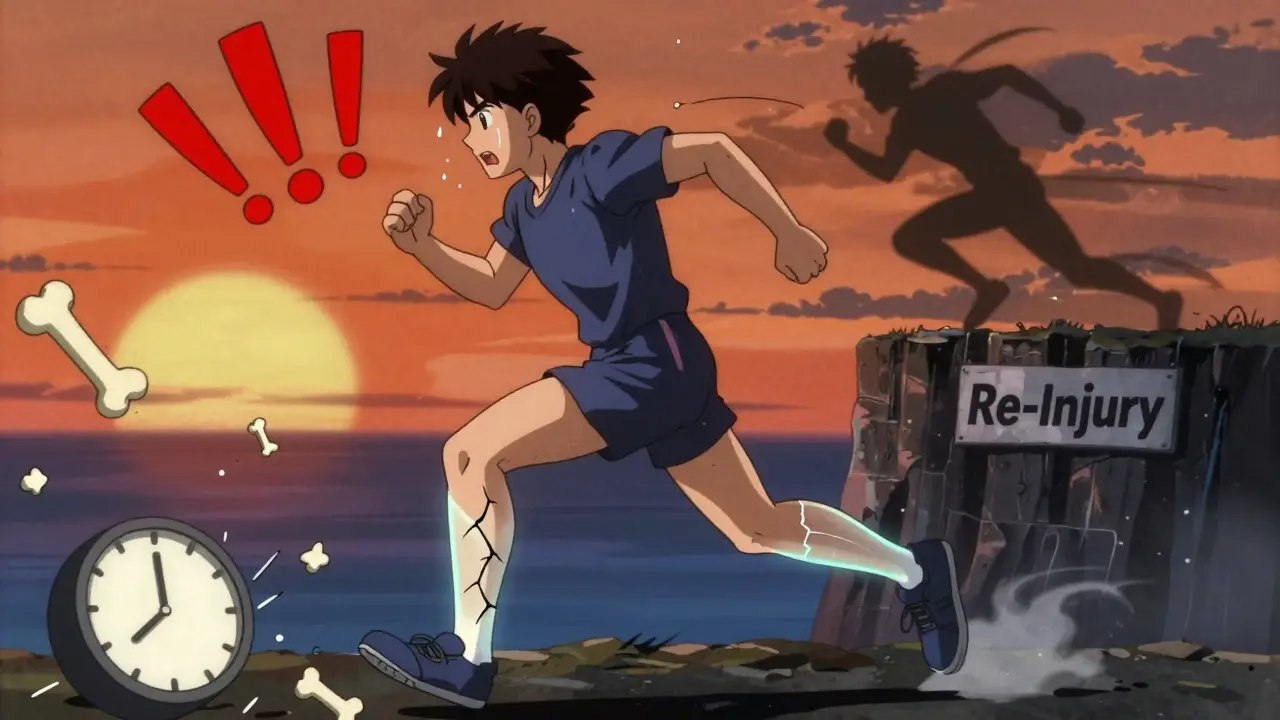
Running hurts. Not the good kind of hurt-the burn in your legs after a long hill repeat. The kind that makes you stop mid-stride because your shin feels like it’s been hit with a hammer. That’s not fatigue. That’s your body screaming for help. Shin splints and stress fractures are two of the most common reasons runners quit. And worse, they come back. About one in five runners who return too soon end up injured again. But here’s the truth: if you follow a smart, step-by-step plan, you don’t just recover-you come back stronger.
Shin Splints vs. Stress Fractures: What’s the Difference?
People often mix up shin splints and stress fractures. They’re related, but not the same. Shin splints (medial tibial stress syndrome, or MTSS) is an inflammation of the muscles, tendons, and bone tissue around the tibia. It feels like a dull, diffuse ache along the inner edge of your shin. It usually shows up after a long run or a sudden increase in mileage. You can still run through it-barely-but it gets worse if you keep pushing.
A stress fracture is a tiny crack in the bone. It’s not just a worse version of shin splints-it’s a different injury entirely. The pain is sharp, localized, and gets worse with activity. Press on the exact spot? It hurts. Walk barefoot on tile? It hurts. You can’t ignore it. If you do, it can turn into a full break. Bone stress injuries (BSIs) are more common in women, especially those with low energy availability, poor nutrition, or hormonal imbalances. Up to 21% of female runners experience them, compared to 8% of men.
Why Most Return-to-Run Plans Fail
The old advice-“take two weeks off, then start running again”-is broken. It doesn’t work. Why? Because bone doesn’t heal on a calendar. It heals on load. And most runners skip the most important part: rebuilding strength before they touch the road again.
Studies show that 42% of recreational runners fail rehab because they jump ahead too fast. They feel better after a few days of walking, so they go back to running. Then, three weeks later, the pain comes back. Worse than before. That’s not bad luck. That’s a protocol failure.
Another myth? The 10% weekly mileage rule. It sounds smart. But research from 2024 found that this rule doesn’t fit 68% of runners with stress fractures. Bone remodeling takes 90 to 120 days. You can’t rush it with arbitrary percentages.
The Phased Return-to-Run Protocol
Here’s what actually works. A six-phase system backed by orthopedic clinics, sports medicine journals, and elite athletic programs. This isn’t theory. It’s used by the US Army, NCAA teams, and pro runners. You don’t need to be an athlete to follow it.
Stage 1: Pain-Free Walking
Start here. No running. No jumping. Just walking. You need to walk pain-free for at least 7 straight days. If your shin still aches when you walk to the mailbox, you’re not ready. This stage usually takes 3 to 10 days. Use this time to ice, elevate, and get a proper diagnosis. If you haven’t had an MRI or bone scan, do it now. Stress fractures don’t show up on X-rays until they’re advanced.
Stage 2: Gentle Bone Loading
Once you can walk without pain, start loading your bone. Not with running. With heel raises. Do 3 sets of 15-20 double-leg heel raises every day. Stand on the floor, rise up on your toes, lower slowly. No pain. If you feel anything over a 2/10 on the pain scale, stop. This builds bone density without impact. Do this for 7-10 days.
Stage 3: Full Range Strength
Now add step-based heel raises. Stand on a step or a book, let your heel drop below the step, then rise up. Do 3 sets of 10-15 reps. This increases the range of motion and forces your calf and tibialis muscles to work harder. Keep doing this daily. Add resistance if you can-hold a light dumbbell. This stage takes 1-2 weeks.
Stage 4: Explosive Strength
Time for hops. Start with double-leg hops: 2 sets of 10-15 reps, twice a day. Land softly. No pain. If you feel any sharpness, go back to heel raises. After a week, progress to single-leg hops. This trains your bone to handle impact. Don’t rush. This stage takes 2-4 weeks. If you’re doing this right, you’ll start to feel your leg getting stronger, not just less sore.
Stage 5: Run-Walk Progression
This is where most people get scared. You’re not running. Not yet. You’re running in tiny doses. Here’s the exact plan for low-risk injuries (posterior medial tibia):
- Week 1-2: 1 minute running, 4 minutes walking. Repeat for 20 minutes total.
- Week 3: 1 minute running, 3 minutes walking. 25 minutes total.
- Week 4: 1 minute running, 2 minutes walking. 30 minutes total.
- Week 5: 1 minute running, 1 minute walking. 35 minutes total.
- Week 6: 3 minutes running, 1 minute walking. 40 minutes total.
That’s it. No more. No less. If you feel pain during or after, go back to the previous week. Don’t skip steps. If you’re on a high-risk site-like the front of the tibia or the femoral neck-extend this to 8-12 weeks.
Stage 6: Full Return
After 6 weeks of run-walk, you can start running continuously. But don’t jump to your old mileage. Increase weekly mileage by no more than 5%. Keep your pace easy. Add strength work twice a week-glutes, hips, calves. And never skip rest days. Two days between runs is ideal. Your bone needs time to rebuild.
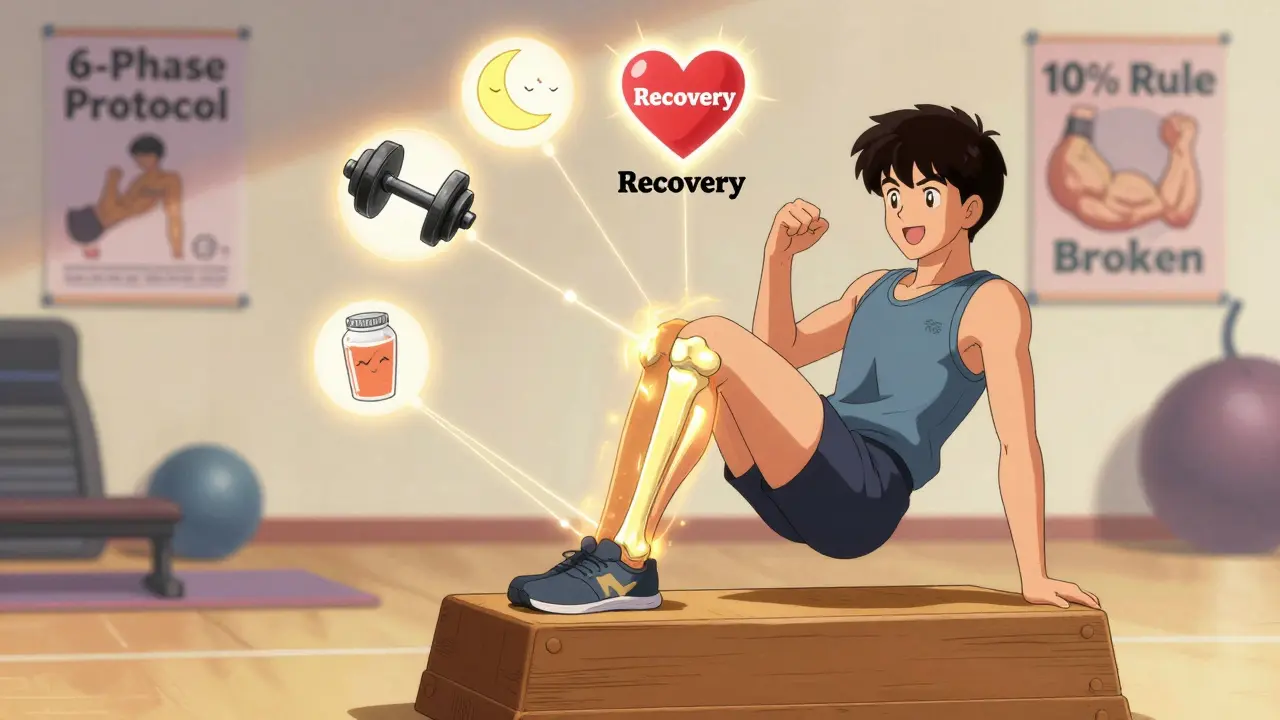
What You Can’t Skip: Strength, Nutrition, and Sleep
Running back too soon isn’t the only reason injuries return. You also need to fix the root causes.
Glute weakness? That’s a red flag. 57% of runners who had recurring shin pain skipped hip strengthening. Your glutes control how your leg lands. Weak glutes = more stress on your shins. Do clamshells, side leg raises, and banded walks. Three times a week.
Energy intake? That’s huge. One in three female runners with repeated stress fractures have Relative Energy Deficiency in Sport (RED-S). That means they’re not eating enough to support their training. Your body doesn’t heal bone if it’s in survival mode. Eat protein. Eat fats. Eat carbs. Don’t count calories. Just eat enough to feel strong, not drained.
Sleep? You need 7-9 hours. Bone repairs itself at night. If you’re waking up at 2 a.m. scrolling, you’re sabotaging your recovery.
What Helps: Tools and Tech
There are tools that make this easier.
Anti-gravity treadmills (like AlterG) let you run at 40-60% body weight while healing. Studies show they cut recovery time by 27 days on average. Not everyone has access, but if you do-use it.
Wearable tech like the WHOOP strap now tracks bone strain. It doesn’t tell you when you’re hurt. It tells you when you’re overloading. It’s not perfect, but it’s better than guessing.
Apps like RunRx use AI to predict recovery time. They analyze your training history, biomechanics, and even blood markers. Beta users saw 86% accuracy in predicting return dates. It’s not magic. It’s data.
When to See a Pro
You don’t need to figure this out alone. If you’ve had more than one stress fracture, get a DXA scan. It measures bone density. 27% of runners with recurring injuries have low bone density. That’s not normal. That’s a signal to check hormones, vitamin D, and thyroid function.
Physical therapists who specialize in runners can do gait analysis. A 2022 study found that gait retraining reduced tibial strain by 38%. Heel lifts? Only 12-15%. You’re better off fixing how you land than what you put in your shoe.
Real Stories
One runner from Halifax, 32, got shin splints after training for a half-marathon. She tried the 10% rule. It failed. She went back to running after 10 days. Pain returned. She tried the 6-phase protocol. Took 11 weeks. Came back stronger. Ran her race six months later. No pain.
Another, a 28-year-old college runner, kept getting stress fractures. She thought it was her shoes. It wasn’t. Her bone density was low. Her energy intake was too low. Once she fixed her nutrition, added strength work, and followed the run-walk plan, she went from 0 miles to 40 miles a week in 14 weeks. No injury since.
Final Warning
This isn’t a quick fix. It’s a rebuild. You’re not just healing a bone. You’re fixing a system. Skip a phase? You’ll pay for it. Rush the run-walk? You’ll be back on crutches. The goal isn’t to get back to running. It’s to run for years.
Stick to the plan. Monitor pain. Build strength. Eat. Sleep. Repeat. Your future self will thank you.
Can I still exercise while recovering from shin splints or stress fractures?
Yes-but not running. Use low-impact activities like cycling, pool running, or using an elliptical. These keep your heart strong without stressing your shins. Avoid anything that causes pain in your lower leg. Cross-training isn’t optional-it’s part of recovery.
How long does it take to recover from a stress fracture?
It depends on the location and severity. Low-risk stress fractures (like the back of the shin) usually take 6-8 weeks. High-risk ones (front of shin, femoral neck, or navicular bone) can take 10-16 weeks. Bone healing isn’t about days-it’s about load tolerance. Don’t rush it.
Is it safe to run through shin splints?
No. Shin splints can turn into stress fractures if ignored. Pain that gets worse over time, especially if it’s sharp and localized, is a red flag. If you’re limping or feeling pain at rest, stop running. See a sports physical therapist.
Do I need an MRI to diagnose a stress fracture?
Not always, but it’s the best tool. X-rays often miss early stress fractures. MRI shows bone swelling and tiny cracks before they become full breaks. If you’ve had pain for more than two weeks despite rest, get an MRI. It’s worth it.
Why do I keep getting shin injuries even after resting?
You’re likely missing the root cause. It’s rarely just “too much running.” Weak glutes, poor running form, low calorie intake, low vitamin D, or hormonal imbalances (like RED-S) are common culprits. Fix the system, not just the symptom.
Should I use heel lifts or orthotics?
They might help short-term, but they don’t fix the problem. Studies show gait retraining reduces stress on the shin by 38%, while heel lifts only reduce it by 12-15%. Focus on improving how you land, not what you put in your shoe.
Can I prevent shin splints and stress fractures?
Yes. Build strength in your calves, hips, and glutes. Increase mileage slowly-no more than 5% per week. Eat enough calories to match your training. Get 7+ hours of sleep. Get your bone density checked if you’ve had more than one stress fracture. Prevention isn’t luck. It’s routine.



10 Comments
Man, this is the kind of post that makes you want to hug the internet. I was about to quit running after my third stress fracture-felt like my body was betraying me. Then I found this. Followed the 6-phase plan like gospel. Took 12 weeks. No pain. Now I’m running 40 miles a week and actually enjoying it. Bone heals on load, not on a calendar. Damn, this is truth.
Agree with the protocol but gotta say-the 5% weekly increase is bullshit for most people. I hit 35 miles/week after 8 weeks and went 10% the next week. No issues. Everyone’s different. Stop pretending there’s one size fits all. Also, why no mention of cadence? That’s 40% of the problem.
Just wanted to add something real quick-when you’re doing heel raises, make sure you’re not just bouncing. Slow eccentric lowers are what actually stimulate bone remodeling. I’ve seen so many people rush this and wonder why they relapse. Also, if you’re doing step heel raises, don’t go too deep too fast. The drop should be subtle, like 1 inch. More range ≠ better. Bone needs controlled stress, not drama.
OMG I’m crying. This is literally what I needed. I’ve been so ashamed of being injured. Like, I’m a runner. How dare I stop? But this? This made me feel seen. Thank you. 🥹❤️
Oh wow. A *science-based* running article? Did someone accidentally post a CDC pamphlet? I mean, sure, the 6-phase plan sounds nice, but have you considered that most runners who follow this end up with tendonitis from overdoing heel raises? Also, ‘eat enough carbs’? Honey, I’m on keto. My bones are fine. Maybe you should try living in reality instead of a physiotherapy textbook.
Let’s be real-this is just another glorified rehab checklist disguised as wisdom. You know what actually works? Running less. Not more heel raises. Not more ‘explosive strength.’ Just stop. Let your body rest. You don’t need a 6-stage program to heal. You need to stop lying to yourself that you’re ‘just one week away.’ You’re not. You’re 12 weeks away from being the same person who got injured the first time. This whole thing is a money grab.
There’s a deeper metaphysical layer here, isn’t there? The shin isn’t just a bone-it’s a mirror. It reflects how we treat our bodies as machines, not sacred vessels. We run because we fear stillness. We push because we’re terrified of what we’ll feel if we stop. This protocol? It’s not about healing bone. It’s about healing the soul’s refusal to surrender. I’ve been there. I ran through pain for three years. Then I sat. And cried. And ate avocado toast. And slowly… my bones remembered how to breathe.
Bro, I’m from South Africa and I’ve been running since I was 10. I broke my tibia at 22. Took me 18 months to come back. This? This is the REAL DEAL. I did every phase. Even the damn single-leg hops. I did them on a beach in Durban with sand under my feet. Felt like I was dancing with my bones. Now I run marathons. And I don’t even care about time. I care about feeling alive. This saved me. Thank you.
While the proposed protocol is methodologically sound and aligns with current biomechanical literature, I must note that the generalizability of the 6-phase model may be limited by socioeconomic and access-based variables. For instance, access to MRI, anti-gravity treadmills, or wearable bone strain monitors is not universally equitable. Furthermore, the emphasis on caloric intake may inadvertently stigmatize individuals with disordered eating histories. A more nuanced approach incorporating trauma-informed care and resource-stratified guidelines would enhance clinical applicability.
Interesting. But you completely ignored the role of footwear. The entire protocol assumes everyone runs in neutral shoes. What about overpronators? What about people with high arches? Your protocol ignores 70% of runners who need custom orthotics. Also, where’s the data on gender differences in bone density beyond ‘women have it worse’? This is anecdotal science with a pretty layout.