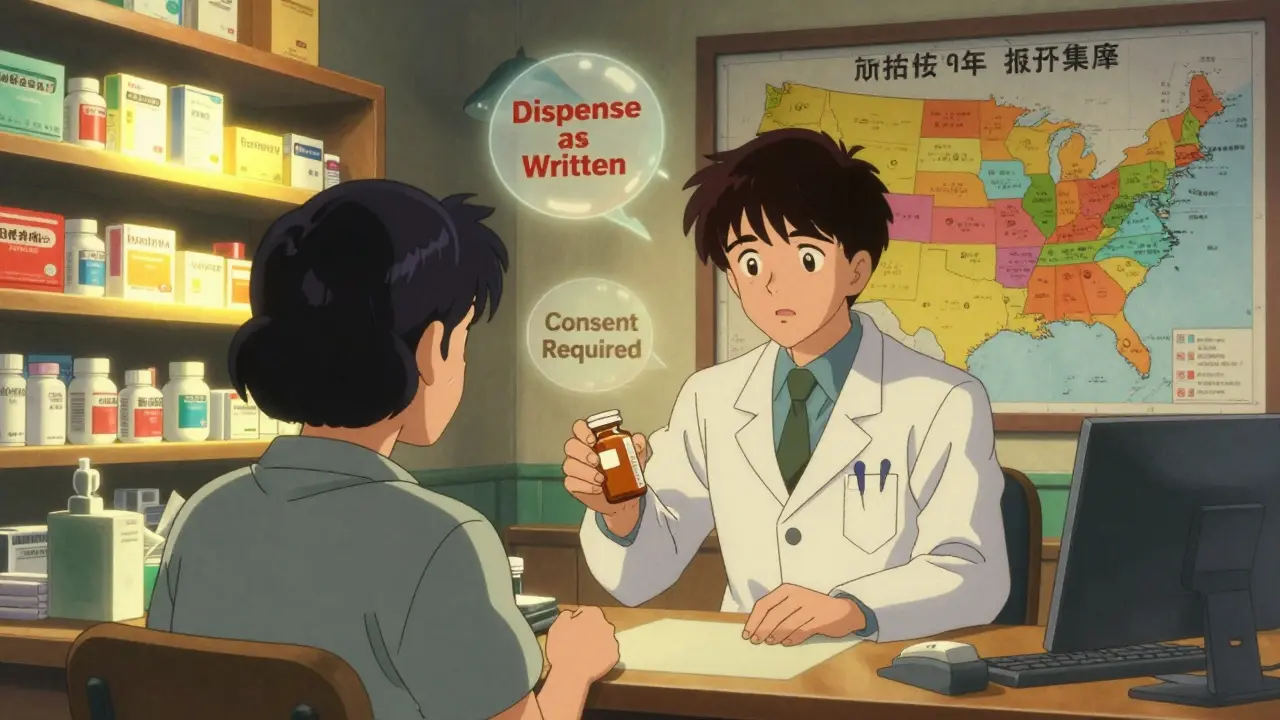
When you pick up a prescription, you might not realize that the pill in your bottle could be a completely different brand than what your doctor wrote on the script. That’s because of generic drug substitution laws-rules that vary from state to state and determine whether a pharmacist can swap your brand-name medication for a cheaper generic version. These laws exist to save money, but they also create a patchwork of confusing rules that can affect your care, your safety, and even your trust in the pharmacy system.
Why Do These Laws Exist?
Generic drugs are chemically identical to their brand-name counterparts. They contain the same active ingredient, dosage, and intended effect. The FDA requires them to meet the same strict standards before approval. But while they work the same way, they cost far less-often 80% cheaper. In 2022, generics made up 90.7% of all prescriptions filled in the U.S., saving patients and insurers billions. Without substitution laws, pharmacists would have to dispense the exact brand prescribed, even if a cheaper, equally effective version was available. That’s what used to happen in most states before the 1980s. Then, as drug costs climbed, states began passing laws to let pharmacists substitute generics unless the doctor specifically said no.How States Differ: Mandatory vs. Permissive Laws
Not all states treat substitution the same way. There are two main models: mandatory and permissive.Seventeen states, including California, New York, and Texas, require pharmacists to substitute a generic drug if it’s available and the prescription doesn’t say "dispense as written." This means unless your doctor checks a box or writes a note, the pharmacist must switch you to the generic. These states have seen generic use rates 8-12 percentage points higher than states that don’t require substitution. That translates to savings of $50-$150 per prescription on average.
The other 33 states and Washington, D.C., allow substitution but don’t force it. Pharmacists can switch the drug, but they don’t have to. In these places, the decision often comes down to the pharmacy’s policy or whether the patient asks. Four of these states-Alaska, Delaware, Maine, and New Hampshire-require pharmacies to post signs saying substitution is possible. It sounds simple, but it creates confusion. A patient might assume substitution is automatic if they see the sign, but it’s not required by law.
Patient Consent: Do You Get to Say No?
One of the biggest differences between states is whether you need to give permission before a substitution happens.Seven states-Connecticut, Hawaii, Maine, Maryland, New Hampshire, Vermont, and West Virginia-plus Washington, D.C., require explicit, written or verbal consent from the patient before a pharmacist can switch the drug. In these places, the pharmacist must explain the change, answer questions, and get your okay before filling the prescription. This is meant to protect patients, especially those on drugs with narrow therapeutic indexes (like warfarin or levothyroxine), where even tiny differences in absorption can cause problems.
But 31 states and D.C. only require notification after the fact. That means the pharmacist can swap the drug without asking you first, then tell you afterward-usually on the label or receipt. Many patients don’t notice this small print. A 2022 survey by the National Psoriasis Foundation found that 42% of patients on biologic medications didn’t realize their drug had been switched to a biosimilar, even though state laws required notification.
What Drugs Are Off-Limits?
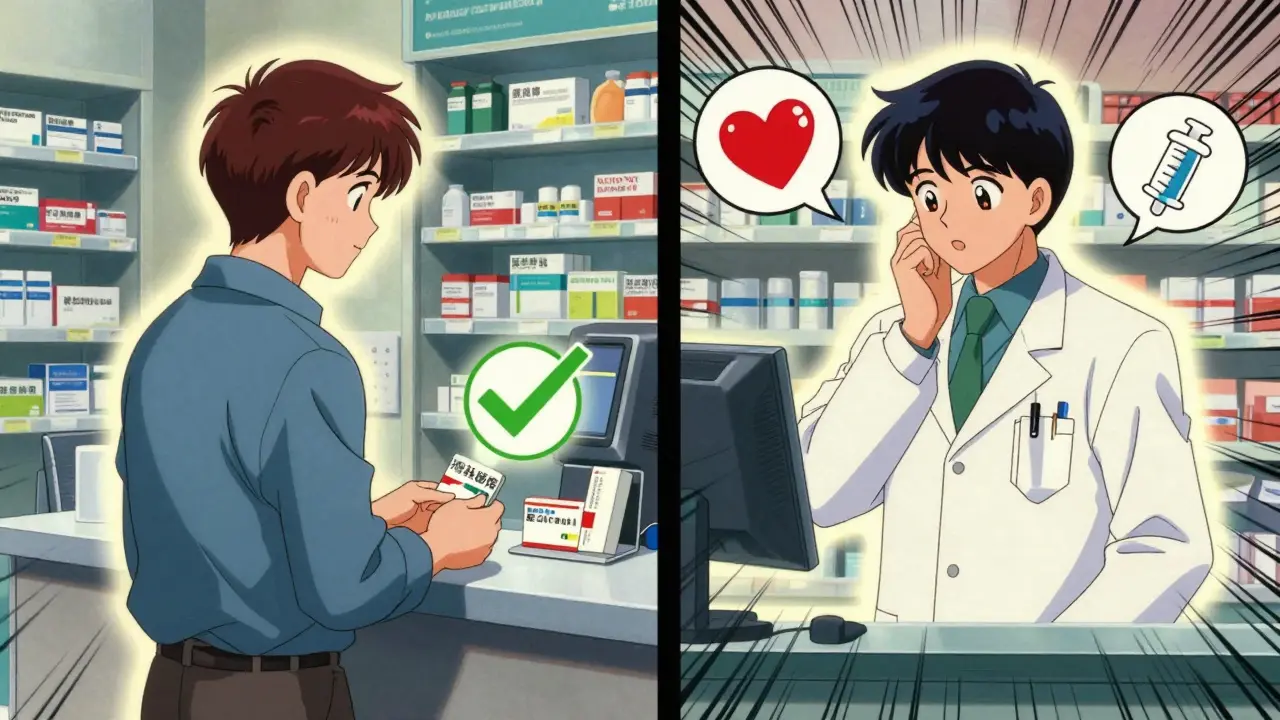
Not all drugs can be swapped. Some medications have a very narrow therapeutic index, meaning the difference between an effective dose and a harmful one is tiny. For these, states impose extra rules.Kentucky, for example, has a list of drugs that can’t be substituted without a doctor’s approval-like digitalis glycosides (used for heart conditions) and antiepileptic drugs. Hawaii goes further: it requires both patient and prescriber consent before substituting any antiepileptic drug. The American Epilepsy Society supports these restrictions, arguing that even small changes in how a seizure medication is absorbed can trigger breakthrough seizures.
Other states, like Oklahoma, go so far as to say substitution is only allowed if either the prescriber or the patient (or insurer) specifically allows it. This creates a triple-layer approval system that can delay care.
Biologics and Biosimilars: The New Frontier
Biologic drugs-used for conditions like rheumatoid arthritis, cancer, and psoriasis-are complex proteins made from living cells. They’re expensive, and their cheaper versions, called biosimilars, are harder to make and regulate than small-molecule generics.Forty-five states treat biosimilar substitution differently than regular generics. Most require the FDA to designate the biosimilar as "interchangeable" before a pharmacist can switch it. But even then, rules vary. Six states that require generic substitution (like Florida and Pennsylvania) make biosimilar substitution optional. That means you might get a generic version of a pill, but not the biosimilar version of your biologic shot-even if it’s approved and cheaper.
Also, 48 states plus D.C. require pharmacists to notify the prescribing doctor within 2-7 days after substituting a biosimilar. Many doctors don’t get these notices. A 2023 study in Health Affairs found that nearly 30% of prescribers never received notification, leaving them unaware that their patient’s treatment had changed.
Liability: Who Gets Blamed If Something Goes Wrong?
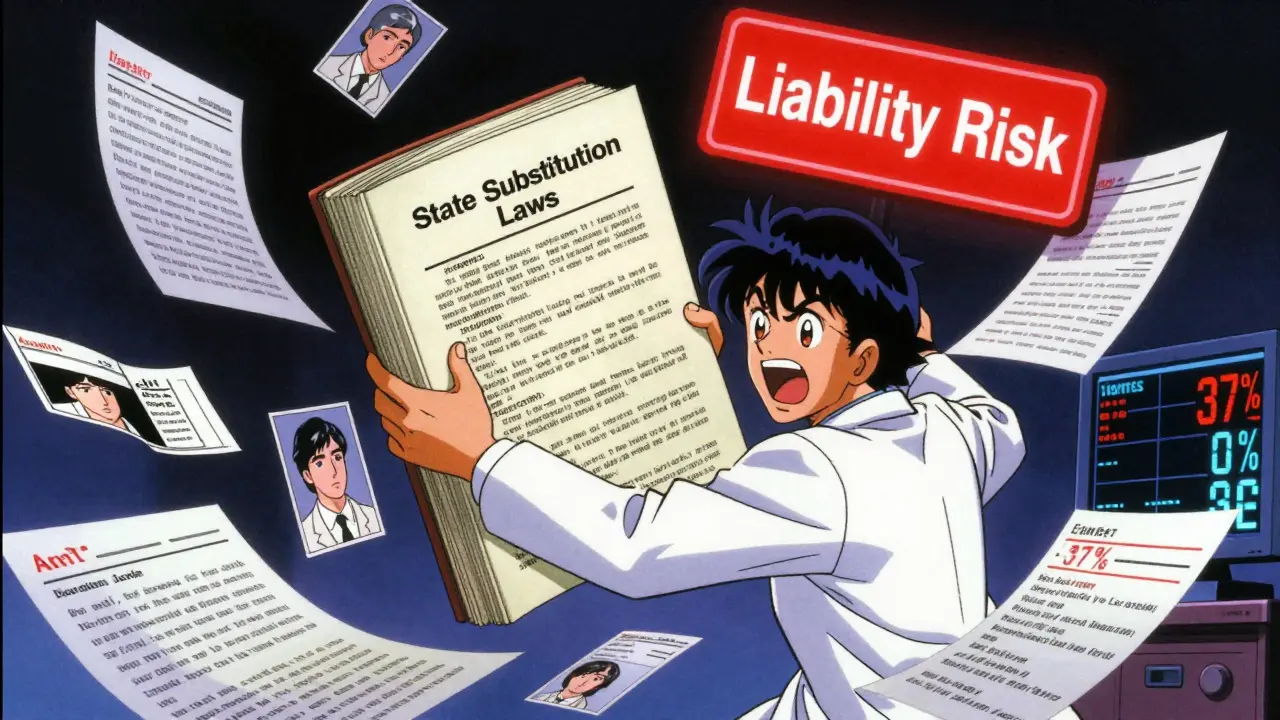
Pharmacists are caught in the middle. They want to save money, but they’re also legally responsible if a substitution causes harm.In 24 states-including Alabama, Arizona, Illinois, Massachusetts, Missouri, Nebraska, New Mexico, Oregon, and Rhode Island-there’s no legal protection for pharmacists who substitute a generic. If a patient has an adverse reaction, the pharmacist could be sued, even if they followed state law. This fear causes delays. One pharmacist in a multi-state chain told a national trade publication: "I’ve had patients wait 20 minutes while I called the doctor just to make sure I wasn’t risking my license."
Meanwhile, in states with clear liability protections, substitutions happen faster. The National Community Pharmacists Association found that independent pharmacists in liability-protected states spent 40% less time on substitution-related phone calls.
What Happens When You Cross State Lines?
Imagine you live in Pennsylvania, where substitution is mandatory for generics, but you visit your sister in Ohio, where it’s only allowed, not required. You get a prescription filled in Ohio. The pharmacist doesn’t substitute it because they don’t have to. You get home, and your pharmacy in Pennsylvania tries to refill it-but now they’re confused. Did you want the brand? Did you get the generic? Did you consent?This isn’t rare. Border communities like those near Iowa-Missouri or New Jersey-New York see this daily. Pharmacists in chain stores report spending 15-30 minutes a day just sorting out state-specific rules. One Walgreens pharmacist on Reddit said: "I have to check five different rulebooks every time someone from another state walks in. It’s a nightmare."
Electronic health record systems like Epic have tried to fix this. Since 2019, they’ve included a "State Substitution Rules Engine" that auto-applies the correct rules based on the pharmacy’s location. That cut substitution errors by 37%. But not all pharmacies use these systems-and rural clinics often still rely on paper files and memory.
What’s Changing in 2025?
In 2023, 12 states introduced legislation to standardize substitution rules across borders. The goal? A "State Harmonization of Generic Substitution Act" that would create uniform consent, notification, and liability rules. So far, no state has passed it, but pressure is building.The FDA also updated its Orange Book in 2022 to include new "interchangeability" designations for complex generics-drugs that aren’t simple chemical copies but still meet high equivalence standards. Eighteen states have started reviewing their laws to match. Meanwhile, the Congressional Budget Office warns that without standardization, the U.S. will waste $4.7 billion annually by 2030 on unnecessary brand-name prescriptions.
What’s clear: the system is broken. Too many rules. Too many exceptions. Too little communication between patients, pharmacists, and doctors. And yet, the potential savings are huge. A patient on a monthly biologic could save $1,200 a year if their biosimilar is substituted. But only if the system lets them.
What You Can Do
You don’t have to wait for lawmakers to fix this. Here’s how to take control:- Always ask: "Is this the brand or the generic?" Don’t assume.
- If you’re on a narrow therapeutic index drug (like warfarin, levothyroxine, or seizure meds), ask your doctor to write "dispense as written" on the prescription.
- Check your receipt or label. If the drug name changed, call your pharmacy and ask why.
- For biologics, ask if your medication is a biosimilar and whether your state requires notification.
- Use the FDA’s Orange Book app to look up whether your drug has an approved generic or biosimilar.
Generic substitution laws aren’t about right or wrong. They’re about balance: saving money without risking safety. But right now, that balance is different in every state. And until it’s consistent, patients will keep paying more-and worrying more-than they should.



14 Comments
Always check the label. I had a generic switched on me for levothyroxine and didn’t notice until my TSH went nuts. Pharmacies don’t always explain it well. Simple fix: ask for the brand if you’re on a narrow window med. Saved my health.
Also, the FDA Orange Book app is a game-changer. Free, reliable, and actually useful.
It is not merely a matter of pharmacological equivalence; it is a systemic erosion of patient autonomy, orchestrated by corporate interests under the guise of cost-efficiency. The FDA’s approval standards, while ostensibly rigorous, are fundamentally compromised by industry lobbying. The so-called "bioequivalence" thresholds are arbitrary, and the pharmacokinetic variance allowed is dangerously lax. Have you considered that the inactive ingredients-fillers, binders, dyes-may trigger immune responses in sensitive individuals? There is no long-term cohort study on cumulative exposure to generic formulations. This is not science; it is a corporate experiment on the American public.
Man, I used to think generics were just as good until my buddy had a seizure after switching to a generic antiepileptic. Turns out, even tiny differences in absorption can mess with your brain. Now I always tell my doc to write "dispense as written"-no exceptions.
Also, biosimilars? They’re not even close to regular generics. They’re like trying to copy a Rolex with a 3D printer. Just say no unless you’re 100% sure.
Oh and yeah, the orange book app? Totally stole that from u/gretchenrivas. Thanks, sis.
THIS IS A NATIONAL CRISIS! We are allowing pharmacies to play Russian roulette with people’s lives! Do you know how many families have lost loved ones because a pharmacist thought saving $50 was worth risking a stroke? The system is broken, and no one is holding these people accountable!
I’ve personally called 17 pharmacies in 5 states just to get the same drug without substitution. I’m not asking for luxury-I’m asking for basic safety! We need a federal mandate NOW, not more state-by-state chaos!
I just cried reading this. I’m on warfarin and my pharmacist switched me without telling me. I didn’t find out until my INR was 8.8. I almost bled out. I’m so angry. Why does no one care? I feel so alone.
😭😭😭
It is a fallacy to assume that chemical equivalence implies clinical equivalence. The FDA’s bioequivalence criteria permit a 20% variance in AUC and Cmax. In a population with comorbidities, polypharmacy, or hepatic impairment, this variance is clinically significant. Furthermore, the absence of mandatory prescriber notification constitutes a breach of the duty of care. The current regulatory framework is not merely inadequate-it is negligent.
While the intent behind generic substitution laws is commendable, the implementation lacks coherence. The variation in state requirements creates a regulatory labyrinth that undermines patient safety. A standardized federal framework, with mandatory prescriber notification and patient consent protocols, would significantly reduce adverse events. Moreover, the exclusion of biosimilars from mandatory substitution protocols in states that otherwise enforce generic substitution reveals a critical inconsistency in policy logic.
Interesting piece. I’ve worked in pharmacy across three countries, and the U.S. system is uniquely fragmented. In the UK, substitution is automatic unless flagged, and patients are informed via leaflets and digital portals. No confusion. No delays. The U.S. could learn from that. The liability issue, though, is a real barrier-pharmacists are overworked and underprotected. Maybe we need a national indemnity fund for substitution-related claims?
you know what i hate? when u go to the pharmacy and they give u the generic and u dont even know it. i mean, come on. i dont even know what im taking half the time. and then i get all weird and tired and i think its the meds but its just the filler. also why is the label so tiny? like, is the government trying to make us blind? #genericproblems
The substitution paradigm reflects a metaphysical reductionism: the conflation of molecular structure with therapeutic identity. In reducing the patient to a data point in a cost-benefit algorithm, we have severed the ontological continuity of care. The body is not a machine to be calibrated with interchangeable parts; it is a dynamic, context-sensitive system. To substitute a drug without informed consent is not merely a legal or economic error-it is an epistemological failure of medicine itself.
I’m a pharmacist in rural Ohio, and this is our daily reality. We get prescriptions from Pennsylvania, Illinois, Kentucky-all with different rules. We do our best, but sometimes we mess up. I wish we had one national rule. Patients trust us. We don’t want to break that.
Also, if you’re on a biologic, ask for the brand. Biosimilars are great, but they’re not identical. And yes, we do have to notify the doc-but half the time, the fax goes to a dead number.
So let me get this straight: we’re saving money by letting pharmacists swap life-saving drugs without telling patients, and then we blame them when things go wrong? Classic American logic. Next they’ll replace your car’s engine with a knockoff and say "you signed the waiver when you bought gas."
Actually, this is kind of a wake-up call. I never realized how much control I gave up by not asking. Now I always say "Is this generic?" before I pay. And I check the label. And I screenshot the name and send it to my doctor.
Also, I just found out my biosimilar was switched last month. I called my doctor. He had no idea. We’re all just guessing. We need better communication tools. Like, a text alert. Or something.
My mom’s on levothyroxine. She’s 72. She doesn’t use apps. She doesn’t read labels. She trusts the pharmacy. And last year, they switched her without telling her. She got dizzy, thought she was getting sick, went to the ER. Turned out her TSH was off the charts.
They didn’t mean to hurt her. But they did.
I don’t blame pharmacists. I blame the system. We need a simple rule: if it’s a high-risk drug, you ask. No exceptions. No gray areas. Just ask.
And if you’re reading this? Ask next time. Even if it feels awkward. It’s worth it.