
Imagine serving your child a simple snack, only to watch their throat swell shut within minutes. It is a nightmare scenario for millions of parents, but it is also a reality that modern medicine is finally learning how to prevent. IgE-mediated food allergies are immune system disorders where the body mistakenly identifies harmless food proteins as dangerous threats, triggering rapid and potentially life-threatening reactions. Unlike digestive issues that creep in hours later, these reactions hit fast-often within minutes.
The stakes have never been higher. Since the 1990s, we have seen a dramatic spike in these conditions. Today, roughly 8% of children and 5% of adults in Western countries live with a food allergy. That is a 50% jump in pediatric cases between 1997 and 2011 alone. But here is the good news: our understanding of why this happens has shifted from pure avoidance to active prevention. We now know that introducing certain foods early can actually protect your child, rather than put them at risk.
How IgE Reactions Work in Your Body
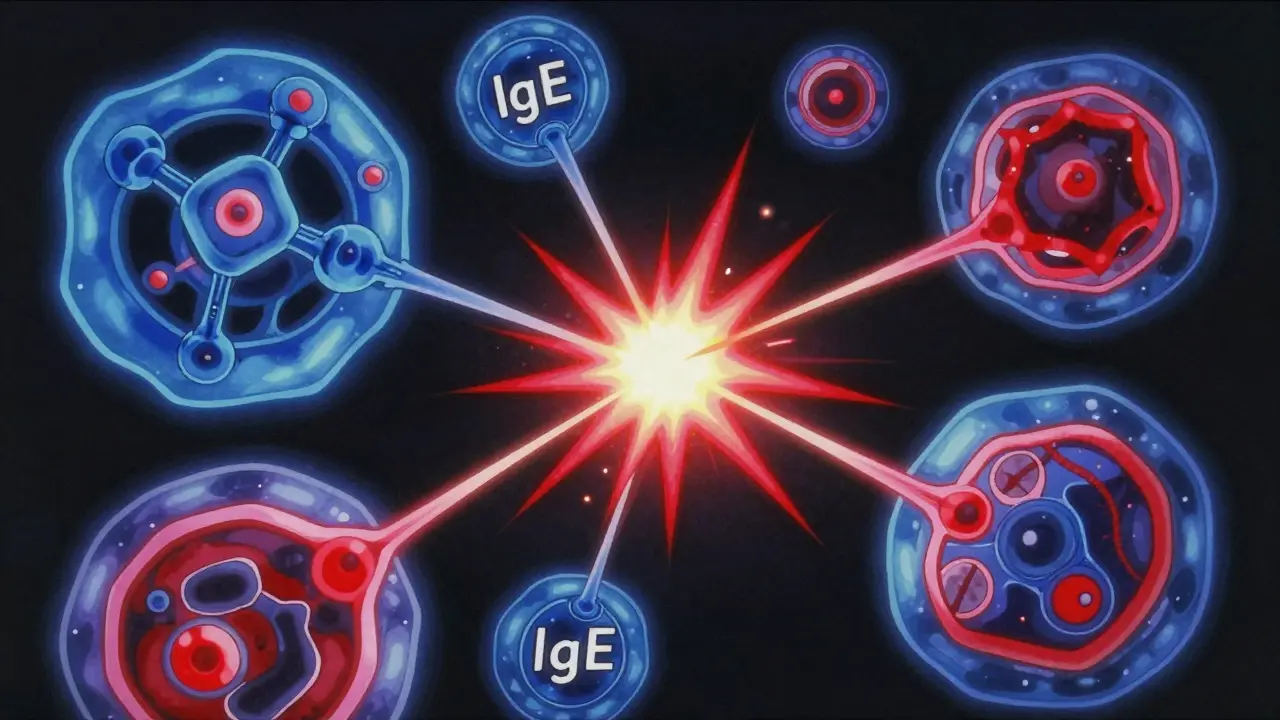
To understand prevention, you first need to grasp the mechanism. When someone with an IgE allergy eats a trigger food, their immune system goes into overdrive. Specialized cells called dendritic cells present the food protein to T cells, which then signal B cells to produce allergen-specific IgE antibodies. These antibodies attach themselves to mast cells and basophils throughout your body, essentially priming them like loaded guns.
When you eat that food again, the allergen cross-links those IgE antibodies. The result? Immediate degranulation. Mast cells release histamine, leukotrienes, and prostaglandins within minutes. This chemical flood causes symptoms across multiple systems: hives on the skin, wheezing in the lungs, vomiting in the gut, and a dangerous drop in blood pressure. The threshold for this reaction varies wildly. Some people react to trace amounts-just 1-2 mg of peanut protein-while others might tolerate slightly more. There is no safe "test dose" without medical supervision.
A key concept here is the dual-allergen-exposure hypothesis. Research suggests that if allergens enter through damaged skin (like eczema), they cause sensitization and allergy. But if they enter through the gut early in life, they promote tolerance. This distinction is crucial because it changes how we think about preventing allergies from day one.
Early Introduction: The Game Changer
For decades, doctors told parents to wait until age one or even three before introducing common allergens like peanuts. That advice was wrong. The landmark LEAP trial, published in 2015, changed everything. It showed that high-risk infants (those with severe eczema or egg allergy) who ate peanut-containing foods regularly starting between 4 and 11 months old had an 81% lower risk of developing a peanut allergy compared to those who avoided peanuts entirely.
Current guidelines from the National Institute of Allergy and Infectious Diseases (NIAID) reflect this shift:
- High-risk infants: Introduce peanut-containing foods between 4-6 months, after evaluation by an allergist.
- Moderate-risk infants: Introduce around 6 months of age.
- Low-risk infants: No specific timing required; introduce when ready alongside other solids.
Egg follows a similar pattern. The EAT study found a 44% reduction in egg allergy when cooked egg was introduced at 3 months versus the standard 6 months. Skin barrier protection also plays a huge role. The BEEP trial demonstrated that applying petroleum jelly daily from birth reduced food allergy incidence by 50% in high-risk infants. Keeping the skin intact prevents allergens from sneaking in through cracks and cuts.
Diagnosis: Beyond the Skin Prick Test
If you suspect an allergy, diagnosis is not just about a quick prick test. While skin prick testing is useful-a wheal 3mm larger than the negative control is considered positive-it has limitations. A positive test doesn't always mean clinical allergy. For example, a peanut skin test wheal of 8mm has only a 50% positive predictive value.
Blood tests offer more precision. Serum-specific IgE testing measures antibodies in kU/L. For peanuts, a level of 14 kU/L predicts a 95% chance of clinical reactivity in children. Even better are component-resolved diagnostics. These tests look at specific protein components, like Ara h 2 for peanuts. If your child’s IgE targets Ara h 2 (>0.35 kU/L), they are highly likely to have a true, persistent allergy. If it targets heat-labile proteins, they might outgrow it.
The gold standard remains the double-blind, placebo-controlled food challenge (DBPCFC). However, open food challenges are often used in practice when history strongly suggests allergy. Be aware that these challenges carry a 14-17% risk of requiring epinephrine, so they must be done in a controlled medical setting.
| Allergen | Skin Prick Wheal Size (mm) | Serum sIgE Level (kU/L) | Predictive Value |
|---|---|---|---|
| Peanut | ≥8 mm | ≥14 kU/L | 95% Positive Predictive Value |
| Milk | Variable | ≥32 kU/L | 95% Positive Predictive Value |
| Egg | ≥7 mm | Variable | ~50% Positive Predictive Value |
Managing Established Allergies and Treatment Options
If your child already has a diagnosed IgE-mediated allergy, strict avoidance is still the primary management strategy. But you are not powerless. Emergency preparedness is non-negotiable. Epinephrine is the first-line treatment for anaphylaxis. Auto-injectors like EpiPen (0.3mg for individuals ≥30kg) or Auvi-Q (0.15mg for individuals 15-30kg with voice instructions) must be administered within 5-15 minutes of symptom onset. Delaying administration beyond 30 minutes increases the risk of biphasic reactions by 68% and ICU admission by 2.3 times.
Long-term therapies are evolving rapidly. Oral Immunotherapy (OIT) helps desensitize patients. Palforzia, an FDA-approved peanut allergen powder for ages 4-17, allows many children to tolerate the equivalent of two peanuts without reaction. About 67% of participants in trials achieved this milestone. Sublingual immunotherapy (SLIT) offers modest benefits, helping 50-75% of patients tolerate small amounts of peanut protein after 12-24 months.
Newer biologics are also changing the landscape. Omalizumab (Xolair), an anti-IgE antibody, reduces reaction rates during OIT by 50%. Dupilumab, which targets IL-4Rα, is another emerging option. These treatments don't necessarily cure the allergy, but they raise the threshold for reaction, providing a safety net against accidental exposure.

Prognosis: Will They Outgrow It?
Hope is part of the conversation. Not all food allergies are lifelong sentences. Approximately 80% of children outgrow milk and egg allergies by age 16. In contrast, only 20% outgrow peanut allergy and 10% outgrow tree nut allergy. Tolerance to baked forms of milk or egg is a strong positive sign. Children who can eat baked milk products have a 75% chance of outgrowing the allergy within three years, compared to just 35% for those who cannot.
Component testing helps predict this too. If a child’s IgE is directed against heat-stable egg proteins (Gal d 2), the allergy is likely persistent. If it’s against heat-labile proteins (Gal d 1), resolution is more probable. Knowing this helps families plan school meals and social events with realistic expectations.
Anaphylaxis Prevention Strategies
Prevention isn't just about avoiding food; it's about building a safety culture. Accidental exposures happen. Studies show 50-80% of children with peanut allergy experience at least one accidental ingestion over five years, with 25-35% requiring epinephrine. To mitigate this:
- Create a written emergency action plan. Ensure schools, daycare centers, and relatives have a copy.
- Train everyone. Only 50% of prescribed auto-injectors are carried consistently, and 40% are misused. Practice drills matter.
- Leverage technology. Wearable injectors with voice prompts improve correct administration rates from 60% to 92% in simulations.
- Read labels meticulously. Look for "may contain" warnings, though voluntary labeling practices vary.
School policies play a huge role. States with comprehensive food allergy management laws see 32% fewer emergency department visits for anaphylaxis. Advocate for allergen-aware zones in classrooms and cafeterias.
Can vitamin D prevent food allergies?
Observational studies suggest a link. Maternal vitamin D levels above 75 nmol/L correlate with a 30% lower odds of food sensitization in offspring. Additionally, infants with adequate vitamin D levels (≥30 ng/mL) have higher levels of regulatory T cells, which help maintain immune tolerance. However, large randomized controlled trials are still ongoing to confirm causation, so supplementation should be discussed with a healthcare provider rather than used as a standalone prevention method.
Is it safe to give peanut butter to a baby with eczema?
It depends on the severity. For infants with mild-to-moderate eczema, introducing peanut-containing foods around 6 months is generally recommended. For those with severe eczema or existing egg allergy, you should consult an allergist first. They may recommend testing or a supervised food challenge before home introduction. Never apply peanut oil to the skin, as this can increase sensitization risk through the damaged barrier.
What is the difference between IgE and non-IgE mediated allergies?
IgE-mediated reactions are immediate, occurring within minutes to two hours, and involve multiple organ systems like skin, lungs, and heart. Non-IgE mediated reactions are delayed, appearing hours to days later, and typically affect the gastrointestinal tract, causing symptoms like chronic diarrhea, vomiting, or failure to thrive. Diagnosis and management strategies differ significantly between the two types.
Does oral immunotherapy cure food allergies?
Currently, OIT does not provide a complete cure for most patients. It induces desensitization, meaning the patient can tolerate small amounts of the allergen without reacting, which protects against accidental exposure. However, most patients must continue daily dosing to maintain this state. Sustained unresponsiveness (tolerance without daily dosing) is achieved by only 30-50% of patients, usually after 2-3 years of therapy.
How do I recognize anaphylaxis in its early stages?
Early signs often include hives, itching, flushing, or swelling of the lips and tongue. Gastrointestinal symptoms like nausea or vomiting can also occur. Respiratory symptoms such as coughing, wheezing, or throat tightness are critical warning signs. If symptoms involve two or more body systems (e.g., skin and breathing) or any single severe symptom like difficulty breathing or low blood pressure, treat it as anaphylaxis immediately with epinephrine.



Write a comment