
Imagine trying to hear a conversation in a noisy room, but your ear feels plugged with cotton. You turn up the volume on your TV, yet the sound remains muffled and distant. For millions of people, traditional hearing aids are not just ineffective-they are medically impossible to use due to chronic infections, missing ear canals, or severe structural defects. This is where bone-conduction hearing aids change the game. They do not amplify sound into the ear canal. Instead, they send vibrations directly through your skull to the inner ear, completely bypassing the outer and middle ear structures that are causing the problem.
This technology is not a new fad. It is a proven medical solution for specific types of hearing loss that conventional devices cannot fix. If you or a loved one has been told that standard hearing aids will not work, understanding how these alternative amplification systems function can open up a world of clarity and connection. Let's look at who needs them, how they work, and what life is like after switching from air-conduction to bone-conduction technology.
Who Actually Needs Bone-Conduction Technology?
Most people with hearing loss benefit from standard hearing aids that sit behind or inside the ear. These devices amplify sound waves through the air (air-conduction). However, if the pathway for those sound waves-the outer ear or middle ear-is blocked or damaged, amplifying the air does nothing. The sound simply cannot get through. Bone-conduction devices are designed specifically for three main groups of patients.
- Conductive Hearing Loss: This occurs when sound waves cannot travel efficiently through the outer or middle ear. Causes include chronic ear infections, fluid buildup, or otosclerosis (hardening of the middle ear bones).
- Single-Sided Deafness (SSD): Also known as unilateral hearing loss, this affects one ear while the other remains normal. Standard hearing aids only help if both ears have some residual hearing. In SSD, the brain struggles to locate sounds and understand speech in noise because it lacks input from one side.
- Congenital Malformations: Some individuals are born without an ear canal or eardrum (aural atresia) or with malformed middle ear structures. Since there is no physical path for air-conducted sound, bone conduction becomes the primary viable option.
If you fall into any of these categories, a standard hearing aid might cause discomfort, feedback whistling, or simply fail to provide clear speech recognition. According to clinical data, patients with conductive losses often see a 25-40% improvement in speech understanding in noisy environments when switching to bone-conduction implants compared to attempting to use conventional aids.
How Does Sound Travel Through Bone?
The concept seems counterintuitive until you understand the physics. Your inner ear (the cochlea) contains fluid and tiny hair cells that convert vibrations into electrical signals for the brain. Normally, sound travels through the air, vibrates the eardrum, moves the middle ear bones, and then shakes the cochlear fluid.
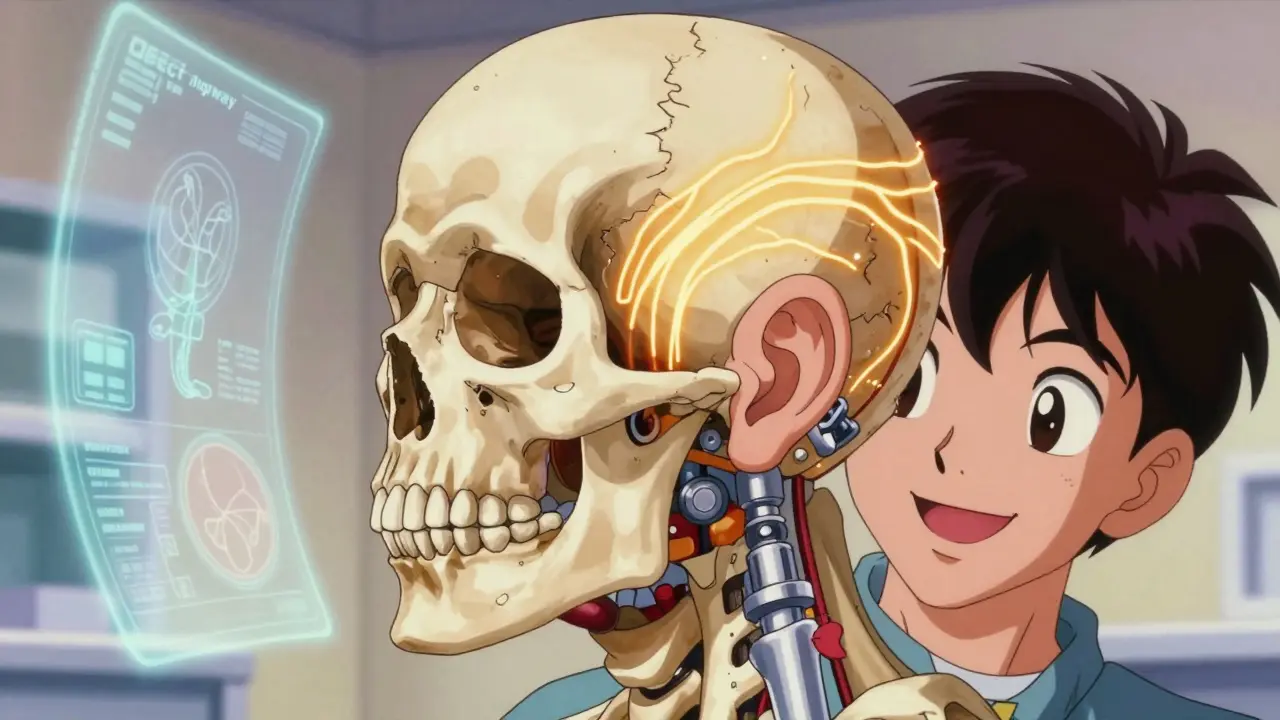
Bone-conduction skips the first two steps entirely. When a device vibrates against the skull, those vibrations travel through the dense temporal bone directly to the cochlea. Research by Dr. Stenfelt at Linköping University shows that the inertia of the cochlear fluids accounts for about 60% of this transmission. Essentially, the skull acts as a direct highway to the hearing nerve, avoiding the "traffic jam" in the outer or middle ear.
This method eliminates the "occlusion effect," which is that hollow, booming sensation many users feel when their ear canal is blocked by a traditional aid. Because the ear canal remains open, natural sounds enter normally, and the added bone-conducted signal blends seamlessly.
Implantable Systems: Percutaneous vs. Transcutaneous
Unlike over-the-counter hearing aids, most high-performance bone-conduction solutions require a minor surgical procedure to place an implant in the skull. There are two primary technologies available today, each with distinct pros and cons.
| Feature | Percutaneous (Abutment-Based) | Transcutaneous (Magnetic) |
|---|---|---|
| How it Works | A titanium post protrudes through the skin; the processor snaps onto it. | An internal magnet holds an external processor against the skin via magnetic force. |
| Sound Quality | Excellent. Direct contact provides maximum signal strength (up to 50 dB gain). | Good. Skin thickness causes slight signal attenuation (10-15 dB loss), max ~45 dB gain. |
| Skin Care | Requires daily cleaning around the abutment to prevent irritation/infection. | No skin penetration. Lower risk of infection, but sweat/moisture can affect magnet adhesion. |
| Surgery Time | 30-60 minutes. Requires 3-6 months for bone healing (osseointegration) before use. | 30-60 minutes. Can often be used immediately or shortly after surgery. |
| Popular Models | Cochlear BAHA Connect, Oticon Medical Ponto | MED-EL Bonebridge, Cochlear BAHA Attract |
Percutaneous systems, like the Cochlear BAHA, have been around since the late 1970s. They are the gold standard for power and reliability because the metal-to-metal connection ensures zero signal loss. However, roughly 15-30% of users experience skin reactions around the abutment, requiring regular hygiene routines with alcohol wipes.
Transcutaneous systems, such as the MED-EL Bonebridge, are newer and increasingly popular. They hide the implant under the skin, offering a cosmetic advantage and eliminating the need for daily wound care. The trade-off is that the skin itself absorbs some vibration energy, slightly reducing the maximum output power. For most users with mild-to-moderate conductive loss or single-sided deafness, this difference is negligible, but those with severe losses may prefer the raw power of percutaneous models.
Non-Surgical Alternatives: Softband and Headband Devices
Not everyone wants or can undergo surgery. For infants awaiting bone growth, adults with insufficient bone density, or those who simply want to test the technology, non-surgical options exist. These include softbands (for babies) and headbands (for adults) that hold a bone-conduction transducer against the skull.
While convenient, these devices have significant limitations. They rely on pressure to maintain contact, which can become uncomfortable during long wear. More importantly, they leak sound energy, resulting in lower fidelity and less power than implanted systems. They are generally considered temporary solutions or diagnostic tools rather than long-term replacements for implants. If you are an active adult considering a permanent fix, the investment in an implant usually pays off in comfort and performance within the first year.
Bone Conduction vs. CROS Hearing Aids
For people with single-sided deafness, another common option is the CROS (Contralateral Routing of Signal) hearing aid. A CROS system picks up sound on the deaf side and wirelessly beams it to a hearing aid in the good ear. It is non-invasive and cheaper than bone-conduction implants.
However, CROS systems have a major flaw: they do not restore true binaural hearing. Both ears receive the same signal, so the brain loses its ability to determine where sounds are coming from (sound localization). Studies published in the Journal of the American Academy of Audiology indicate that bone-conduction implants provide more natural sound localization and improve speech reception thresholds by 15-20 dB compared to CROS devices. If spatial awareness and hearing in noise are priorities, bone conduction is the superior choice despite the higher upfront cost.

The Cost and Insurance Reality
Money is always a factor in medical decisions. Premium conventional hearing aids typically range from $1,500 to $3,500 per ear. In contrast, bone-conduction implants involve surgical fees, the implant hardware, and the external processor. Total costs often range from $4,000 to $7,000 per ear, depending on the system chosen and geographic location.
Because these are considered medical devices rather than elective enhancements, insurance coverage varies. In Canada and the United States, many provincial health plans or private insurers cover the surgical portion if the device is deemed "medically necessary"-which applies to cases of conductive loss, aural atresia, or chronic otorrhea (ear drainage). Single-sided deafness coverage is trickier and often requires additional advocacy. Always consult with an audiologist and your insurer early in the process to understand your specific benefits.
What Is Life Like After Surgery?
The surgical procedure itself is minor, typically performed under local anesthesia in an outpatient setting. Most patients return to normal activities within 48 hours. The real adjustment period comes later.
For percutaneous users, the wait for osseointegration (bone fusion) takes 3 to 6 months. During this time, you cannot use the device. Once activated, there is a learning curve. Your brain is receiving sound through a new pathway. Audiologists recommend 2-4 weeks of auditory training to adapt to the altered perception. Users frequently report that voices sound slightly different at first-often described as "closer" or "more resonant"-but this normalizes quickly.
One practical challenge is MRI compatibility. Most current implants contain magnets or titanium components that interfere with MRI scans. Many users must have the external processor removed or, in some cases, the internal implant temporarily unscrewed for high-field MRIs. This is a known limitation that should be discussed with your surgeon if you anticipate needing frequent imaging.
Future Trends: Smaller, Smarter, Fully Implantable
The field is evolving rapidly. As of 2024-2025, we are seeing a shift toward fully implantable systems that require no external parts at all. Companies like Sonova are testing devices that house the battery and processor entirely under the skin, recharged wirelessly. These aim to eliminate the aesthetic concerns and maintenance issues of current models.
Additionally, Bluetooth connectivity and AI-driven noise reduction are becoming standard in external processors. The latest models offer 30+ hours of battery life and seamless streaming from smartphones. The market is growing at nearly 9% annually, driven by better surgical techniques that have reduced complication rates from 25% to under 10%. If you are on the fence, waiting for the next generation of fully implantable tech might be an option, but current systems are already highly effective and reliable.
Does a bone-conduction hearing aid hurt?
The surgery involves a small incision behind the ear, similar to wisdom tooth extraction. Most patients report mild discomfort manageable with over-the-counter pain relievers for a few days. Post-surgery, the device itself does not hurt. However, percutaneous systems require careful skin care to prevent irritation around the abutment. Transcutaneous systems avoid this issue but may cause mild skin sensitivity from the magnet's pressure.
Can I swim with a bone-conduction hearing aid?
You can swim, but you must remove the external sound processor. The implant itself is waterproof and sealed under the skin. Most external processors are water-resistant but not submersible. Manufacturers often sell waterproof covers for light splashing, but for full immersion, it is best to take the processor off. The implant will not be affected by water.
How long does the battery last?
Battery life depends on usage and features enabled. Modern rechargeable processors typically last between 12 to 30 hours on a single charge. Heavy use of Bluetooth streaming or advanced noise-canceling features will drain the battery faster. Most users charge their device overnight, ensuring it lasts comfortably through the day.
Are bone-conduction hearing aids covered by insurance?
Coverage varies significantly by region and provider. In many cases, if the device is prescribed for conductive hearing loss, chronic ear infections, or congenital malformations, it is considered medically necessary and partially or fully covered. Coverage for single-sided deafness is less consistent. Always check with your specific insurance plan and ask your audiologist for documentation supporting medical necessity.
Do bone-conduction aids work for age-related hearing loss?
Generally, no. Age-related hearing loss (presbycusis) is sensorineural, meaning the damage is in the inner ear or nerve, not the outer/middle ear. Bone conduction bypasses the outer/middle ear but still relies on a functioning cochlea. If your inner ear is damaged, bone conduction will not help. Standard air-conduction hearing aids are the correct treatment for presbycusis.





Write a comment