CYP2D6 Risk Assessment & Medication Checker
Assess Your Risk Profile
Select your ethnic background to see the statistical prevalence of CYP2D6 Ultrarapid Metabolism (UM) in your population.
Medication Safety Check
If you are a confirmed or suspected Ultrarapid Metabolizer, check these common medications for safety.
Codeine
AVOIDProdrug converted to Morphine via CYP2D6. High risk of fatal respiratory depression in UMs.
Tramadol
CAUTIONPartial conversion via CYP2D6. Risk of toxicity and seizures in UMs. Avoid if possible.
Morphine / Hydromorphone
SAFEDirectly active opioids. Minimal CYP2D6 involvement. Predictable effects regardless of genetics.
NSAIDs (Ibuprofen)
SAFENon-opioid analgesics. Bypass opioid pathway entirely. No morphine toxicity risk.
Recommendation: If you experience unexpected drowsiness or confusion after taking codeine/tramadol, consult your doctor about genetic testing.
Codeine has been a household name for pain relief and cough suppression for over a century. It’s often prescribed as a mild opioid because it’s perceived as safer than stronger drugs like morphine or oxycodone. But for a specific group of people, this perception is dangerously wrong. If you are a CYP2D6 ultrarapid metabolizer, a person with a genetic variation that causes their liver to convert codeine into morphine at an accelerated rate, taking a standard dose of codeine can lead to life-threatening morphine toxicity. This isn’t a rare theoretical risk; it’s a documented cause of fatal respiratory depression, even in children who received normal therapeutic doses.
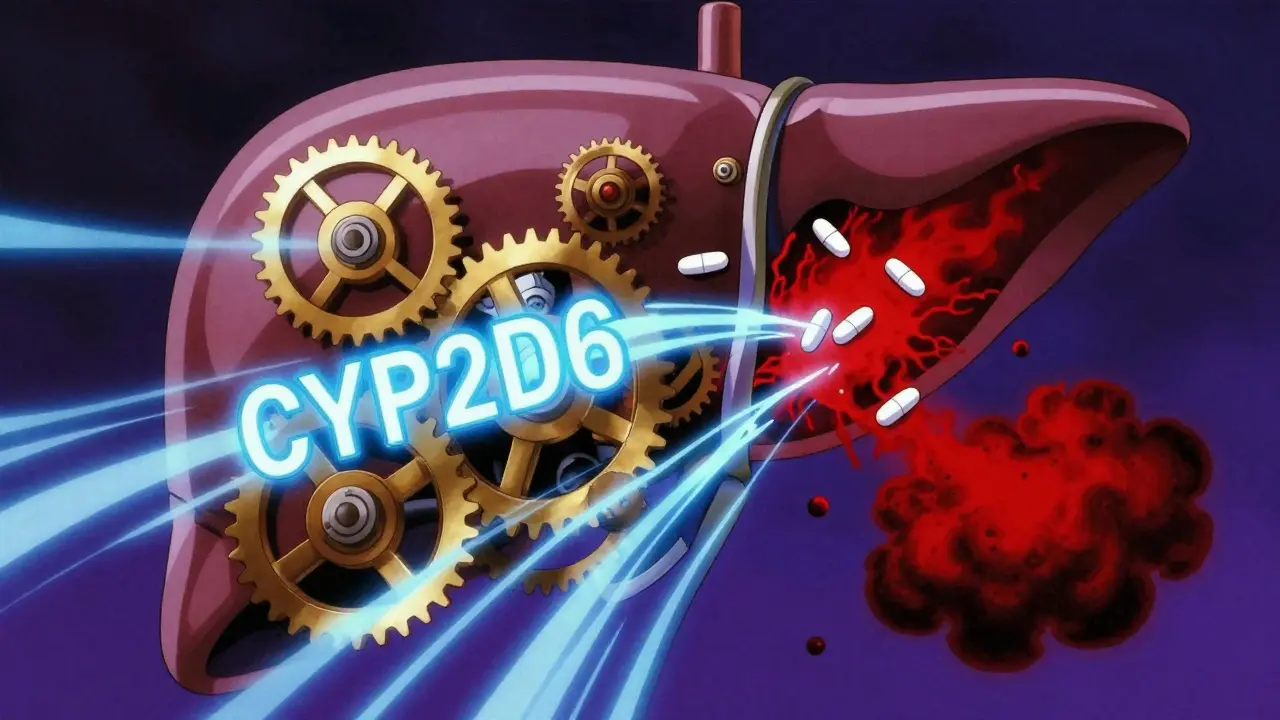
The core issue lies in how your body processes the drug. Codeine itself is largely inactive. It relies on an enzyme called CYP2D6 in your liver to transform it into morphine, the active compound that relieves pain. For most people, this conversion happens at a steady, manageable pace. But if you have extra copies of the functional CYP2D6 gene, your body turns codeine into morphine three to four times faster than average. The result? Your blood morphine levels skyrocket quickly, bypassing the safety buffer that makes codeine seem mild for others.
Why Genetics Dictate Drug Safety
Your genes determine how efficiently your enzymes work. In the case of CYP2D6, genetic variations create different metabolic phenotypes. Most people are "normal" or "extensive" metabolizers. Some are "poor" metabolizers, meaning they get little to no pain relief from codeine because their bodies can’t convert it effectively. Then there are the ultrarapid metabolizers (UMs). These individuals possess gene duplications-such as the *1/*1xN or *2/*2xN genotypes-that give them supercharged enzyme activity.
This genetic trait is not evenly distributed across populations. While only about 1-2% of East Asian populations are UMs, the prevalence jumps to 3-7% in Europeans. In North African and Ethiopian populations, up to 29% of people may be ultrarapid metabolizers. This means that in certain communities, nearly one in three people could face a severe overdose risk from a standard prescription of codeine. Understanding this demographic variation is crucial for clinicians prescribing pain management in diverse patient groups.
The Clinical Pharmacogenetics Implementation Consortium (CPIC) uses an "activity score" to categorize these risks. An activity score greater than 2.25 classifies a patient as an ultrarapid metabolizer. For these patients, the CPIC guidelines explicitly state that codeine should not be used. The risk of severe toxicity with label-recommended dosing is simply too high to ignore.
The Hidden Danger of Standard Doses
The tragedy of codeine-related overdoses in UMs is that they often occur despite following medical instructions perfectly. Patients aren’t taking extra pills; they’re taking exactly what was prescribed. Yet, their bodies produce morphine levels that rival those seen in acute poisoning cases.
Symptoms of this rapid morphine accumulation include extreme sleepiness, difficulty waking up, nausea, vomiting, and constipation. In severe cases, it progresses to respiratory depression-where breathing becomes so shallow it cannot sustain oxygen levels-leading to circulatory collapse, shock, and cardiac arrest. Blood tests from overdose cases frequently show morphine levels well above the therapeutic range, confirming that the toxicity stems from internal production rather than external overdose.
A landmark study published in the New England Journal of Medicine highlighted this danger with the case of a 15-month-old child who died after receiving a standard dose of codeine for post-surgical pain. Post-mortem analysis revealed the child was a CYP2D6 ultrarapid metabolizer, and toxic levels of morphine were found in her system. This single case helped catalyze global regulatory changes, proving that "one size fits all" prescribing is lethal for genetically susceptible individuals.

Regulatory Actions and Warnings
In response to mounting evidence, health authorities worldwide have tightened restrictions on codeine use. The U.S. Food and Drug Administration (FDA) issued a critical drug safety communication in September 2013. After reviewing 64 case reports of serious adverse events-including 24 deaths, 21 of which occurred in children under 12-the FDA mandated boxed warnings on all codeine-containing products.
The warning specifically states that respiratory depression and death have occurred in children who received codeine following tonsillectomy or adenoidectomy and had evidence of being CYP2D6 ultrarapid metabolizers. Consequently, the FDA recommends against using codeine for pain or cough in any child younger than 12 years old. They also advise against its use in breastfeeding women, as the infant can ingest concentrated morphine through breast milk.
Global agencies followed suit. New Zealand’s Medsafe issued similar warnings in March 2013, and the European Medicines Agency restricted codeine use in children under 12 by 2015. These actions reflect a shift toward personalized medicine, acknowledging that genetic makeup must inform prescribing decisions to prevent preventable fatalities.
| Drug | Metabolism Pathway | Risk for UMs | Recommendation |
|---|---|---|---|
| Codeine | Prodrug converted to Morphine via CYP2D6 | High (Fatal Respiratory Depression) | Avoid Completely |
| Tramadol | Partial conversion to active metabolite via CYP2D6 | Moderate to High (Seizure/Toxicity Risk) | Avoid or Use with Extreme Caution |
| Morphine | Directly active; minimal CYP2D6 involvement | Low (Standard Opioid Risks) | Safe Alternative |
| Hydromorphone | Directly active; minimal CYP2D6 involvement | Low (Standard Opioid Risks) | Safe Alternative |
Safe Alternatives for Pain Management
If you are identified as an ultrarapid metabolizer, or if you belong to a high-prevalence ethnic group, switching medications is the safest course of action. Fortunately, several effective alternatives exist that do not rely on CYP2D6 for activation.
Non-opioid analgesics: For mild to moderate pain, non-steroidal anti-inflammatory drugs (NSAIDs) like ibuprofen or naproxen, and acetaminophen, are often sufficient. These drugs bypass the opioid pathway entirely, eliminating the risk of morphine toxicity.
Direct-acting opioids: When stronger pain relief is necessary, doctors can prescribe opioids that are already in their active form. Morphine, hydromorphone, and fentanyl are excellent choices. Since these drugs don’t need to be converted by CYP2D6, their effects are predictable regardless of your genetic status. You take a specific dose, and you get that specific effect, without the unpredictable spike in morphine levels.
Caution with other prodrugs: Be aware that tramadol, another common painkiller, also requires CYP2D6 for full efficacy. Like codeine, it poses a risk to ultrarapid metabolizers due to potential toxicity and seizure risk. The CPIC guidelines recommend avoiding tramadol for UMs as well. Always inform your healthcare provider about your CYP2D6 status before starting any new medication.

The Role of Genetic Testing
Knowing your CYP2D6 status is the key to safe prescribing. Genetic testing for this enzyme is clinically available through multiple laboratories. A simple cheek swab or blood sample can reveal your genotype. Turnaround times typically range from 3 to 14 days, depending on the lab and testing platform.
While pre-emptive testing-testing everyone before they ever need a prescription-is becoming more common in major academic medical centers, it is not yet universal. Currently, only 15-20% of major U.S. academic centers implement routine testing. However, if you have a family history of unusual reactions to painkillers, or if you belong to a high-risk ethnic group, requesting a test is a proactive step.
The cost of testing varies but generally ranges from $200 to $500 per test. Many insurance plans cover it, though prior authorization may be required. The investment pays off by preventing emergency room visits, hospitalizations, and potentially fatal outcomes. As point-of-care testing technology develops, we may soon see results within hours, making real-time genetic screening a standard part of clinical practice.
What You Can Do Today
You don’t have to wait for a crisis to address this risk. Start by asking your doctor about your CYP2D6 status, especially if you’ve ever experienced unexpected drowsiness or confusion after taking codeine or tramadol. If you haven’t been tested, discuss the possibility of genetic testing during your next visit.
If you are currently prescribed codeine, ask your pharmacist or doctor if a direct-acting opioid or non-opioid alternative would be safer for you. Never adjust your medication dosage on your own, but do advocate for a review of your pain management plan based on your genetic profile. Personalized medicine is not just a future concept; it’s a current reality that can save lives.
What are the symptoms of codeine overdose in ultrarapid metabolizers?
Symptoms include extreme sleepiness, difficulty waking, nausea, vomiting, constipation, pinpoint pupils, slow or shallow breathing (respiratory depression), low blood pressure, and in severe cases, coma or cardiac arrest. These symptoms can occur shortly after taking a standard dose.
Is genetic testing for CYP2D6 covered by insurance?
Coverage varies by insurer and region. Many plans cover CYP2D6 testing when medically justified, such as for patients with a history of adverse drug reactions or those requiring long-term opioid therapy. Prior authorization is often required, and out-of-pocket costs can range from $200 to $500.
Can I take Tylenol (acetaminophen) if I am an ultrarapid metabolizer?
Yes. Acetaminophen does not rely on CYP2D6 for metabolism and is considered safe for ultrarapid metabolizers. It is a common non-opioid alternative for mild to moderate pain.
How common is the ultrarapid metabolizer phenotype?
Prevalence varies significantly by ethnicity. It affects approximately 1-2% of East Asians, 3-7% of Europeans, and up to 29% of North Africans and Ethiopians. This wide variation highlights the importance of considering ancestry in pharmacogenetic risk assessment.
Why did the FDA restrict codeine use in children?
The FDA restricted codeine use in children under 12 due to multiple cases of fatal respiratory depression linked to CYP2D6 ultrarapid metabolism. Children are particularly vulnerable because their smaller body mass makes them more sensitive to sudden spikes in morphine levels, and they cannot always communicate early symptoms of toxicity.
Does CYP2D6 status affect other medications besides codeine?
Yes. CYP2D6 metabolizes many drugs, including tramadol, tamoxifen, certain antidepressants, and beta-blockers. Being an ultrarapid metabolizer can lead to toxicity with tramadol and reduced efficacy with tamoxifen, making genetic testing valuable for broader treatment planning.




Write a comment