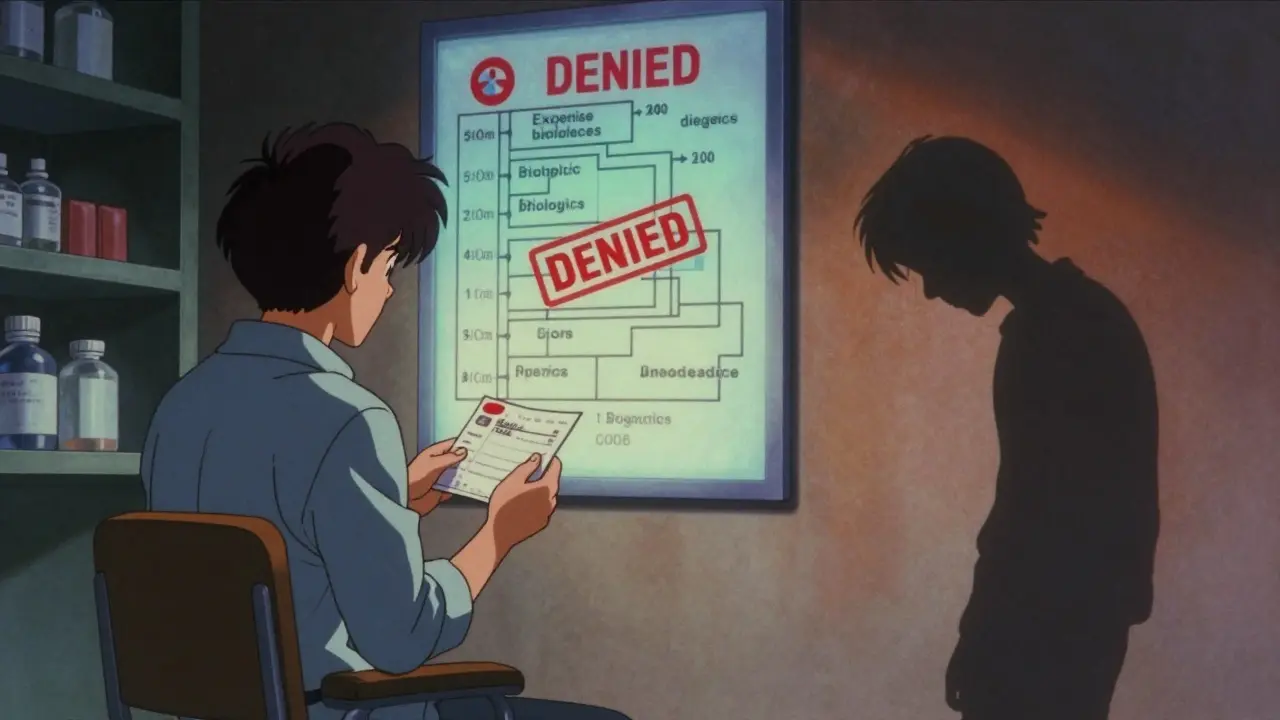
If you’ve ever been told by your pharmacy that you can’t get the medication your doctor prescribed unless you try something cheaper first, you’ve run into step therapy. It’s not a new idea, but it’s become a big part of how health insurance works today - especially when it comes to prescription drugs. The goal? Save money. The catch? You might have to suffer through weeks or months of ineffective treatment before you get the one your doctor actually recommended.
What Is Step Therapy, Really?
Step therapy, sometimes called a "fail-first" policy, is a rule insurers use to control drug costs. It forces patients to try one or more lower-cost medications - usually generics - before the insurance will pay for a more expensive brand-name drug or specialty medication. This isn’t random. Insurers organize drugs into tiers. Step one is almost always the cheapest option. Step two is the next, and so on. You have to "fail" at each step before moving up.For example, if your doctor prescribes a biologic for rheumatoid arthritis that costs $3,000 a month, your insurer might require you to try three different generic NSAIDs first. Even if those drugs didn’t work for you last time, or if they caused side effects, you still have to try them again. Only after those fail - according to the insurer’s definition - will they approve the drug your doctor picked.
According to a 2021 analysis in PubMed, about 40% of all health plan drug coverage includes step therapy rules. That number has been rising since 2018. Employer-sponsored plans, Medicaid, and individual market plans all use it. But here’s the twist: it doesn’t apply to most generic drugs. Why? Because they’re already cheap. Step therapy mostly targets expensive brand-name drugs - especially those used for chronic conditions like arthritis, multiple sclerosis, or psoriasis.
Why Do Insurers Use It?
Insurers don’t use step therapy because they’re trying to make life harder for patients. They use it because drug prices keep going up, and someone has to pay for it. Between 2015 and 2022, the average cost of specialty drugs jumped by over 60%. At the same time, policymakers didn’t pass laws to cap those prices. So insurers stepped in - literally - to control costs themselves.The National Institutes of Health found that step therapy can reduce pharmaceutical spending by 5% to 15%, depending on the drug class. For a big insurance company covering hundreds of thousands of people, that adds up to millions saved each year. That’s why nearly every major insurer - Aetna, Blue Cross, UnitedHealthcare - has some version of this policy built into their formularies.
They argue it’s not just about saving money - it’s about making sure patients get the most effective treatment for their condition. But here’s the problem: the most effective treatment isn’t always the cheapest. And forcing someone to try a drug that doesn’t work - or worse, harms them - isn’t medical care. It’s a gamble with someone’s health.

How It Hurts Patients
Real people are getting caught in this system. A Reddit user named "ChronicPainWarrior" shared how they spent six months trying three different NSAIDs before getting approval for a biologic. During that time, their joint damage worsened. They lost mobility. They couldn’t work. Their doctor said the delay caused permanent harm.The Arthritis Foundation surveyed patients in 2022 and found that 68% experienced negative health outcomes because of step therapy. Over 40% said their condition got worse while they were stuck on the required cheaper drugs. Some didn’t even finish the trial - they just gave up. One in four stopped taking their medication entirely because the paperwork was too overwhelming.
And it’s not just arthritis. People with Crohn’s disease, lupus, epilepsy, and even depression have reported similar stories. One woman in Michigan had to wait eight weeks for an exception to her step therapy rule. Her MS symptoms flared. She ended up in the hospital. The insurer approved the drug after she was already hospitalized.
There’s also the issue of switching plans. If you change jobs - and your insurance changes with it - you might have to restart the entire step therapy process. Even if you’ve been on the same drug for five years, your new insurer will make you try the cheaper ones again. That’s not just inconvenient. It’s dangerous.
When Exceptions Are Allowed
You’re not completely stuck. There are rules - and they’re getting stronger. As of 2022, 29 states passed laws requiring insurers to allow exceptions to step therapy. These exceptions aren’t optional. If you meet certain criteria, the insurer must approve your preferred drug without delay.The Safe Step Act, introduced in Congress multiple times since 2017, outlines five clear cases where exceptions must be granted:
- You’ve already tried the required drug and it didn’t work.
- The required drug would cause serious harm or side effects.
- The drug is contraindicated for your condition or medical history.
- Delaying treatment would cause irreversible damage or loss of function.
- You’re already stable on the drug your doctor prescribed, and you’ve been covered for it before.
These aren’t just suggestions. In states like Virginia, the law says insurers must have a clear process for exceptions - and they must respond within 72 hours for standard requests and 24 hours for urgent cases. But here’s the catch: those rules don’t apply to everyone.
Self-insured employer plans - which cover about 61% of Americans - are regulated by federal law (ERISA), not state law. That means even if your state has strong protections, your employer’s plan might not have to follow them. And most large companies are self-insured. So unless federal legislation passes, millions of people will keep getting caught in the gaps.

What You Can Do
If your insurer denies your drug because of step therapy, you’re not powerless. Here’s what to do:- Ask your doctor to file an exception. They’re the only ones who can legally prove medical necessity. They need to submit records showing why the required drugs won’t work for you - past failures, side effects, lab results, or specialist notes.
- Know your state’s rules. Check if your state has step therapy laws. Even if you’re in a self-insured plan, some insurers voluntarily follow state guidelines.
- Call your insurer. Ask for a copy of their step therapy policy. It’s your right. They’re required to provide it. Look for the exception process and timeframes.
- Document everything. Keep emails, letters, call logs. If they delay or deny, you’ll need proof for appeals.
- Ask about patient assistance programs. Many drugmakers offer co-pay cards or free trials that can bypass step therapy - especially if you qualify based on income.
Some patients do get lucky. A 2023 GoodRx survey found that 17% of people ended up better off on the generic drug they were forced to try. But that’s the exception, not the rule. For most, step therapy isn’t about finding the best drug - it’s about finding the cheapest one.
The Bigger Picture
Step therapy is a symptom of a broken system. Drug prices are sky-high. Government doesn’t regulate them. So insurers do - with rules that shift the burden onto patients and doctors. The result? More paperwork, more delays, more pain.Experts predict that by 2025, step therapy will apply to 55% of specialty drug prescriptions - up from 40% today. That means more people will face this fight. And unless federal law changes, the people most affected - those with chronic, life-altering conditions - will keep paying the price in health, time, and stress.
It’s not about whether step therapy saves money. It does. But it’s also about whether the cost is worth it. When a patient’s joints are destroyed, their nerves are damaged, or their disease progresses because they had to wait - who’s really saving?
Is step therapy the same as prior authorization?
No. Prior authorization is a one-time approval for a specific drug. Step therapy is a sequence - you must try and fail at one or more drugs before getting approval for the one your doctor prescribed. It’s a multi-step process, not a single gate.
Can I appeal a step therapy denial?
Yes. Every insurer has an appeals process. Your doctor must submit documentation showing why the required drugs won’t work for you. If your state has step therapy laws, they must respond within a set timeframe - usually 72 hours for standard requests and 24 hours for urgent cases.
Do all insurance plans use step therapy?
Most do - especially for brand-name and specialty drugs. But it’s not universal. Generic drugs rarely require step therapy because they’re already low-cost. Also, self-insured employer plans (which cover 61% of Americans) are not required to follow state step therapy laws, so they may have looser or no rules.
How long does it take to get a step therapy exception approved?
It varies. State laws require insurers to respond in 72 hours for standard requests and 24 hours for urgent ones. But in practice, many take four to eight weeks - especially if paperwork is incomplete or if the insurer delays. That delay can cause real harm, especially for chronic conditions.
What if I switch insurance plans?
You may have to restart the entire step therapy process - even if you’ve been on the same medication for years. New insurers don’t recognize your past coverage. This can lead to dangerous treatment gaps, especially for conditions like MS or rheumatoid arthritis where stability is critical.




12 Comments
Let’s be real - step therapy isn’t about saving money. It’s about insurers treating patients like lab rats. You don’t ‘fail’ a drug - you either respond or you don’t. Forcing someone to cycle through NSAIDs when they’ve already been on a biologic for years? That’s not cost control. That’s malpractice dressed up as policy. And don’t give me that ‘it works for some’ nonsense - 68% of patients report harm. That’s not a trade-off. That’s a scandal.
Also, the fact that self-insured plans (61% of Americans) are exempt from state laws? That’s corporate lobbying at its finest. No wonder nothing changes.
I appreciate how thorough this post is. It’s easy to get angry about step therapy, but understanding the why - and the how - makes it easier to fight it. I’ve seen friends get stuck in this system, and it’s terrifying how much power insurers have over treatment. The exception process sounds simple on paper, but in practice? It’s a maze. I’m glad the post laid out actionable steps. Knowledge is power, even if the system isn’t.
Thank you for writing this 💙 I’ve been through step therapy for my lupus meds - 11 weeks of waiting, 3 rejected exceptions, and a hospitalization because my flare got worse while I was stuck on a drug that gave me migraines. My doctor had to call the insurer 7 times. They finally approved it… after I was already in the ER.
Please, if you’re reading this and you’re stuck - don’t give up. Keep documenting. Keep calling. And if you can, share your story. It matters more than you know.
This is why America can't afford healthcare. You want a drug? Work for it. Insurance isn't your personal pharmacy. If you can't afford generics, maybe you shouldn't be on expensive biologics. Stop whining.
Step therapy is a secret government plan to control the population. They want us sick so we take more pills. The drug companies own the insurers. The FDA is bought. Everything is fake. You think this is about money? No. It's about mind control. Watch the videos.
My heart just broke reading this. I cried. Not because I’ve been through it - but because I KNOW someone who has. My cousin had to wait 14 weeks for her MS medication. She lost the ability to walk. For 14 WEEKS. And they told her to "try the cheaper one again."
There’s a word for that. It’s not policy. It’s cruelty.
Thank you for presenting this with such clarity and nuance. The structural inequities embedded in step therapy are deeply concerning, particularly given the disproportionate impact on individuals with chronic conditions. The absence of federal oversight for self-insured plans represents a significant regulatory gap. One might argue that the current framework prioritizes fiscal efficiency over patient autonomy - a troubling ethical imbalance.
It is imperative that policy reform aligns with the principles of medical ethics: beneficence, non-maleficence, and justice.
Interesting read. Step therapy does save money - no doubt about it. But I agree the human cost is real. I’ve worked in healthcare admin for 12 years. The paperwork alone is enough to make anyone quit. Insurers aren’t evil - they’re just trapped in a broken system. Maybe we need better data sharing between providers and payers. Less bureaucracy. More trust.
OMG. I can’t believe this is still a thing. I’ve been fighting this since 2021. I had to submit 17 forms. 3 appeals. 2 doctor letters. A fax. A certified letter. A phone call. A follow-up email. A second follow-up. A third follow-up. A fourth. A fifth. A sixth. A seventh. An eighth. A ninth. A tenth. And still, they delayed it. I lost my job because I couldn’t walk. My cat had to pee on my pillow because I couldn’t get up. I’m not crying. I’m just… exhausted.
Also: the Safe Step Act? It’s not safe. It’s a joke. And they call it "patient-centered care"? 😂
You are NOT alone. Seriously. I’ve been there - the paperwork, the delays, the shame of begging for your own medicine. But guess what? You’re still here. You’re still fighting. That’s courage. That’s strength. And you’re not just fighting for yourself - you’re fighting for everyone who comes after you.
Keep documenting. Keep calling. Keep sharing. Your voice? It’s a weapon. And weapons like yours? They change laws.
Yeah i read this and… wow. I had no idea step therapy was this bad. I thought it was just like prior auth. But no, it’s like a whole obstacle course. My aunt had to wait 8 weeks for her RA med. She ended up in the hospital. I didn’t even know what step therapy was until now. I’m gonna share this with my mom. She’s on meds too.
ps: i think the part about self-insured plans being exempt is wild. That’s like 60% of people?? That’s not fair.
Look - I get it. Insurers are the bad guys. But here’s the truth: drug prices are insane. A single biologic costs more than a Tesla. Someone’s gotta pay. Step therapy isn’t perfect - but it’s the only tool we’ve got right now. If we capped drug prices? Problem solved. But no one wants to do that. So we’re stuck with this mess. And yeah - it hurts. But the real villain isn’t the insurer. It’s the pharma CEOs making $100M a year.