
When people start GLP-1 medications like Ozempic, Wegovy, or Mounjaro for weight loss, they often expect fast results. But the first few weeks? Many feel worse before they feel better. The biggest culprit? Nausea. It’s not rare. It’s not unusual. It’s expected. And if you know how to handle it, you can stick with the treatment and actually lose weight - not quit because you felt sick every day.
Why GLP-1 Medications Cause Nausea
GLP-1 medications work by mimicking a natural hormone your body makes after eating. That hormone tells your pancreas to release insulin, tells your liver to stop making sugar, and - most importantly - slows down how fast your stomach empties. That’s why you feel full longer. That’s also why you feel nauseous. It’s not a bug. It’s a feature. Slowing digestion means food stays in your stomach longer. Your brain interprets that as a threat. Your body reacts with nausea. It’s the same reason you feel queasy after a huge meal. But with these drugs, it’s happening on purpose - and it’s working. The nausea isn’t random. It’s tied directly to the mechanism that helps you lose weight. Studies show 20% to 30% of people get nauseous at the start. At full dose, that jumps to 30% to 45%. It’s worse with higher doses. Tirzepatide (Mounjaro) and semaglutide (Wegovy) tend to cause more nausea than liraglutide (Victoza), but they also lead to more weight loss. In one trial, people on 15 mg of tirzepatide lost an average of 20.9% of their body weight. But nearly half of them had nausea. You can’t have one without the other.Dosing Schedules: Why Slow Start Matters
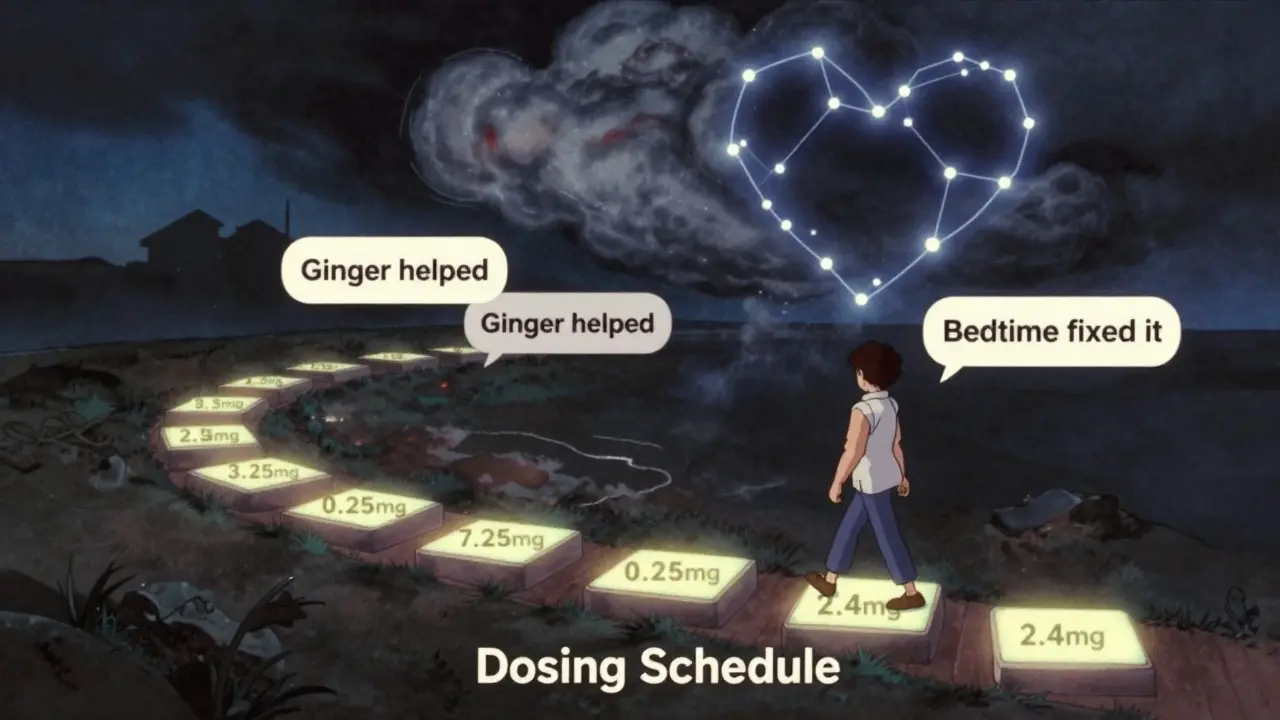
No one starts on the full dose. That’s not an accident. It’s the whole plan. For Wegovy (weight loss), the schedule looks like this:- Weeks 1-4: 0.25 mg once a week
- Weeks 5-8: 0.5 mg
- Weeks 9-12: 1 mg
- Weeks 13-16: 1.7 mg
- Week 17 and beyond: 2.4 mg (maximum)
Real-World Tips to Reduce Nausea
If you’re feeling sick, you’re not alone. And there are practical things you can do right now to feel better.- Take it at bedtime. A Cleveland Clinic survey found that 63% of users felt less nauseous when they injected at night. You sleep through the worst of it.
- Eat smaller meals. Big meals overwhelm your slowed stomach. Try five small meals instead of three big ones. Think snacks: yogurt, fruit, hard-boiled eggs, a handful of almonds.
- Avoid fatty, fried, or sugary foods. These are harder to digest. They sit in your stomach longer and make nausea worse. Stick to lean protein, veggies, and complex carbs.
- Drink water - but not with meals. Sipping water during meals fills your stomach faster. Drink between meals instead. Aim for at least 1.5 liters a day. Dehydration makes nausea worse.
- Try ginger. Over 78% of obesity specialists recommend ginger. Tea, capsules, or even candied ginger. It’s not magic, but it helps. A 2023 survey of patients found 61% reported less nausea after using ginger daily.
- Don’t lie down after eating. Stay upright for at least 30 minutes. Gravity helps your stomach process food.

When to Push Through - and When to Pause
Some doctors say: “Push through mild nausea.” Others say: “Wait until it’s gone.” The truth? It depends. If your nausea is mild - you feel a little queasy, but you can still eat, sleep, and go to work - keep going. Most people adapt within weeks. A 2023 study from the Obesity Action Coalition found that 89% of people who stuck with the treatment through the first 8 weeks lost at least 5% of their body weight. Only 47% of those who quit did. But if you’re vomiting, dizzy, or can’t keep any food down? That’s not mild. That’s a sign to pause. Don’t increase the dose. Don’t try to tough it out. Call your doctor. You might need to stay at your current dose longer. Or switch to a different GLP-1. Dr. Robert Gabbay from the American Diabetes Association puts it simply: “The goal isn’t to suffer. The goal is to lose weight sustainably.” If nausea is stopping you from eating, you’re not losing weight - you’re losing muscle and energy.What About Other Side Effects?
Nausea is the big one. But it’s not the only one.- Vomiting - happens in up to 15% of users, usually early on.
- Diarrhea or constipation - common, but often temporary.
- Headaches - mild, usually gone in a week.
- Fatigue - your body is adjusting. Rest more.
- Low blood sugar - rare if you’re not on insulin or sulfonylureas. Still, watch for dizziness or shakiness.
Support Systems That Actually Help
You don’t have to figure this out alone. Manufacturers offer free support programs:- Wegovy Support Program by Novo Nordisk - includes coaching, injection training, and nutrition tips.
- Mounjaro Care by Eli Lilly - connects you with nurses and dietitians.
Why This Matters Beyond Weight Loss
GLP-1s aren’t just for weight loss. The 2023 SELECT trial showed that semaglutide reduced major heart events - like heart attacks and strokes - by 20% in people with obesity but no diabetes. That’s huge. The same drug that helps you lose 15% of your weight might also save your life. But only if you stay on it. The biggest barrier? Not cost. Not access. It’s nausea. And it’s temporary.What’s Next?
Oral semaglutide is coming in 2025. Early data suggests it causes less nausea than injections. That could change everything. Meanwhile, supply is still tight. Wegovy and Ozempic were on the FDA’s drug shortage list for 14 straight months through October 2023. Insurance coverage is improving - 32% of Fortune 500 companies now cover these drugs - but out-of-pocket costs can still hit $10,000 a year. The bottom line? Nausea is real. It’s common. It’s manageable. And it doesn’t last forever. If you’re willing to adjust your eating habits, take it slow, and use the tools available, you can get through it. And the results? They’re worth it.How long does GLP-1 nausea last?
Nausea usually starts within the first week of a dose increase and peaks in the first 7-10 days. For most people, it improves significantly within 2 to 4 weeks at each dose level. By the time you reach your maintenance dose, 70% or more report little to no nausea. If nausea persists beyond 6 weeks at a stable dose, talk to your doctor - it may mean the dose is too high for your body.
Can I take GLP-1 medications if I have a history of eating disorders?
GLP-1 medications are not recommended for people with active eating disorders like anorexia or bulimia. These drugs suppress appetite and slow digestion, which can worsen unhealthy behaviors. If you’re in recovery, talk to your doctor and a mental health specialist before starting. Some patients in long-term recovery do well on GLP-1s with close monitoring, but it’s not one-size-fits-all.
Do GLP-1 medications work without diet and exercise?
They help - but not enough. Clinical trials show that people who combined GLP-1s with lifestyle changes lost significantly more weight than those who only took the drug. On average, adding healthy eating and regular movement increased weight loss by 3-5% more. The medication lowers your appetite and slows digestion, but if you’re still eating large portions of processed foods, you won’t see the full benefit. Think of it as a tool, not a magic pill.
Is it safe to drink alcohol while on GLP-1s?
Moderate alcohol is generally okay, but it can make nausea worse. Alcohol irritates the stomach lining, and GLP-1s already slow digestion. Drinking on an empty stomach or mixing alcohol with sugary mixers increases the risk of dizziness, low blood sugar, and vomiting. If you drink, do it with food, stick to one drink, and avoid sugary cocktails. Many users report feeling more sensitive to alcohol on these drugs - so go slow.
What happens if I miss a dose?
If you miss a dose and it’s been less than 5 days since your last injection, take it as soon as you remember. If it’s been more than 5 days, skip the missed dose and wait until your next scheduled day. Don’t double up. Missing one dose won’t ruin your progress, but going off schedule can trigger nausea or slow weight loss. Set a weekly phone reminder. Most people find that sticking to the same day each week - like Sunday night - helps them stay consistent.




8 Comments
Yo, I started Wegovy last month and holy hell, the nausea was real. First week I thought I was gonna die. Then I did what the article said-took it Sunday night, ate a tiny grilled chicken salad, and sipped ginger tea like it was my job. By day 4? Zero nausea. I’m now at 1.7mg and feeling like a lean machine. Don’t quit. Just adjust. Your gut ain’t your enemy, it’s just confused.
So let me get this straight… we’re telling people to ‘push through’ nausea because it’s a ‘feature’? Like, what, your body’s just supposed to be okay with being forcibly slowed down like a rusted-out sedan? Next thing you know they’ll say ‘cancer’s a feature’ because it makes you ‘eat less’. I’m not taking a drug that turns my stomach into a graveyard. Just sayin’.
Ugh. I tried Mounjaro. Nausea for 3 weeks straight. I cried. I cried into my ginger ale. I cried while eating a single hard-boiled egg. And then I realized… I didn’t even want to lose weight. I just wanted people to stop asking if I’d ‘tried the new shot’. So I quit. And now I’m happier. And slightly heavier. And honestly? Better.
Anyone else think it’s weird that the ‘real-world tips’ all sound like things your grandma would’ve told you in 1978? Eat small meals. Don’t lie down. Drink water. Take ginger. Wow. Groundbreaking. Next you’ll tell us to wear socks in winter. This isn’t medicine. It’s just common sense with a $10,000 price tag.
Let’s be real-the entire GLP-1 industry is built on exploiting desperation. They market weight loss as a ‘lifesaving tool’ while quietly ignoring that 40% of users drop out because they feel like death. The ‘support programs’? Marketing fluff. The ‘Reddit communities’? Echo chambers. The real reason these drugs work? People are so terrified of being fat they’ll swallow nausea, fatigue, and a $10k bill. That’s not science. That’s trauma capitalism.
Thank you for this thorough breakdown. The dosing schedule explanation was especially helpful. I appreciate how the data was cited from peer-reviewed studies and real user surveys. It’s important to emphasize that the nausea is temporary and dose-dependent. Many patients panic when they experience side effects, not realizing adaptation is normal. Consistency, patience, and communication with your provider are key.
Wait. So you’re telling me this drug was designed to make you sick on purpose? That’s not medicine. That’s a trap. Who even approved this? Big Pharma knew people would suffer so they could profit. And now they’re telling us to ‘drink ginger tea’ like it’s a magic spell? There’s a reason they call it ‘Ozempic’-it sounds like a spell from Harry Potter. I’m telling you: this is a government experiment. They’re testing mass appetite suppression. Wake up.
I’m not saying this is bad, but let’s not pretend this is some miraculous breakthrough. I’ve been on semaglutide for 8 months. Lost 22 lbs. But here’s the thing: I still crave bread. I still eat ice cream at 2 a.m. I still binge-watch Netflix with a bag of chips. The drug didn’t change me. It just made me too nauseous to eat more than 800 calories a day. I didn’t ‘transform’-I just got really good at eating celery and feeling guilty. Also, my sister has been on it for a year and now she’s 15% underweight and doesn’t talk to anyone. So… maybe it’s not all sunshine?