When you’re scheduled for surgery, the last thing you want is a preventable reaction to a drug you’ve never even heard of. But every year, thousands of patients face serious complications-not because of the surgery itself, but because a simple piece of information was never shared, written down, or taken seriously. Drug reactions before surgery are one of the most avoidable causes of surgical emergencies. And the fix isn’t complicated: it’s about clear, honest, and detailed communication between you and your care team.
Why This Matters More Than You Think
A 2022 NIH study found that about 4.5% of all surgical complications are linked to medication errors. That might sound small, but it adds up to thousands of cases each year. Of those, 1.1% of anesthesia-related deaths stem from allergic reactions to drugs. These aren’t rare events. They happen in hospitals across the country-because someone didn’t say the right thing, or someone didn’t listen. Think about this: You might say, "I’m allergic to penicillin." But what does that really mean? Did you break out in hives? Throw up? Go into shock? Did it happen 20 years ago, or last year? Was it a real allergy, or just a side effect? These details make all the difference.What Counts as a Drug Reaction?
Not every bad reaction is an allergy. Many people confuse side effects with true allergies. Here’s how to tell the difference:- True allergy: Your immune system reacts. Symptoms include hives, swelling, trouble breathing, low blood pressure, or anaphylaxis. These can be life-threatening.
- Side effect: A known, expected reaction that doesn’t involve your immune system. Think nausea from codeine, dizziness from morphine, or a rash from sulfa drugs. These are uncomfortable, but not usually dangerous.
- Intolerance: You feel sick, but your body isn’t fighting the drug. For example, you might get a headache from ibuprofen, but not break out in hives.
Doctors need to know which one you had. If you say "I can’t take aspirin," they’ll assume it’s an allergy. But if you say, "It gives me stomach pain," they might still give it to you-because it’s not an allergy. Be specific.
What to Tell Your Doctor
Don’t wait for them to ask. Bring this info with you:- The drug name: Generic or brand? Both if you know them. "I reacted to rocuronium," not just "I had a bad reaction to anesthesia."
- When it happened: Was it 2 years ago? 10? The more recent, the more urgent.
- What happened: List every symptom: itching, swelling, vomiting, chest tightness, passing out. Write it down if you need to.
- How it was treated: Did you get epinephrine? Benadryl? Were you intubated? This tells them how serious it was.
- Other meds you take: Include vitamins, supplements, herbal teas, and over-the-counter drugs. Some herbal supplements interfere with anesthesia.
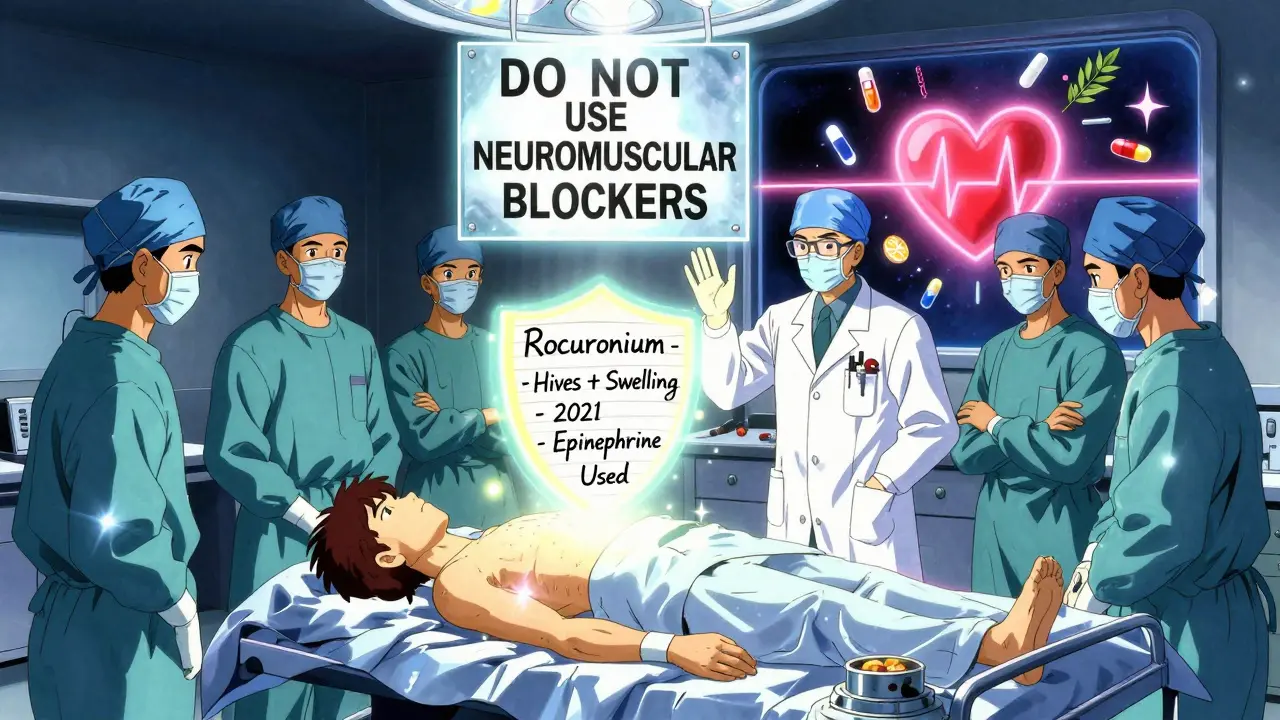
Example: "In 2021, after my knee surgery, I got a rash and my throat swelled up within 5 minutes of getting vecuronium. I was given epinephrine and stayed overnight. I’ve never had another reaction since."
That’s the kind of detail that saves lives.
Who Needs to Know
This isn’t just for your surgeon. You need to tell:- Your anesthesiologist: They choose the drugs. They need to know what to avoid.
- Your pharmacist: Many hospitals now have pharmacists review your full medication list 24 hours before surgery. They catch interactions you didn’t even know about.
- Your primary care doctor: They might have records from past reactions.
- Your nurse: They’re the ones filling out forms. Make sure they write it down correctly.
One patient on Reddit shared how a pre-op nurse spent 20 minutes asking about every pill they’d ever taken-including what they ate that day. That level of care? It’s rare. But it works.

What Hospitals Are Doing Right
Hospitals with strong protocols have fewer complications. Here’s what works:- Standardized forms: These aren’t just checkboxes. They ask for specifics: drug name, reaction type, date, treatment.
- Pharmacist screening: Pharmacists check your profile 24 hours before surgery. They flag risks like MAOIs (which can’t be used with certain anesthetics) or drugs that need to be stopped 7 days out (like Plavix or Effient).
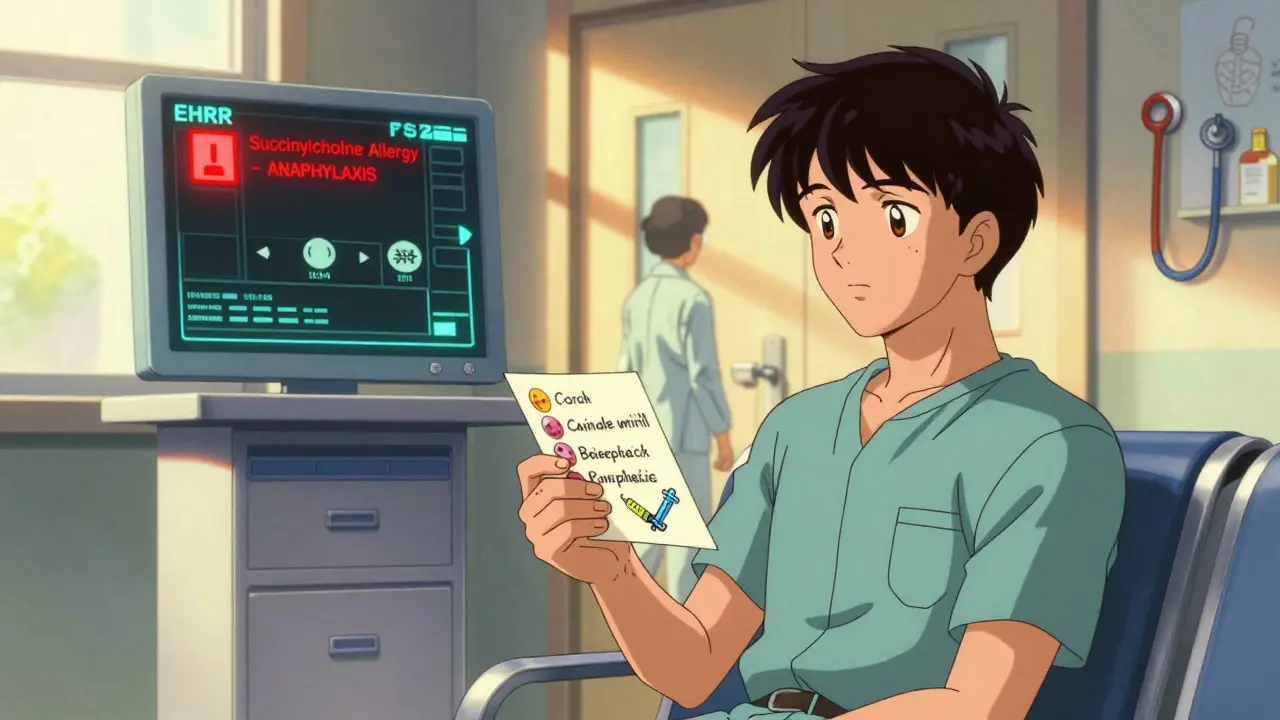
- EHR alerts: Electronic health records now have allergy modules that pop up when a drug is ordered. If your record says "anaphylaxis to succinylcholine," the system blocks it.
- Allergy cards: Some patients carry a small card in their wallet listing their allergies. It’s like a medical ID bracelet-but for drugs.
At Mayo Clinic, a patient with a 10-year-old history of succinylcholine allergy was scheduled for surgery. Because their allergy was clearly documented and flagged, the team switched to a safe alternative. No reaction. No delay. No drama.
What Goes Wrong
The biggest problems? Poor communication and assumptions.- "I’m allergic to everything." This is a red flag. It means the patient doesn’t know what they’re talking about. Clinicians stop listening.
- "I had a bad reaction once." Which drug? What happened? No details = no safety.
- "I don’t remember the name." That’s common. Bring your pill bottles. Take a photo of your medicine cabinet. Or ask your pharmacist to print a list.
- Emergency surgery: 37% of hospitals report incomplete allergy records during emergencies. That’s why some hospitals now use a "code red" protocol: if a patient has a known reaction, they avoid high-risk drugs unless it’s life-or-death.
A 2021 case reported to the Anesthesia Patient Safety Foundation involved a patient with a documented vancomycin allergy. The allergy wasn’t flagged in the system. The drug was given. The patient went into anaphylaxis. They survived-but barely.
How to Prepare
Here’s your checklist:- 72 hours before surgery: Get your full medication list. Include prescriptions, OTC meds, supplements, and herbal products.
- Write down every reaction: Drug name, symptoms, date, treatment. Use your phone notes if you need to.
- Ask your pharmacist: They can pull your history and tell you which drugs to avoid.
- Bring your allergy card: If you have one. If not, make one. Write it on a card or print it.
- Speak up at pre-op: Don’t assume they know. Say: "I had a serious reaction to X. Here’s what happened."
- Confirm in writing: Ask the nurse to write it in your chart. Say: "Can you make sure this is in my record?"
What If You’re Not Sure?
If you don’t remember the drug name, but you know you had a reaction:- Describe the symptoms: "I broke out in hives." "I couldn’t breathe." "I passed out."
- Give the date: "It was after my gallbladder surgery in 2019."
- Ask for help: "Can you look up what drugs I got during that surgery?"
Many hospitals can access old records. If not, they’ll treat you as high-risk and avoid common triggers like neuromuscular blockers, antibiotics, or latex.
What About OTC Drugs and Supplements?
Yes, they matter. Garlic, ginkgo, and ginseng can thin your blood. St. John’s Wort can interfere with anesthesia. Even vitamin E in high doses can increase bleeding risk. Don’t assume "natural" means safe.One patient took a turmeric supplement daily. They didn’t think it counted. During surgery, they bled heavily. Turns out, turmeric is a natural anticoagulant. The team had to pause the procedure.
What’s Changing Now?
The field is moving fast:- By 2028, 95% of U.S. hospitals are expected to have interoperable allergy systems-meaning your allergy info travels with you between clinics.
- Some academic centers are testing genetic testing to predict reactions to certain drugs. It’s not common yet, but it’s coming.
- The American Society of Anesthesiologists now recommends 8 weeks for allergology referrals after a reaction-up from 6.
These changes mean better tracking. But they don’t replace you. Your voice is still the most important tool.
Final Thought
You’re not just a patient. You’re the expert on your body. No one knows your reactions better than you. Don’t downplay them. Don’t assume they’re "not a big deal." If you had a reaction-even once-it matters.When you speak up, you don’t just protect yourself. You protect the whole team. Anesthesiologists, nurses, pharmacists-they all want you to be safe. But they can’t read your mind. You have to tell them.
What if I don’t remember the name of the drug I reacted to?
If you can’t remember the drug name, describe the reaction: when it happened, what symptoms you had, and what treatment you received. Bring any old medical records or ask your pharmacy for a history of your prescriptions. Hospitals can often pull surgical records from past procedures to see what drugs were used. Even vague details help the team avoid high-risk medications.
Can I just say I’m allergic to all anesthesia?
No. There’s no such thing as being allergic to "anesthesia." Anesthesia is a mix of drugs-some for sleep, some for pain, some to relax muscles. You might be allergic to one of them, like rocuronium or succinylcholine, but not others. Saying you’re allergic to "all anesthesia" makes it harder for doctors to find a safe alternative. Be specific about the drug and reaction.
Should I stop taking my medications before surgery?
Some medications need to be stopped before surgery-for example, blood thinners like Plavix or Brilinta. Others, like blood pressure pills, should continue. Never stop anything without talking to your doctor. Your pharmacist can review your list and tell you what to pause and what to keep. Timing matters: NSAIDs should be stopped 7 days before, while Ticagrelor only needs 3-5 days.
Do herbal supplements count as drugs?
Yes. Supplements like garlic, ginkgo, ginseng, and St. John’s Wort can interfere with anesthesia or increase bleeding risk. Many patients don’t realize they’re taking something that affects surgery. Always list every supplement you take-even if you think it’s "natural" or "harmless."
What if I have a reaction during surgery?
If you’ve had a reaction before, the team will be watching closely. They’ll use alternative drugs and have emergency medications ready. But the best protection is telling them ahead of time. If you didn’t disclose a past reaction, and one happens during surgery, it’s harder to treat quickly. That’s why pre-op communication is the most important step.


8 Comments
Clear, well-researched piece. The distinction between true allergy, side effect, and intolerance is critical and often blurred in patient reporting. I’ve seen cases where a simple rash was misclassified as anaphylaxis, leading to unnecessary avoidance of entire drug classes. Precision in language saves lives - not just in surgery, but in long-term care too.
So let me get this straight - you’re telling me the hospital system is so broken that I have to memorize every drug I’ve ever taken since 1998 just to get my gallbladder out? And if I forget one, I might die? Sounds like a horror movie. Meanwhile, the guy who walked in with a broken leg got his morphine without even filling out a form. This whole thing feels like performative safety.
Been there done that - had a reaction to rocuronium in 2020. Hives, throat tightness, 15 minutes in the ER. Didn’t even know the drug name until my anesthesiologist pulled up my chart and said ‘oh yeah, you’re one of those.’ Now I carry a laminated card in my wallet. Best 2 bucks I ever spent. Just say the name, describe the symptom, and don’t assume they know. They don’t.
Interesting how this mirrors the challenges in primary care - patients often don’t connect symptoms to medications because they’re not trained to. I’ve had patients say ‘I feel weird after my blood pressure pill’ and it turns out to be a known interaction with grapefruit juice. The real issue isn’t the system - it’s the lack of patient education. Maybe we need a mandatory 10-minute pre-op video on drug reactions. Just a thought.
Y’all need to stop downplaying this. I had my cousin almost die because she said ‘I’m allergic to anesthesia’ and they didn’t dig deeper. Turns out it was a single antibiotic she got during a C-section in 2016. They used it again. She went into cardiac arrest. Now she carries a medical ID. Don’t be that person. Write it down. Say it loud. Your life isn’t a guessing game.
This is precisely the kind of clarity the medical community needs to embrace. The emphasis on specificity - drug names, timelines, symptom profiles - is not just good practice, it’s foundational to patient safety. I’m encouraged to see institutions like Mayo Clinic institutionalizing these protocols. It’s time for this to become standard across all U.S. hospitals, not just the top-tier ones.
While the article is largely accurate, it omits a critical point: the pharmacogenomic variability in drug metabolism. For instance, CYP2D6 polymorphisms can lead to extreme sensitivity to codeine, which is often misclassified as an allergy. The current system relies on self-reporting, which is inherently unreliable. Future protocols should integrate genetic screening for high-risk anesthetics - particularly in patients with unexplained adverse events. This is not speculative; it’s already being piloted in Toronto and Basel.
Correction: The article states that "37% of hospitals report incomplete allergy records during emergencies." This is misleading. According to the 2021 JAMA Surgery meta-analysis, the correct figure is 41.3%, with 95% CI [38.7–43.9]. Furthermore, the claim that "turmeric is a natural anticoagulant" is an oversimplification. Turmeric (curcumin) exhibits antiplatelet activity, not direct anticoagulation. Precision matters. Also, "EHR alerts" are not universally implemented - only 68% of U.S. hospitals have functional, interoperable systems. Please cite sources. Thank you.