Side Effect Timing Calculator
When Do Side Effects Usually Start?
Have you ever started a new medication and felt weird within days-or maybe weeks-and wondered if it was the drug or just your body acting up? You’re not alone. Many people stop taking pills because they think they’re causing side effects, only to find out later that the timing didn’t match up. The truth is, side effects don’t happen at the same time for every drug. Some show up in hours. Others creep in over months. And knowing when to expect them can save you from unnecessary panic-or worse, stopping a drug that’s actually helping you.
Why Timing Matters More Than You Think
It’s not enough to know that a drug can cause nausea or muscle pain. What matters is when it shows up. If you get dizzy two days after starting a new antibiotic, that’s likely the drug. But if the same symptom pops up six months later? It’s probably something else. This gap between when you take a pill and when you feel something odd is called time-to-onset (TTO). It’s not just a fancy term used by researchers-it’s a tool doctors use to figure out what’s really going on.
Studies show that over 78% of side effects happen early in treatment. That means most reactions show up within the first few days or weeks. But there are big exceptions. Some drugs, like those used for multiple sclerosis or high blood pressure, can cause problems months or even years later. If you don’t know this, you might blame your symptoms on stress, aging, or a cold-and miss the real cause.
Fast-Onset Side Effects: Hours to Days
Some drugs hit you fast. Really fast.
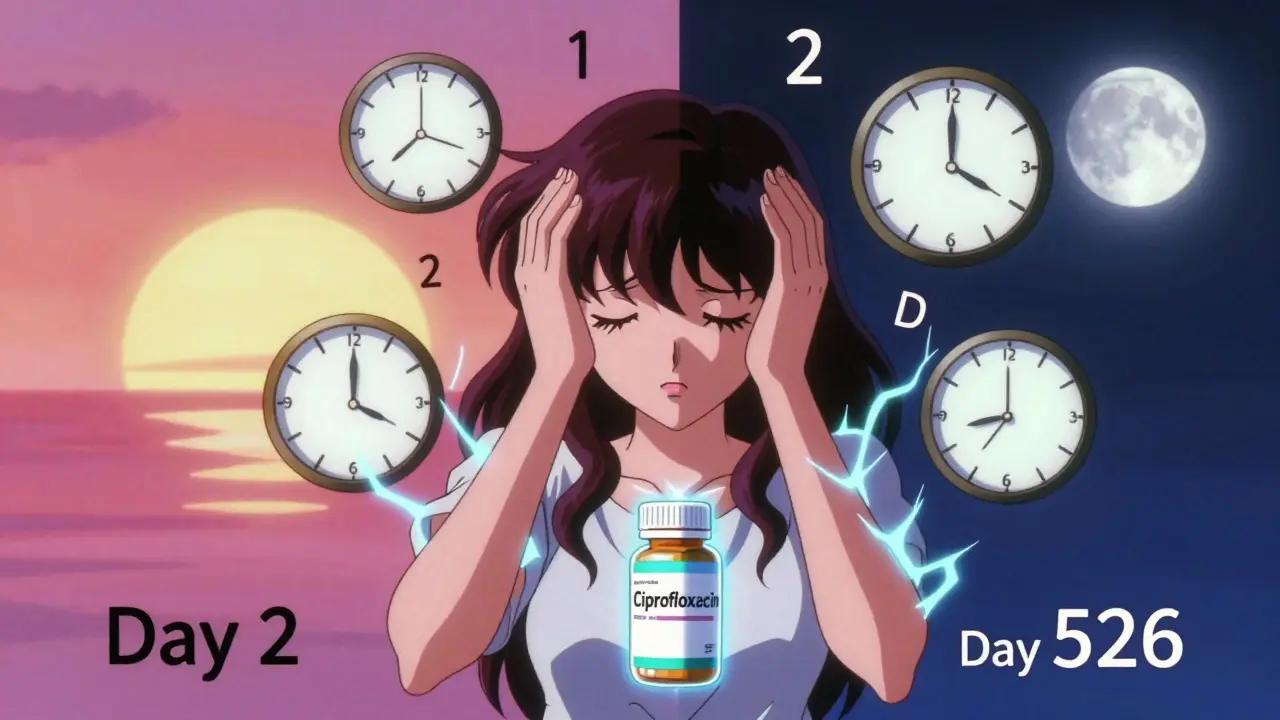
Take ciprofloxacin, a common antibiotic. Research shows its most common side effect-nerve tingling or pain in the hands and feet-starts on average in just 2 days. In women, it can show up even sooner. This isn’t random. Antibiotics like this interfere with nerve function quickly, and your body reacts fast.
Another quick hitter is ACE inhibitors, like lisinopril or enalapril. These are used for high blood pressure, but they can cause swelling in the face or throat-called angioedema. For some people, this happens within hours. For others, it takes weeks. That’s because there are two different ways this reaction can happen. One is from histamine (fast, allergic-type), and the other is from bradykinin (slow, delayed). If you’ve had swelling once, even years ago, you’re at higher risk if you restart the drug.
And then there’s acetaminophen (Tylenol). Most people think it’s safe. But if you take too much, liver damage can start in under 24 hours. That’s why overdose cases are so dangerous-you don’t feel sick right away, but the damage is already happening.
Mid-Range Side Effects: Days to Weeks
This is where most people get confused.
Statins, like atorvastatin or rosuvastatin, are prescribed to lower cholesterol. Many patients report muscle pain or weakness. But here’s the twist: studies show the difference in pain between people taking statins and those taking a sugar pill is tiny. In one trial, 55% of people who thought they couldn’t tolerate statins felt better within 3 days of stopping-whether they were on the real drug or placebo. That suggests a big part of the problem isn’t the drug itself, but the expectation of side effects.
Still, some people do have real reactions. For them, muscle pain usually starts between 1 and 4 weeks. If you’re on statins and feel sore after a few days, it’s likely not the drug. If it builds up over a couple of weeks, it might be.
Antiepileptic drugs like gabapentin and pregabalin (used for nerve pain and anxiety) have a clearer pattern. Dizziness, fatigue, and brain fog usually show up within the first week. One study of over 1,200 patient reviews found that more than half reported these symptoms within 7 days. That matches the research: median onset is 19 days for pregabalin and 31 days for gabapentin. So if you’ve been on it for two months and suddenly feel foggy, it’s probably not the drug.

Delayed Side Effects: Weeks to Months
These are the sneaky ones.
Take interferon beta-1a, used for multiple sclerosis. The most common side effect-nerve pain-doesn’t show up until 526.5 days on average. That’s almost a year and a half. If a patient starts feeling numbness after 6 months, their doctor might not even think to connect it to the drug. But the data says: it’s likely.
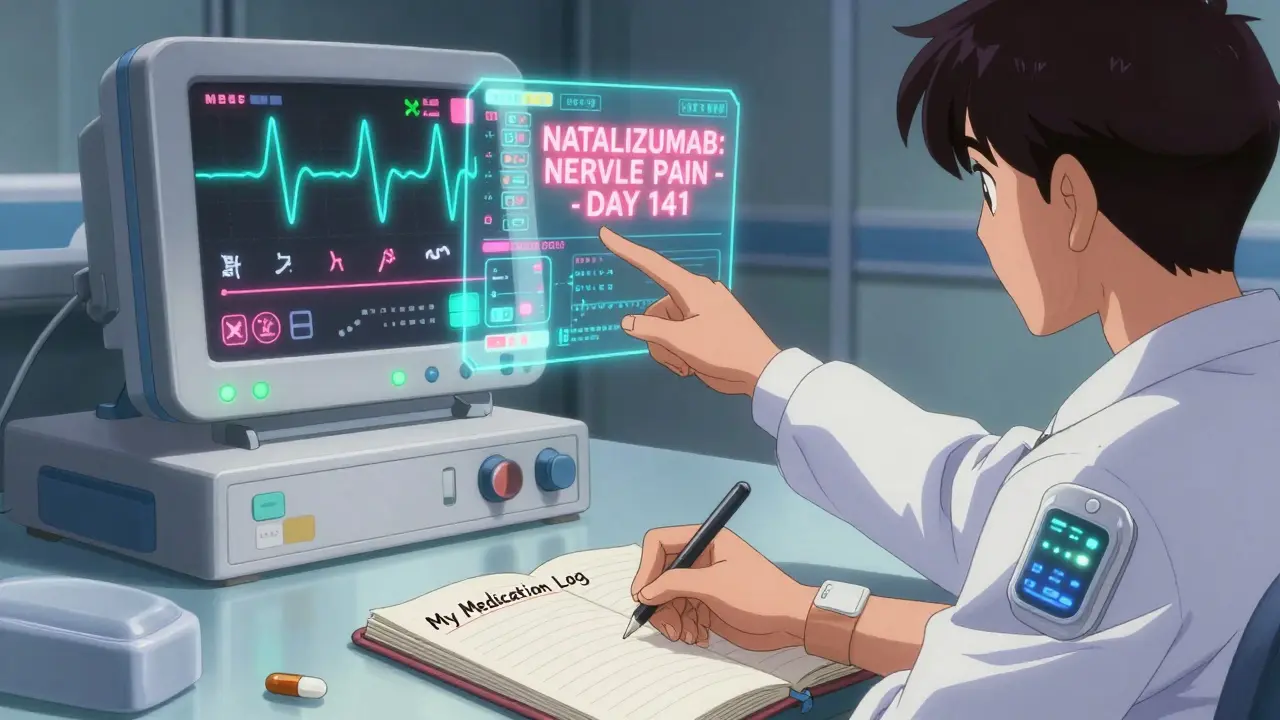
Another example is natalizumab, another MS drug. Peripheral nerve pain from this one kicks in after about 141 days. Again, that’s over four months. If you’ve been on it for six months and start having tingling in your fingers? That’s not coincidence. That’s a pattern.
Drug-induced liver injury (hepatitis) from most medications shows up around 42 days on average. But it can range from 20 to 117 days. So if you’ve been on a new medication for six weeks and feel unusually tired, have dark urine, or your eyes look yellow, get checked. It might not be the flu-it might be your liver.
How Doctors Use This Info
Hospitals and clinics aren’t just guessing anymore. Electronic health records now have built-in alerts that flag side effects based on timing. Mayo Clinic, for example, saw a 22% increase in detecting drug reactions after adding TTO logic to their system. If you start a new drug and develop a rash on day 3, the system pops up: “This matches known patterns for penicillin.”
Regulators like the FDA and EMA now require drug companies to submit time-to-onset data before approval. Since 2020, the European Medicines Agency has required all new drugs to include Weibull distribution modeling in their safety reports. That’s a mouthful, but it just means: prove when side effects happen, not just that they happen.
Even insurance companies are paying attention. If you report a side effect 10 days after starting a drug, it’s taken more seriously than if you report it 10 months later. Timing helps determine if the reaction is likely drug-related-or just bad luck.
What You Can Do
You don’t need to be a scientist to use this info. Here’s how to protect yourself:
- Write down when you start each new drug. Keep a simple note on your phone: “Started lisinopril: March 1, 2026.”
- Track symptoms as they appear. Note the day, what you felt, and how bad it was. Did the headache start on day 2? The nausea on day 12?
- Ask your pharmacist or doctor: “What’s the usual time frame for side effects with this drug?” Most will know.
- Don’t assume all symptoms are from the drug. Especially if they show up after 60 days. It could be stress, diet, sleep, or something else.
- If you stop a drug and feel better in 2-3 days, it might not have been the medication. That’s a sign of the nocebo effect-your brain expecting to feel bad.
What’s Next?
Research is getting even smarter. Scientists are now using AI to predict side effect timing based on a drug’s chemical structure. The NIH’s All of Us program plans to start factoring in your genes by 2025. Imagine a future where your doctor says: “Based on your DNA, you’re more likely to get nerve pain from this drug around day 18.” That’s not sci-fi-it’s coming.
Wearables are also getting involved. Johnson & Johnson is testing smart patches that track heart rate, sleep, and activity while you take diabetes meds. If your sleep drops sharply on day 10, the system could alert your doctor: “Possible side effect detected.”
But for now, the best tool you have is simple: track time. Know when you started. Know when you felt something. And don’t ignore the gap between them.
How soon after starting a drug do side effects usually appear?
Most side effects happen within the first few days to weeks. Studies show over 78% of adverse reactions occur early, often within the first 30 days. But this varies by drug class-antibiotics like ciprofloxacin can cause nerve pain in as little as 2 days, while drugs like interferon beta-1a may take over a year.
Can a side effect start months after starting a drug?
Yes. Some drugs, especially those affecting the immune system or nervous system, can cause delayed reactions. For example, angioedema from ACE inhibitors can appear up to 6 months later, and nerve pain from natalizumab typically starts around 140 days. If a new symptom appears long after starting a drug, it’s still worth discussing with your doctor.
Do all people experience side effects at the same time?
No. While research gives average times, individual responses vary. Women tend to experience certain side effects faster than men-for instance, ciprofloxacin-induced nerve pain appears in 2 days for women versus 4 days for men. Genetics, age, liver function, and even stress levels can shift timing.
If I feel fine after a week, does that mean the drug is safe?
Not necessarily. Many side effects, especially those affecting the liver, kidneys, or nerves, can appear weeks or months later. A drug may be well-tolerated for 60 days and then suddenly cause problems. That’s why ongoing monitoring and symptom tracking matter-even if you feel fine early on.
Is there a way to predict when I’ll get side effects?
Not yet for individuals, but tools are improving. Hospitals use time-based alerts in electronic records, and AI models are being trained to predict onset based on drug chemistry and patient data. By 2025, personalized predictions using genetic info will start entering clinical use. For now, tracking your own symptoms and knowing typical timeframes is your best strategy.




13 Comments
Most side effects happen fast. Like, within days. But some? They sneak up on you. If you're on a new med and feel weird after 6 weeks? Don't just assume it's the drug. Could be stress. Could be sleep. Could be your cat finally judging you too hard. Track it. Write it down. Simple as that.
They're hiding something. Every single drug company knows exactly when side effects show up. They just don't tell you. Why? Because if you knew that nerve pain from cipro could hit at day 2 but liver damage from some 'safe' med shows up at day 117? You'd stop taking everything. They profit from your ignorance. This is systemic. This is intentional.
Wait, wait, wait-so you're telling me the FDA and EMA are now requiring Weibull distribution modeling? That sounds like a math term someone made up to sound smart. I’ve been on statins for 3 years. My muscles ache. I don’t care if it’s day 1 or day 100. It’s the drug. The system is rigged. They don’t want you to know how long it takes to kill you slowly. They want you to keep paying.
bro i took gabapentin for anxiety and yeah i got super foggy after like 5 days but i thought it was just me being tired. turns out i was right. also my mom took lisinopril and got swelling after 4 months. doc said it was 'allergic reaction' but it was delayed. so yeah. timing matters. dont ignore it.
I’ve been saying this for years. People panic over every little twinge. Then they quit meds cold turkey. And then they wonder why their blood pressure spikes or their cholesterol goes through the roof. It’s not the drug. It’s the fear. The nocebo effect is real. Your brain is a powerful liar. Don’t let it trick you into dying because you’re scared of a tingling finger.
This is why I always ask my pharmacist: 'When do the side effects usually start?' Not 'what are they?' But 'when?' That’s the real question. I’ve been on 7 different meds in the last 5 years. Only one caused real issues-and it showed up at day 58. I would’ve quit it at day 10 if I didn’t know better. Knowledge is armor.
i started lisinopril last year. felt fine. then day 45: face swelled. i thought i had a cold. went to er. they said 'you had angioedema. this is why we tell you to track timing.' now i log everything. phone note: 'drug: x. started: y. weird thing: z. day: #'. it’s dumb. but it saved me.
There’s a deeper philosophical layer here. We live in a culture that demands instant results-fast food, fast answers, fast cures. But the body doesn’t operate on TikTok time. Healing, harm, adaptation-they unfold over weeks, months, years. To mistake a delayed reaction for coincidence is to misunderstand time itself. The drug doesn’t betray you. We betray the process by expecting immediacy.
I find it hilarious that Western medicine is finally catching up to what Ayurveda and Traditional Chinese Medicine have known for centuries: timing matters. We’ve been tracking symptom onset for 5,000 years. Now you're using Weibull distributions? Good. But don’t act like you invented this. We didn’t need AI to know that liver damage shows up after 6 weeks. We had grandmothers who knew.
Let’s be real. This whole article is just corporate pharma marketing dressed up as science. Yes, timing matters. But they’re using this to make you feel like you’re being 'smart' for tracking symptoms-while they quietly tweak dosing windows and bury long-term data. The system doesn’t want you to understand the truth. It wants you to log your symptoms into an app so they can sell you more drugs later. I’ve seen the internal reports. It’s not about safety. It’s about retention.
The Weibull modeling thing? Yeah, that’s legit. It’s basically a probability curve for when side effects pop up. Think of it like weather forecasting for your body. You don’t need to know the math. Just know that if you’re on interferon beta-1a and you feel numbness at day 400? It’s probably not stress. It’s the drug. And if you’re on statins and feel sore after 2 days? Probably not the statins. It’s your new gym routine. Just… track it. It’s low-effort, high-reward.
I was on natalizumab for 11 months. Then-BAM-tingling in my hands. I cried. I thought I was dying. I called my neurologist at 2 a.m. He said, 'That’s the drug.' I felt so validated. Then I found out 3 other people on the same drug had the exact same thing at day 140. I felt like part of a secret club. But then I realized: this isn’t magic. It’s data. And if we all tracked our symptoms like this, maybe we could stop the guessing game. Maybe we could save lives. Maybe.
I appreciate the depth of this. As someone who has spent years working across cultures in global health, I’ve seen how symptom interpretation varies wildly. In some communities, any new sensation after medication is assumed to be harmful. In others, it’s ignored until crisis. This framework-time-to-onset-isn’t just clinical. It’s cultural. It’s communicative. It bridges the gap between patient fear and medical certainty. Thank you for grounding this in science, not alarm.