
Garlic Supplement Risk Calculator
Calculate Your Bleeding Risk
This tool calculates your risk of bleeding complications when taking garlic supplements with blood thinners, based on article findings.
Your Bleeding Risk Assessment
Many people take garlic supplements thinking they’re just helping their heart or boosting immunity. But if you’re on a blood thinner-like warfarin, apixaban, or rivaroxaban-you could be putting yourself at serious risk. Garlic doesn’t just add flavor to your food. In pill form, it acts like a mild but persistent blood thinner itself. And when it teams up with prescription anticoagulants, the result can be dangerous bleeding you never saw coming.
How Garlic Interferes with Blood Clotting
The active compound in garlic that causes trouble is called ajoene. It’s not found in fresh garlic alone-it’s formed during processing, especially in oil-based supplements. Ajoene blocks platelets from sticking together, which is exactly what your body needs to stop bleeding. When platelets can’t clump, even small cuts or internal bruising can turn into bigger problems.
Studies show that standard garlic supplements (600-1,200 mg daily) can reduce platelet function by 20-40%. That’s not a small effect. It lasts for up to 72 hours after you take it. And because your body takes 7-10 days to replace old platelets, the risk doesn’t disappear just because you stopped taking the supplement yesterday.
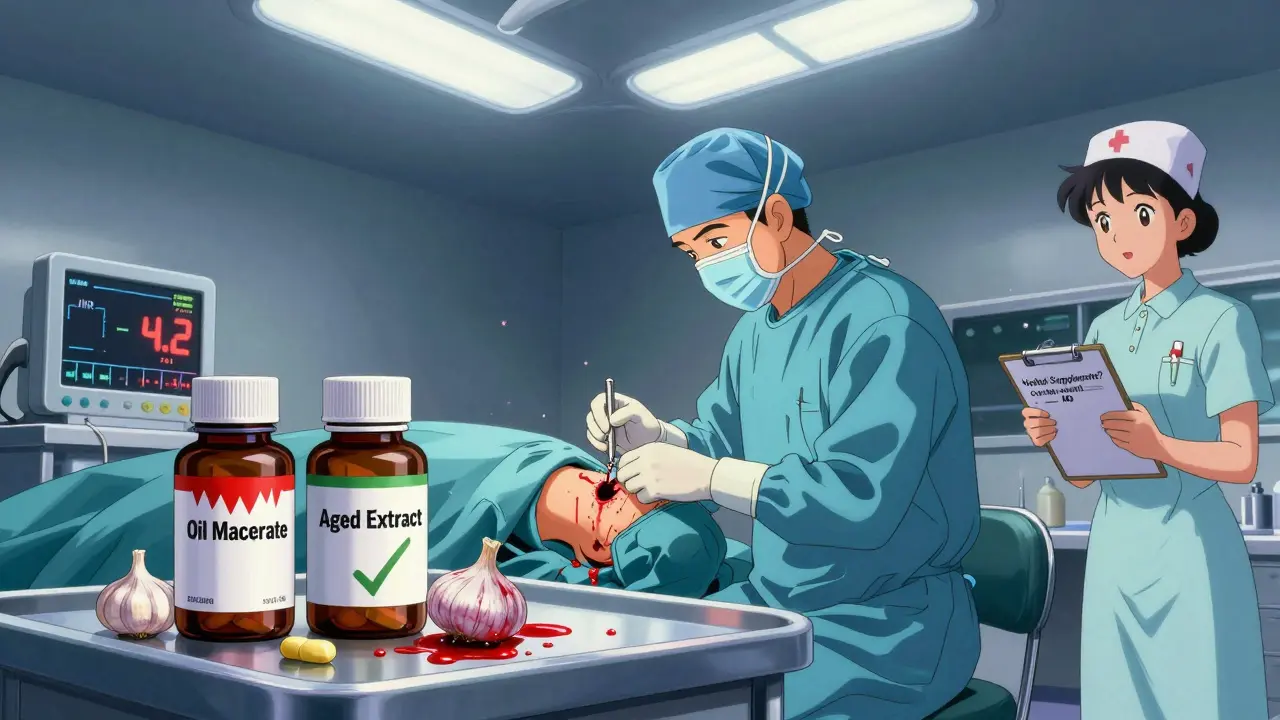
This isn’t theoretical. In 2012, two patients undergoing colorectal surgery developed uncontrolled oozing from capillaries-no major vessels were cut, yet they couldn’t stop bleeding. Both had been taking garlic supplements daily. One needed emergency open surgery. The other required a temporary ileostomy. Neither had been asked about supplements before the operation.
What Happens When Garlic Meets Blood Thinners
Anticoagulants work in different ways. Warfarin slows down clotting factors made by the liver. DOACs like apixaban block specific enzymes involved in clot formation. Garlic doesn’t interfere with those mechanisms directly-but it adds another layer of anti-clotting power on top.
The combination can push your INR (a test that measures how long your blood takes to clot) into dangerous territory. One case series found patients on warfarin who took garlic supplements saw their INR jump by 1.0 to 2.5 points. If your INR was already at 2.8 (near the top of the safe range), adding garlic could push it past 4.0-where spontaneous bleeding becomes likely.
Real-world stories confirm this. A Reddit user on r/anticoagulants described nosebleeds lasting over 30 minutes after taking 900 mg of garlic daily with apixaban. He ended up in the ER. Another patient in 2019 developed a spinal epidural hematoma-a rare, life-threatening bleed around the spine-after taking 2,400 mg of garlic supplements daily. He needed emergency surgery.
Even if you don’t feel anything, the damage can be happening inside. Internal bleeding in the brain, gut, or around organs doesn’t always show symptoms until it’s too late.
Not All Garlic Supplements Are the Same
Here’s where things get confusing. Not every garlic pill has the same effect. The amount of ajoene depends entirely on how it’s made:
- Oil macerates (garlic soaked in oil) contain the highest levels-up to 1.0 mg of ajoene per gram. These are the most dangerous.
- Standard powdered garlic (most common in drugstores) has about 0.1-0.3 mg/g. Still enough to matter.
- Aged garlic extract (like Kyolic) has almost no ajoene. Studies show it has minimal antiplatelet activity.
Many people think they’re safe because they’re taking “aged garlic.” But labels rarely say what kind they are. And even if they do, the FDA doesn’t require manufacturers to list ajoene content. In fact, a 2019 test by ConsumerLab.com found potency varied by up to 15 times between brands-even those labeled the same.
If you’re on a blood thinner, stick with aged garlic extract-or better yet, avoid supplements altogether. Fresh garlic in food is fine. The dose is too low to cause problems.
Who’s Most at Risk?
You might assume only older adults or those with heart disease are at risk. But the truth is more widespread:
- 18.3% of adults over 65 take garlic supplements.
- 22.7% of those users are also on anticoagulants.
- That’s roughly 3.1 million Americans combining the two.
And here’s the kicker: 83% of garlic supplement users don’t know they could be risking bleeding. Only 33% have ever talked to their doctor about it. Most think “natural” means “safe.” But natural doesn’t mean harmless-especially when you’re already on medication that affects your blood.
High-risk situations include:
- Any surgery-even minor ones like dental extractions or colonoscopies
- Neurosurgery (risk of brain bleed)
- Prostate or bladder surgery (risk of severe internal bleeding)
- Emergency trauma or injury
A 2017 study found that 68% of patients continued taking garlic supplements within 7 days of scheduled surgery-even after being asked about herbal use. Doctors often don’t ask specifically about garlic. They say “herbs,” and patients think of echinacea or ginseng, not garlic pills.
What Should You Do?
If you’re on a blood thinner and taking garlic supplements, here’s what you need to do:
- Stop taking garlic supplements immediately. Don’t wait. Don’t cut back. Stop.
- Don’t assume aged garlic is safe. Even if it’s labeled “ajoene-free,” there’s no guarantee. Talk to your pharmacist or doctor.
- Wait 7-14 days before surgery. The American Society of Anesthesiologists recommends 14 days. The European Society says 7. When in doubt, go with 14.
- Ask your doctor to check your INR. If you’ve been taking garlic and warfarin, your INR might be higher than you think.
- Tell every provider you see. Dentists, surgeons, ER staff-they all need to know. Say: “I’m on a blood thinner and I stopped garlic supplements 14 days ago.”
If you’re not on anticoagulants but take garlic supplements for heart health, remember: the benefits are modest. A 2016 meta-analysis found garlic lowers systolic blood pressure by only 7-8 mmHg. That’s less than many lifestyle changes. The risk may not be worth it.
What About Other Supplements?
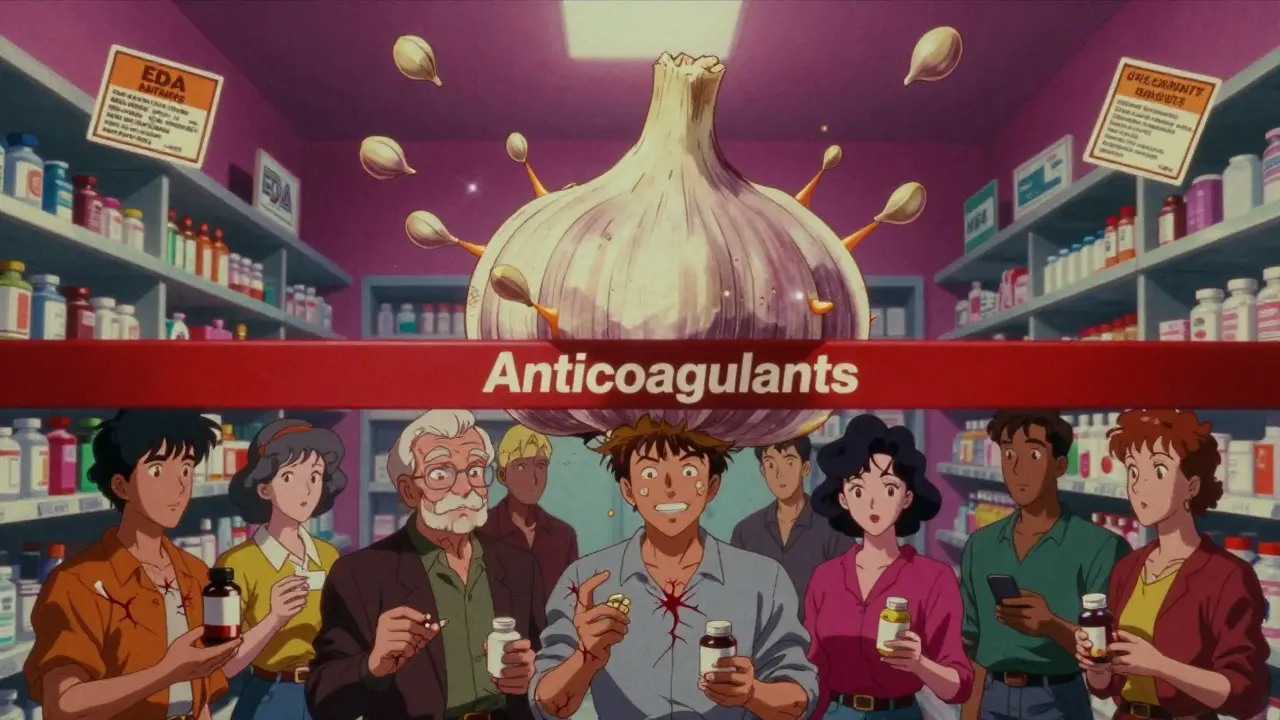
Garlic isn’t the only supplement that interacts with blood thinners. But it’s one of the most common-and one of the most underestimated.
Here’s how it compares:
| Supplement | Antiplatelet Effect | Duration of Effect | Known Severe Cases |
|---|---|---|---|
| Ginkgo biloba | 30-50% | 2-3 days | Yes, multiple |
| Garlic supplements | 20-40% | Up to 72 hours; platelet recovery takes 7-10 days | Yes, including surgery and spontaneous bleeds |
| Fish oil (omega-3) | 10-20% | 1-3 days | Rare |
| Ginseng | 10-25% | 1-2 days | Yes, but less frequent |
| St. John’s Wort | Minimal direct effect | N/A | Indirect (alters drug metabolism) |
Ginkgo is riskier-but fewer people take it. Garlic? It’s everywhere. In pharmacies, health food stores, even Amazon. And most people don’t realize it’s a drug interaction waiting to happen.
The Bigger Picture
The global garlic supplement market hit $1.27 billion in 2022-and it’s growing fast. At the same time, over 10 million Americans are on blood thinners. The overlap is massive. And the system isn’t catching it.
Supplement labels don’t warn you clearly. Doctors don’t always ask. Patients don’t think to tell them. A 2022 survey found that 67% of garlic users never discussed it with their healthcare provider.
The FDA has warned about inconsistent potency. The European Medicines Agency now classifies garlic as a “substance with known anticoagulant effects.” And new guidelines are coming: the FDA is drafting rules to require ajoene content labeling by mid-2024.
Until then, the safest choice is simple: if you’re on a blood thinner, don’t take garlic supplements. Not “sometimes.” Not “low dose.” Not “aged.” Just don’t take them.
Your body doesn’t need the supplement. You already get enough garlic from food. And the risk? It’s real. It’s documented. It’s preventable.
Can I still eat garlic in food if I’m on blood thinners?
Yes. Eating fresh or cooked garlic in normal amounts (1-2 cloves per day) is safe. The amount of ajoene in food is too low to affect clotting. The risk comes from concentrated supplements-pills, oils, or extracts that deliver 10-20 times more than you’d get from your dinner.
How long should I stop garlic supplements before surgery?
The American Society of Anesthesiologists recommends stopping garlic supplements at least 14 days before any surgery, even minor ones. Some guidelines say 7 days, but 14 is safer. Platelet function takes 7-10 days to return to normal after stopping, and you want a full buffer. Don’t wait until the day before your procedure.
I take aged garlic extract. Is it safe?
Aged garlic extract (like Kyolic) has very little ajoene and is considered low-risk for bleeding. However, labels aren’t always accurate. Independent testing shows some products still contain enough active compounds to matter. If you’re on a blood thinner, talk to your doctor before assuming it’s safe. Better yet, avoid all garlic supplements unless your provider confirms the product is truly low-risk.
What if I accidentally took garlic before surgery?
Tell your surgeon and anesthesiologist immediately. Even if it was just one dose, they need to know. They may delay the surgery, check your INR, or adjust your blood thinner. Never hide supplement use-it’s not about blame. It’s about safety. Many complications happen because patients assume it’s “just garlic” and don’t mention it.
Are there any garlic supplements that don’t interact with blood thinners?
Aged garlic extract is the only type with strong evidence of minimal antiplatelet effects. Some manufacturers now market “ajoene-free” versions, but these claims aren’t yet regulated. Until standardized labeling is required (expected in 2024), there’s no way to be 100% sure. The safest approach is to avoid all garlic supplements if you’re on anticoagulants.
Can garlic supplements replace blood thinners?
Absolutely not. Garlic supplements are not a substitute for prescribed anticoagulants. They don’t prevent strokes, clots, or pulmonary embolisms reliably. Relying on garlic instead of your medication is dangerous and could lead to life-threatening events. Always follow your doctor’s advice.
Final Thought
Supplements aren’t harmless. Just because something comes from a plant doesn’t mean it’s safe with your medications. Garlic supplements are one of the most common hidden risks for people on blood thinners-and one of the easiest to fix. Stop them. Talk to your doctor. And don’t assume you’re safe because you’ve never had a problem before. Bleeding doesn’t always announce itself. It just happens.




12 Comments
Let’s be real - ajoene is the silent assassin of the supplement world. We’re talking about a compound that hijacks platelet aggregation like a rogue algorithm in a clotting cascade. The pharmacokinetics here are non-trivial: 72-hour half-life, platelet turnover lag, and zero regulatory oversight. This isn’t ‘natural wellness’ - it’s unregulated polypharmacy with a side of placebo branding. If you’re on DOACs and popping garlic pills, you’re essentially playing Russian roulette with your capillaries.
Hey everyone - just want to say this post is so important 🙏. I used to take garlic for my ‘heart health’ until my dad had a weird nosebleed that wouldn’t stop. Turns out he was on warfarin and didn’t even realize garlic supplements could do this. We’re all trying to be healthy, but sometimes the ‘natural’ path is the most dangerous one. Please, if you’re on blood thinners - talk to your pharmacist. They’re the real MVPs.
How quaint. The myth of the ‘natural remedy’ persists because people refuse to engage with pharmacology as a science. Garlic isn’t a ‘supplement’ - it’s a bioactive compound with dose-dependent pharmacodynamic effects. The fact that the FDA doesn’t regulate ajoene content is a regulatory failure, not a justification for complacency. The real tragedy isn’t the bleeding - it’s the intellectual laziness that allows this to persist in mainstream wellness culture.
I’ve been on rivaroxaban for 5 years now. I took garlic supplements for 18 months because my yoga instructor said it ‘cleansed the blood.’ I didn’t have any symptoms - until I got a minor bruise on my thigh that turned into a golf-ball-sized hematoma. Three weeks of pain, two ER visits, and a terrified wife. I didn’t know. Nobody told me. I thought ‘natural’ meant ‘safe.’ I was wrong. Now I don’t touch anything that isn’t FDA-approved. And even then, I double-check. This isn’t about fear. It’s about accountability. We owe it to ourselves to know what we’re putting in our bodies - especially when we’re already on drugs that alter our biology.
soooo… you’re saying eating garlic bread is fine but taking a pill is deadly? what a shocker. next you’ll tell me oxygen is dangerous if you inhale it but fine if you breathe it. classic fearmongering. also why is this even a post? everyone knows supplements are useless
It is imperative that individuals who are currently under anticoagulant therapy refrain from the ingestion of garlic-derived supplements. The biochemical interaction between ajoene and coagulation pathways is well-documented in peer-reviewed literature. The absence of standardized labeling constitutes a public health liability. Furthermore, the assertion that aged garlic extract is inherently safe is empirically unsupported due to variability in manufacturing processes. This is not a matter of opinion - it is a clinical imperative.
OMG I’m so glad someone finally said this!! 🥹 I took garlic pills for 2 years thinking they were ‘heart heroes’ and then my mom had a stroke - turns out she was on apixaban and never told her doctor. We almost lost her. Now I’m on a mission to tell everyone I know. If you’re on blood thinners, STOP. Just stop. No exceptions. And tell your dentist, your surgeon, your yoga teacher - everyone. ❤️🩸 #StaySafe #GarlicIsNotYourFriend
Let’s cut through the wellness noise. You’re not ‘boosting immunity’ - you’re chemically altering your hemostasis. The fact that 83% of users are unaware of the risk proves the entire supplement industry is a predatory scam. Aged garlic? Please. If the label doesn’t specify ajoene content in mg per dose, it’s a lie. And if your ‘doctor’ didn’t ask you about supplements, they’re negligent. This isn’t about ‘natural vs synthetic’ - it’s about ignorance being lethal. Stop romanticizing plants. They’re not your friends. They’re pharmacologically active substances with zero oversight.
Stop taking garlic pills. Period. If you're on blood thinners, it's not worth it. You don't need it. You're not healthier with it. You're just risking your life for nothing.
Big shoutout to the OP - this is the kind of info we need more of. I’m a nurse and I’ve seen three patients bleed out after surgery because they didn’t mention their garlic pills. One guy thought ‘it’s just garlic’ so he kept taking it till the day of his knee scope. Spoiler: he didn’t make it home. Please, if you’re reading this - talk to your care team. And if you’re a provider - ASK. Don’t assume they know to tell you. We’re all trying to do better. This is one easy win.
Oh wow, another ‘natural is dangerous’ lecture. Let me guess - you also think sunlight causes cancer and water is a controlled substance? People take garlic because it’s cheap, accessible, and makes them feel in control. You think banning supplements will fix healthcare? The real problem is that doctors don’t educate patients. You don’t get to scare people into compliance. You get to inform them. And if they still choose to take it? That’s their autonomy. Not your moral victory.
So let me get this straight - you’re saying that a food-derived compound, consumed for centuries across cultures, suddenly becomes a lethal threat when concentrated? That’s not science. That’s fear. The study you cited? Small sample size. The cases? Anecdotal. And yet you’re painting 3 million people as reckless idiots. Meanwhile, you ignore the fact that DOACs themselves cause 30,000+ hospitalizations a year in the US. But hey - big pharma doesn’t sell ‘stop taking your prescription’ pills. So we get this. This isn’t about safety. It’s about control. And I’m not buying it.