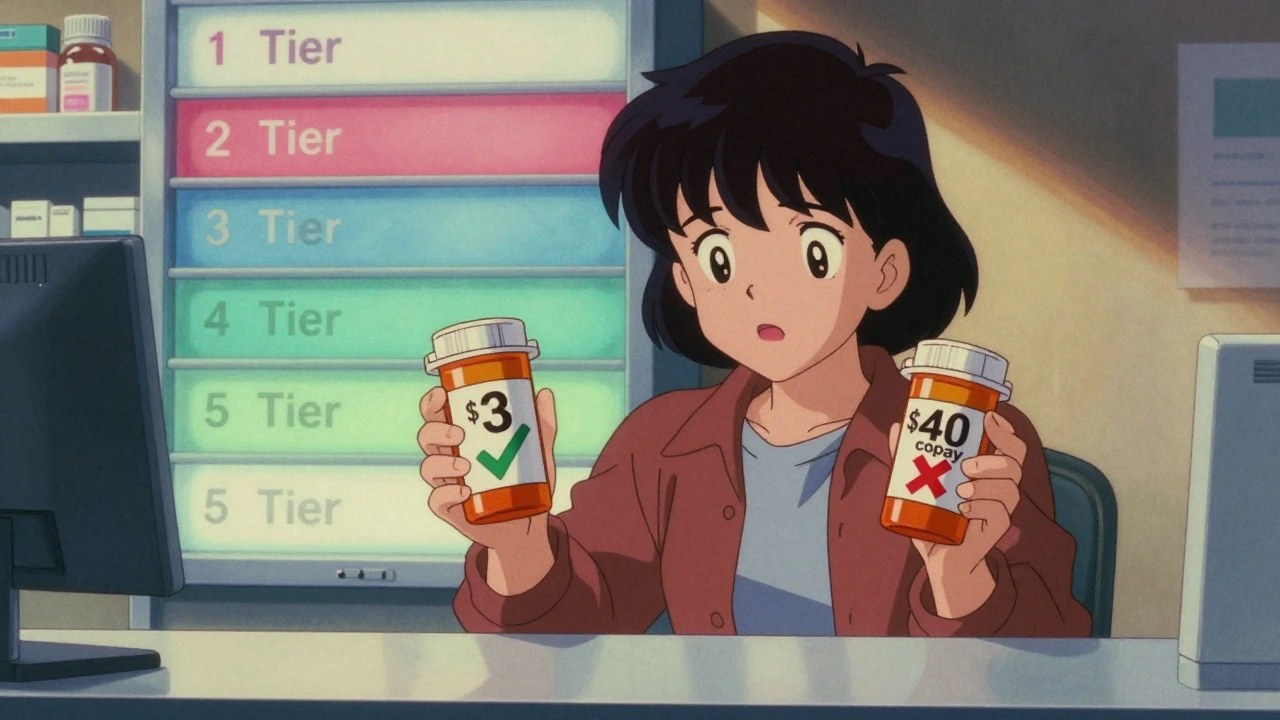
When you switch health plans, your prescription costs can jump overnight - even if you’re taking the same medication. Many people assume all generic drugs are treated the same across plans. They’re not. One plan might charge you $3 for your blood pressure pill. Another might hit you with a $40 copay or make you pay the full price until you meet a $2,000 deductible. That’s not a small difference. It’s the difference between keeping your meds or skipping doses.
Why generic drug coverage isn’t just about price
Generic drugs are chemically identical to brand-name versions. But how your insurance covers them? That’s where things get messy. Most plans use a tiered system called a formulary. Think of it like a ladder. The lower the tier, the cheaper your copay. Tier 1 is usually reserved for generic drugs - and that’s where you want to be. But here’s the catch: not all generics are in Tier 1. Some plans split generics into two groups: preferred and non-preferred. Your metformin might be preferred. Your neighbor’s version, made by a different manufacturer, might not be. Even though both treat diabetes the same way, your cost could double. This isn’t a mistake. It’s by design. Insurers negotiate deals with drug makers. If a company pays more for shelf space on the formulary, their version gets the lower copay.Tier structures you’ll actually see
Most plans use 3 to 5 tiers. Here’s what you’re likely to run into:- 3-tier plans: Tier 1 = generics ($5-$10 copay), Tier 2 = preferred brands, Tier 3 = non-preferred brands.
- 4-tier plans: Tier 1 = generics ($3-$20), Tier 2 = preferred brands, Tier 3 = non-preferred brands, Tier 4 = specialty drugs.
- 5-tier plans: Tier 1 = preferred generics ($0-$10), Tier 2 = non-preferred generics ($20-$40), Tier 3-5 = increasingly expensive brands and specialty meds.
Medicare Part D and Advantage plans - the wild card
If you’re on Medicare, things get even more complex. In 2023, the base deductible for Part D plans was $505. But most plans waive that for Tier 1 generics. You might pay $0-$10 per prescription after the deductible. Medicare Advantage plans that include drug coverage (MA-PDs) often save you 18% on average compared to standalone Part D plans - but only if your meds are on their formulary. Here’s the trap: many people switch Medicare plans during open enrollment and assume their meds are covered. They’re not. In 2023, 15% of Medicare beneficiaries had a generic drug suddenly moved to a higher tier or removed entirely. The most common culprits? Blood pressure meds, diabetes drugs, and thyroid pills. Your levothyroxine might be covered at $0 under Plan A. Under Plan B? 25% coinsurance. That’s $25 for a $100 prescription. And you didn’t even know until you got to the pharmacy.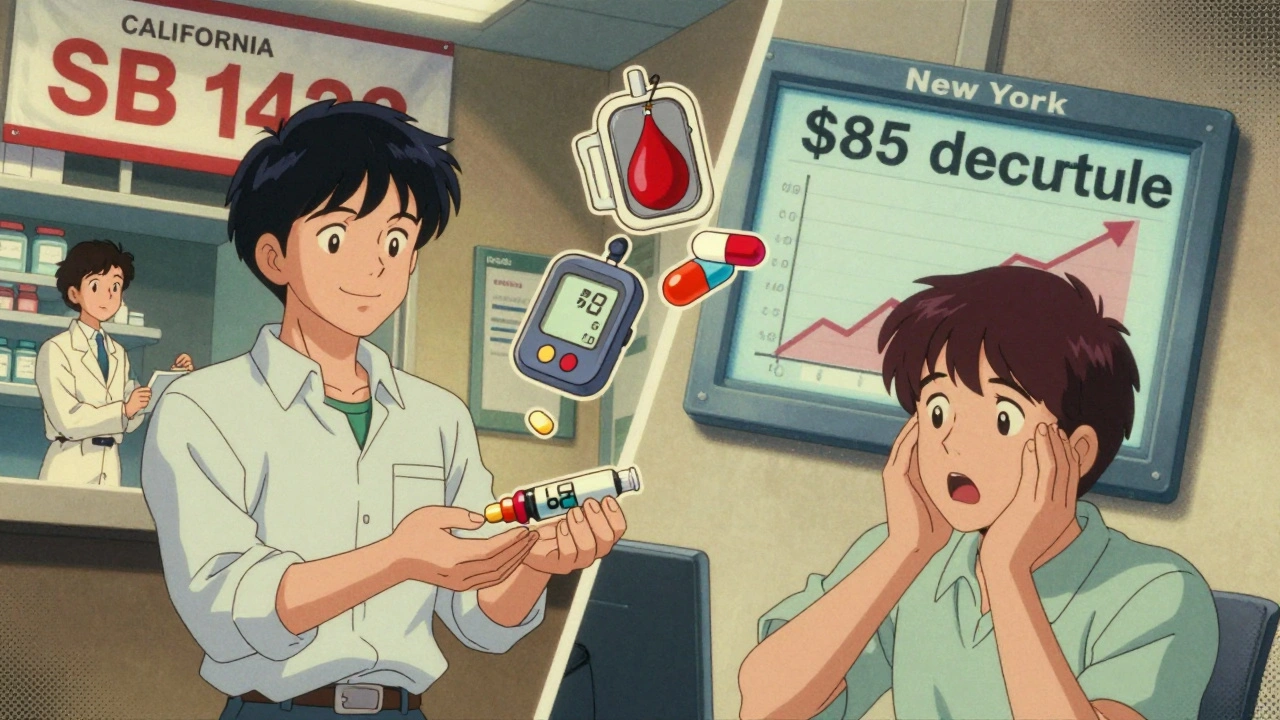
State rules change everything
Where you live matters more than you think. California requires a $85 deductible for outpatient drugs before coverage starts - and then you pay 20% coinsurance, capped at $250 per year. New York? No deductible for generics. Just a flat $75 copay for specialty drugs, but your everyday pills? Often $0. Some states go further. California’s SB 1423 mandates $0 insulin copays. New Jersey caps out-of-pocket costs for diabetes drugs at $30 per month. These rules don’t apply to employer plans or Medicare - only to individual and small group plans sold in-state. So if you’re moving from New York to California, your $3 generic copay could turn into a $85 deductible plus coinsurance. That’s a 2,500% cost increase.How to check your meds before you switch
Don’t guess. Don’t rely on the plan’s website summary. Go straight to the formulary. Here’s how:- Get the full, official formulary list - not just the tier breakdown. Look for the PDF or searchable database on the insurer’s website.
- Search for your exact medication. Don’t just type “metformin.” Type the full name: metformin hydrochloride 500 mg extended-release. Some plans cover the immediate-release version but not the extended-release - even though your doctor prescribed the latter.
- Check the manufacturer. If your pill says “Aurobindo” on it, but the plan only covers “Teva,” you’re not covered at Tier 1. You’ll pay more.
- Verify your pharmacy. If your local pharmacy isn’t in the plan’s network, your $3 copay could become $60. Use the plan’s pharmacy locator tool.
- Use a cost calculator. Medicare.gov’s Plan Finder and Healthcare.gov’s plan selector let you enter your meds and see projected annual costs. Run your current plan and the new one side by side.
What no one tells you about mail-order and specialty drugs
Mail-order pharmacies often charge less for 90-day supplies. But only if your plan lets you use them. Some plans force you to use mail-order for maintenance meds - and if you don’t, you pay full price. Others let you choose, but charge a higher copay at retail. Specialty drugs? Even if they’re generic, they’re often in Tier 4 or 5. A generic version of a biologic like Humira might cost $225 per month with 30% coinsurance. That’s not a $20 copay. That’s a $675 monthly bill before insurance. And yes - some insurers classify these as “specialty,” even if they’re chemically identical to cheaper generics.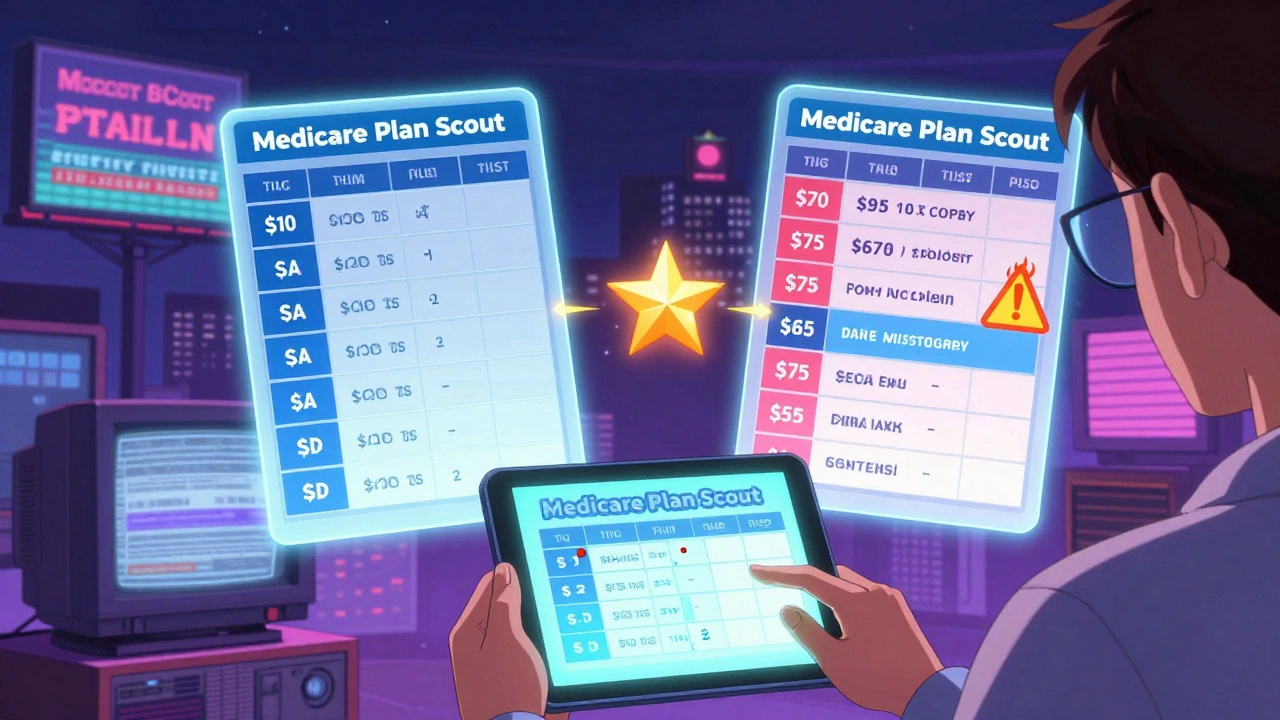
What’s changing in 2025
Starting in 2025, Medicare Part D will cap out-of-pocket drug spending at $2,000 per year. That’s huge. But it doesn’t mean your copays will drop. It just means you won’t pay more than that total - no matter how many drugs you take. Also, 32 states now offer Silver SPD plans with $10 generic copays that don’t require you to meet the deductible. That’s up from 24 in 2023. More states are adopting them because consumers keep switching plans to avoid surprise bills. And new tools are coming. CMS launched a beta AI tool called “Medicare Plan Scout” in late 2023. It analyzes your meds, compares formularies, and flags hidden costs. In testing, it cut enrollment errors by 44%.Biggest mistakes people make
- Assuming “generic” means “covered at the lowest rate.” It doesn’t.
- Not checking the manufacturer. Your pill’s brand name might be different than what’s listed.
- Ignoring pharmacy networks. Your local CVS might be in-network. The one across town? Not.
- Thinking “I’m healthy, I don’t need to check.” Half of all prescriptions are for chronic conditions. You’re not as healthy as you think.
- Waiting until open enrollment to look. By then, it’s too late. Switches take 30 days to process.
Bottom line: Do the work
Switching health plans isn’t about the monthly premium. It’s about what happens when you need your meds. A $50 cheaper premium could cost you $1,200 more in drug costs if your generics aren’t covered right. Take 30 minutes. Write down every medication you take - name, dose, manufacturer, how often. Go to the plan’s formulary. Search each one. Compare the total annual cost, including deductibles and pharmacy fees. Don’t trust the sales rep. Don’t trust the summary page. Go to the source. The savings are real. One person in Massachusetts saved $780 a year by switching to a plan with $3 generic copays for three maintenance drugs. That’s not luck. That’s research.How do I know if my generic drug is covered by a new health plan?
Download the plan’s official formulary document - not just the summary. Search for your exact drug name, dosage, and manufacturer. If it’s listed under Tier 1 or Tier 2, it’s covered. If it’s not listed at all, it’s not covered. Check the pharmacy network too - your local pharmacy might not be in-network.
Are all generic drugs treated the same across health plans?
No. Plans often split generics into preferred and non-preferred tiers. Two identical drugs made by different manufacturers can have wildly different copays. One might cost $3. The other $40. It’s not about the drug - it’s about which manufacturer the insurer has a deal with.
What’s the difference between a deductible and a copay for generics?
A deductible is the amount you pay before insurance starts covering anything. A copay is a fixed fee you pay at the pharmacy. In many plans, you must meet your deductible before generics are covered. But in Silver Standardized Plans, generics often have a fixed $20 copay - even if you haven’t met your deductible. That’s a major savings.
Can I switch health plans mid-year to get better drug coverage?
Usually not. Most people can only switch during open enrollment (November-December) or if they qualify for a Special Enrollment Period - like moving to a new state, losing other coverage, or having a baby. If your meds suddenly become expensive, you’re stuck until the next enrollment period unless you qualify for one of these triggers.
Why does my generic drug cost more in one state than another?
State laws control how insurers structure drug coverage. California has a $85 outpatient drug deductible and 20% coinsurance. New York waives deductibles for generics and charges flat copays. These rules apply to individual and small group plans - not Medicare or large employer plans. So if you move, your drug costs can change dramatically.


8 Comments
I switched plans last year and nearly skipped my blood pressure med because I didn't check the formulary. Turned out my generic was in Tier 2 with a $45 copay. My neighbor took the same pill but from a different maker and paid $3. I cried in the pharmacy aisle. Don't be me.
Always verify the manufacturer on the label. I once spent weeks fighting with my insurer because my metformin was labeled 'Aurobindo' and their formulary only listed 'Teva'. Same active ingredient, different price tier. Insurers don't care about your health - they care about their contracts.
THIS. THIS IS WHY PEOPLE DIE. Not because they're sick - because they're broke. I watched my aunt skip her diabetes meds for six months because her new plan made her pay $120 a month for a pill that used to cost $5. She ended up in the ER. And the insurance rep said, 'Well, you should've read the fine print.' Fine print? That's not a disclaimer - that's a death sentence.
So let me get this straight - we live in a country where two identical pills cost different amounts based on which corporation paid the insurance company more? And we call this capitalism? I'm pretty sure if I tried to sell two identical loaves of bread at different prices based on who paid the grocery store, I'd get arrested. But pills? Nah. That's just 'market dynamics.'
Check the formulary. Search the exact name. Confirm the pharmacy. Do this before you enroll. It takes 20 minutes. It could save you thousands. Simple steps. Huge impact.
Ugh I tried this and the formulary website crashed three times. Then I called customer service and they put me on hold for 47 minutes. When I finally got through they said 'We don't have your meds listed because you're on the wrong plan.' I didn't even know I was on the wrong plan! I just picked the cheapest premium. Who knew that meant my thyroid med would cost $200? I'm so done.
One thing people overlook: mail-order vs retail. My plan gives me a $5 copay for 90-day mail-order but $35 at CVS. I switched and saved $300/year. Also, use Medicare.gov’s Plan Finder - it’s clunky but accurate. Don’t trust the sales reps. They get commissions for enrolling you in plans with higher margins, not lower drug costs.
And yet people still blame the government. 🤦♀️ This isn't a public health crisis - it's a corporate greed crisis. The same companies that sell you pills also lobby to keep the system broken. Don't get mad at your neighbor for taking a cheaper version. Get mad at the CEOs who profit from your suffering. And yes, I'm still salty.