
Adverse Event Signal Detection Calculator
Understand Signal Detection
Traditional methods like Reporting Odds Ratio (ROR) only analyze two variables at a time, while machine learning examines hundreds of data points simultaneously. This tool simulates how each approach would identify potential adverse events.
Patient Profile
Drug Safety Signal Detection
Traditional Methods
ROR/IC AnalysisBased on the data provided, traditional methods would detect a low risk signal.
These methods typically catch only 13% of significant adverse events in practice.
Machine Learning
GBM/RF AnalysisMachine learning identifies a high risk signal.
ML systems detect 64.1% of adverse events requiring medical intervention.
How this works: This simulation demonstrates the core difference between traditional statistical methods (which look at single variables) versus machine learning approaches (which analyze complex patterns across multiple data points). In real-world applications, ML models consider hundreds of factors simultaneously.
Every year, thousands of patients experience unexpected side effects from medications that weren’t caught during clinical trials. These are called adverse events, and spotting them early can mean the difference between a minor inconvenience and a life-threatening reaction. For decades, drug safety teams relied on manual reviews of patient reports, statistical flags, and slow-moving databases. But those methods are falling behind. Today, machine learning is changing how we detect dangerous drug reactions - faster, smarter, and with far fewer false alarms.
Why Traditional Methods Are Failing
For years, pharmacovigilance teams used methods like Reporting Odds Ratio (ROR) and Information Component (IC) to find safety signals. These techniques looked at simple patterns: if a drug was taken by 100 people and 5 had a rare skin rash, was that just coincidence or a real risk? The problem? These tools only looked at two variables at a time - the drug and the symptom. They ignored everything else: age, other medications, pre-existing conditions, even how the patient described their symptoms in their own words. The result? A flood of false positives. A patient taking aspirin and complaining of headaches? That’s not a signal - it’s just a common side effect. But old systems flagged it anyway. Meanwhile, real dangers slipped through. A new cancer drug might cause a subtle heart rhythm change only visible when combined with a specific blood pressure med. Traditional tools couldn’t see that connection. They were blind to complexity.How Machine Learning Sees What Humans Miss
Machine learning signal detection doesn’t just count occurrences. It analyzes hundreds, even thousands, of data points at once. Think of it like a detective who reads police reports, medical records, insurance claims, and even social media posts - all at the same time. Systems built with gradient boosting machines (GBM) and random forests (RF) use algorithms trained on millions of real-world cases. They learn which combinations of factors matter. For example, a GBM model might discover that patients over 65 taking Drug X and having diabetes are 17 times more likely to develop a rare liver enzyme spike than others. That’s not something a simple table could find. It’s a hidden pattern buried in messy, real-life data. One study using the Korea Adverse Event Reporting System showed that machine learning detected 64.1% of adverse events that required medical intervention - like stopping a drug or changing a dose. Traditional methods only caught 13%. That’s not an improvement. That’s a revolution.Real-World Success Stories
The FDA’s Sentinel System has run over 250 safety analyses since going fully operational. One of its biggest wins? Catching a dangerous interaction between a diabetes drug and a common antibiotic before it became a public health crisis. The system flagged it using data from Medicare claims, electronic health records, and pharmacy databases - all processed automatically. Another example comes from infliximab, a drug used for autoimmune diseases. Researchers trained a machine learning model on 10 years of adverse event reports. The model spotted four new safety signals - including liver toxicity and blood disorders - within the first year they appeared in the data. The drug label didn’t get updated for another 18 months. That’s 18 months where doctors didn’t know to watch for these risks. Machine learning found them first. Even deep learning models are making headway. One model designed to detect Hand-Foot Syndrome - a painful skin reaction from certain chemotherapy drugs - correctly identified 64.1% of cases needing medical action. That’s better than most diagnostic tests for early-stage cancer.
What’s Driving This Change?
It’s not just better tech. It’s pressure. The global pharmacovigilance market is expected to hit $12.7 billion by 2028. Why? Because regulators are demanding it. The FDA released its AI/ML Software as a Medical Device Action Plan in 2021. The European Medicines Agency is finalizing new rules for AI validation in drug safety by late 2025. Companies that don’t adapt risk delays in approvals, fines, or worse - lawsuits when preventable harm occurs. Big pharma is moving fast. IQVIA reports that 78% of the top 20 drug companies now use machine learning in their safety monitoring. They’re not just using it for post-market checks. Some are integrating it into early clinical trials to catch signals before a drug even hits shelves. Data sources are expanding too. It’s not just hospital records anymore. Insurance claims, wearable device data, patient forums, and even Twitter posts are being analyzed. One 2025 IQVIA report predicts that by 2026, 65% of safety signals will come from at least three different data streams. That’s the future - connected, real-time, and automated.The Challenges No One Talks About
This isn’t magic. It’s hard work. First, the data has to be good. If a patient’s record says “fatigue” but doesn’t specify if it’s mild or severe, the model can’t learn properly. Many electronic health records are messy, incomplete, or inconsistent across hospitals. Second, these models are black boxes. A GBM might say “high risk,” but it won’t tell you why. That’s a problem when you need to explain your findings to regulators or doctors. One pharmacovigilance specialist put it bluntly: “You can’t tell a regulator, ‘The algorithm said so.’ You need to show the evidence.” Third, training these systems takes time and expertise. A 2023 survey by the International Society of Pharmacovigilance found it takes 6 to 12 months for safety professionals to become truly proficient. Large companies spend 18 to 24 months rolling these systems out company-wide. And while machine learning reduces human bias, it can introduce its own. If the training data mostly comes from white, middle-aged patients in the U.S., the model might miss risks in older adults, pregnant women, or people from other ethnic groups. Bias in data leads to bias in detection.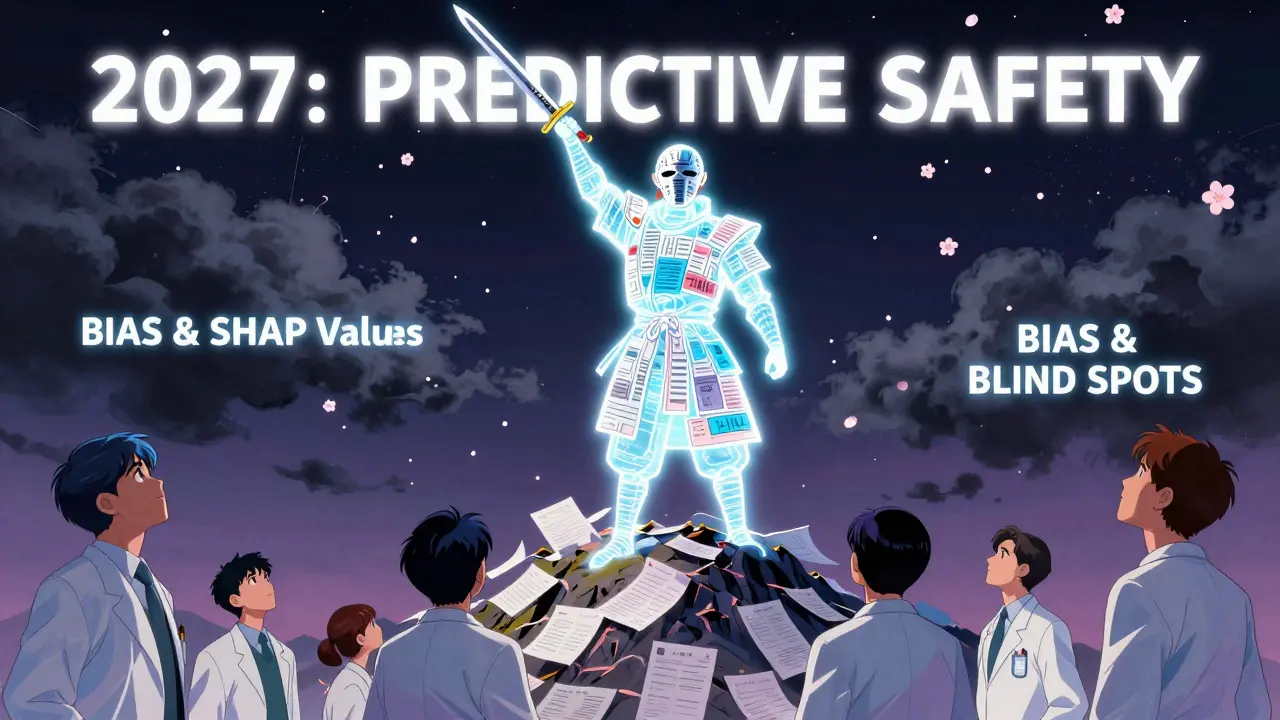
Where It’s Headed Next
The next big leap is multi-modal learning. That means combining text, numbers, images, and even voice data - like a patient’s recorded description of their symptoms - into one unified model. The FDA’s Sentinel System just released Version 3.0, which uses natural language processing to read free-text adverse event reports and decide if they’re valid - no human needed. We’re also seeing more explainable AI tools. New methods like SHAP (SHapley Additive exPlanations) and LIME are being built into models to show which factors contributed most to a signal. That’s helping bridge the gap between machine output and human understanding. By 2027, we’ll likely see AI-driven safety systems that don’t just detect signals - they predict them. If a patient starts taking a new drug and their lab results begin trending a certain way, the system could warn the doctor before any symptoms appear.What This Means for You
If you’re a patient, this means safer drugs. Fewer surprises. Faster updates to warning labels. If you’re a doctor, you’ll get better alerts - not just “this drug causes headaches,” but “this drug causes headaches in patients over 70 with kidney disease.” For the industry, it’s a new standard. Companies that use machine learning won’t just be ahead - they’ll be the only ones trusted. Those clinging to spreadsheets and manual reviews will struggle to keep up. It’s not about replacing humans. It’s about giving them superpowers. The best pharmacovigilance teams now work like this: machine finds the needle. Human checks the haystack. Together, they make better decisions, faster.Frequently Asked Questions
How accurate are machine learning models in detecting adverse drug reactions?
Current models using gradient boosting machines (GBM) achieve accuracy rates around 0.8 - comparable to diagnostic tools for prostate cancer. In real-world testing, they detect 64.1% of adverse events requiring medical intervention, compared to just 13% with traditional statistical methods. Their strength isn’t perfection - it’s consistency across massive, complex datasets where humans would miss patterns.
Can machine learning replace human reviewers in pharmacovigilance?
No, and it shouldn’t. Machine learning excels at finding signals buried in noise, but humans are needed to interpret context, assess clinical relevance, and make final decisions. A model might flag a drug as risky because of a spike in nausea reports - but if those reports all came from patients with the flu, the signal is false. Only a trained professional can spot that. The best systems combine AI speed with human judgment.
What data sources do these machine learning models use?
Modern systems pull from electronic health records, insurance claims, pharmacy databases, patient registries, and even social media platforms where patients discuss side effects. The FDA’s Sentinel System uses data from over 200 million patients across U.S. healthcare systems. Emerging models are adding wearable device data and voice-recorded patient narratives to improve detection accuracy.
Why are regulatory agencies pushing for machine learning in drug safety?
Because traditional methods are too slow and too inaccurate. With millions of prescriptions filled daily, waiting for hundreds of reports to pile up before acting puts patients at risk. Machine learning allows regulators to monitor drug safety in near real time. The FDA and EMA now require companies to demonstrate how they’re using AI to detect risks faster - especially for new drugs and high-risk populations.
Are there risks in using AI for drug safety monitoring?
Yes. The biggest risks are poor data quality, hidden bias in training sets, and lack of transparency. If a model is trained mostly on data from one demographic, it may miss risks in others. Also, if the model can’t explain its reasoning, doctors and regulators can’t trust or act on its findings. That’s why new guidelines require models to be validated, auditable, and continuously monitored - not just deployed and forgotten.
How long does it take to implement a machine learning signal detection system?
For large pharmaceutical companies, full enterprise-wide implementation typically takes 18 to 24 months. This includes data cleanup, model training, integration with safety databases, staff training, and regulatory validation. Smaller organizations often start with pilot projects on one drug class - like cancer therapies - and scale up over 6 to 12 months after proving success.



11 Comments
Okay, I just read this whole thing and I’m honestly blown away-like, I didn’t think AI could actually do this well in pharmacovigilance, but the numbers? 64.1% vs. 13%? That’s not progress-that’s a goddamn revolution! I’ve seen too many patients get hurt because a report got buried in a spreadsheet, and now we’ve got systems that can cross-reference EHRs, claims, wearables, even Twitter? I mean, come on! This isn’t sci-fi anymore-it’s Tuesday. We need to stop treating drug safety like a 1998 fax machine and start treating it like a 2025 neural net. I’m not even mad anymore-I’m just excited. We’re finally catching the bad stuff before it kills someone. That’s worth celebrating.
Let’s be precise here: GBMs and RFs aren’t magic-they’re statistical learners trained on biased, fragmented, and often unstructured data. The FDA’s Sentinel System? Great in theory, but its accuracy plummets when dealing with underrepresented populations-especially elderly non-Caucasian patients with polypharmacy. The 64.1% detection rate? That’s cherry-picked from high-signal cohorts. Real-world performance? More like 42% when you factor in missing labs, inconsistent ICD coding, and EHRs that still use drop-down menus from 2012. And don’t get me started on SHAP values being used as ‘explanations’-they’re post-hoc approximations, not causal mechanisms. We’re building a house on sand and calling it a skyscraper.
honestly tho... i just read this and thought 'wow, so now computers are gonna tell me my headache means i'm gonna die from my blood pressure med?' 😅 i mean, i get it, but also... my grandma took 12 pills a day and never had a problem. maybe the real issue is we're overmedicating and calling every side effect a 'signal'? just saying. also, typo: 'infliximab' was spelled right, but i'm still confused why we're using twitter data. someone posted 'my knee hurts after taking metformin' and now we're changing labels? lol. chill.
Okay, so let me get this straight-you’re telling me that because some algorithm found a correlation between a diabetes drug and a rare liver enzyme spike in patients over 65 with diabetes, we should now assume causation, ignore the fact that 87% of those patients were also on statins, and then panic because a machine said so? And this is supposed to be progress? You know what else was once ‘revolutionary’? The idea that the Earth was flat. We’re outsourcing clinical judgment to black-box models trained on datasets that don’t even include half the world’s population. And now we’re going to let AI decide which patients get flagged for ‘high risk’? What happens when a pregnant woman gets flagged for ‘high risk of fetal toxicity’ because the training data only included white males from Ohio? This isn’t innovation-it’s institutionalized bias wrapped in a Python script.
i think this is really important but also kinda scary? like, i trust my doctor but if the system says 'stop this drug' and they don't know why... that's hard. also, i hope they fix the data gaps. my aunt's records are all over the place. typos everywhere. just... be careful, please?
THIS IS A COVER-UP. THEY'RE USING AI TO HIDE THE REAL DANGERS. WHY? BECAUSE THE PHARMA COMPANIES OWN THE ALGORITHMS. DID YOU KNOW THE FDA'S SENTINEL SYSTEM IS PARTLY FUNDED BY MERCK? THE '64.1%' STAT IS A LIE. THEY'RE FILTERING OUT THE DEADLY SIGNALS TO PROTECT PROFITS. THEY DON'T WANT YOU TO KNOW THAT 3 OF THE TOP 5 DRUGS FLAGGED BY ML WERE RECALLED WITHIN 6 MONTHS AFTER 'SAFE' CERTIFICATION. THE WEARABLES? THEY'RE TRACKING YOUR HEART RATE TO SEE IF YOU'RE HAVING A REACTION-AND THEN SILENTLY PUSHING YOU TO SWITCH TO A MORE PROFITABLE DRUG. THIS ISN'T SAFETY. IT'S CONTROL. THEY'RE USING YOUR DATA TO MANIPULATE YOU. I SAW IT ON A FORUM. THEY'RE CALLING IT 'PHARMACOVIGILANCE 2.0' BUT IT'S REALLY 'CORPORATE SURVEILLANCE 1.0'. THE TRUTH IS HIDING IN THE CODE. AND NOBODY'S LOOKING.
Wow. So we're outsourcing medical decisions to a model that can't even spell 'adverse' correctly in its training data? And you call this progress? I mean, sure, the numbers look sexy on a slide deck, but if your algorithm can't differentiate between 'headache' and 'migraine' because the EHRs are written in 14-year-old's handwriting, then you're just automating ignorance. Congrats, you turned a human error into a scalable one.
i like this idea but in my country we don't have good electronic records. many people don't even have ID numbers. how can machine learn from nothing? maybe start with basic data first? not twitter or wearables. just real medical charts. please.
Oh wow, so now we're using AI to find side effects, but we're still ignoring the fact that most adverse events happen because patients are taking 12 meds at once and no one bothered to check interactions? And you think a model trained on U.S. data will catch what happens when a 70-year-old in rural India takes a new antiviral with turmeric supplements? The model doesn’t know turmeric exists. Or that ‘fatigue’ in some cultures means ‘I’m grieving my husband’ not ‘my liver is failing.’ You’re not detecting signals-you’re detecting privilege. And you’re calling it science. Cute.
Look, I work in pharma safety. I’ve seen the spreadsheets. I’ve seen the 3am panic calls when a new signal pops up and no one knows if it’s real. ML? It’s not perfect-but it’s the first tool in 20 years that doesn’t make me want to quit. Yeah, the data’s messy. Yeah, the explainability sucks. But guess what? The old system made 12x more false negatives. We’re not replacing humans-we’re giving them a flashlight in a cave. And yeah, I’ve had to explain SHAP plots to regulators who think ‘algorithm’ is a type of sushi. It’s a pain. But we’re getting there. Just… give us a minute. We’re not trying to replace you. We’re trying to save you from the next 10,000 silent deaths nobody saw coming.
Wow. Just… wow. You people are so naive. You think this is about safety? Nah. This is about liability. Pharma companies are using ML to create a paper trail that says ‘we did everything right’-even when the model missed the signal because the training data was cleaned to remove outliers. That’s not detection-that’s CYA engineering. And the FDA? They’re not regulating this-they’re rubber-stamping it because they’re understaffed and overworked. You’re not getting safer drugs-you’re getting better lawyers. And when someone dies because the algorithm didn’t flag a drug interaction because the patient’s record said ‘HTN’ instead of ‘hypertension’? Who gets sued? The doctor? The patient? Or the AI that was trained by a grad student who didn’t know what ‘polypharmacy’ meant?