
You know that feeling. You wake up with a stiff back, take one step, and suddenly your mind is racing. "This will never get better." "I'm going to be stuck in bed forever." "What if I can't work?" The physical ache is there, sure, but the mental spiral is what actually knocks you down. If this sounds familiar, you aren't just dealing with pain; you are likely dealing with pain catastrophizing, which is an exaggerated negative mental set brought to bear during actual or anticipated painful experience. It is not just "being negative." It is a specific psychological pattern that amplifies suffering, and it is perhaps the strongest predictor of poor outcomes in chronic pain.
The good news? You can unlearn it. Cognitive Behavioral Therapy (CBT) offers concrete tools to break this cycle. This isn't about positive thinking or ignoring your body's signals. It is about separating the physical sensation from the story your brain tells you about that sensation. When you stop catastrophizing, you often find that the pain itself becomes more manageable, even if it doesn't disappear completely.
Understanding the Three Pillars of Catastrophizing
To fix the problem, we first need to name it. In the 1990s, researchers led by Dr. Mick Sullivan developed the Pain Catastrophizing Scale (PCS), a tool consisting of 13 items rated on a 5-point Likert scale used to measure catastrophic thinking patterns. This scale identified three distinct dimensions that drive the distress:
- Rumination: This is the repetitive focus on pain symptoms. You can't stop thinking about how much it hurts, replaying the sensation over and over in your head like a broken record.
- Magnification: This involves exaggerating the threat value of the pain. A twinge in your knee isn't just discomfort; in your mind, it becomes proof that your leg is collapsing and you'll never walk normally again.
- Helplessness: This is the feeling that you have no control and cannot cope. You believe the pain is entirely outside your influence, leading to a sense of defeat before you even try to move.
When these three elements combine, they create a feedback loop. Rumination keeps the pain in your spotlight, magnification turns it into a monster, and helplessness removes your ability to fight back. Neuroimaging studies show that these thoughts actually increase activity in brain regions responsible for processing pain, such as the dorsolateral prefrontal cortex. In short, your fear of the pain makes the pain signal louder.
Why CBT Works Where Other Methods Fail
You might wonder why talking helps when pills don't. The answer lies in specificity. A systematic review published by the International Association for the Study of Pain (IASP) in 2023 found that while many treatments offer modest relief, CBT is the standout intervention specifically for reducing catastrophizing. In targeted studies, CBT showed an effect size of SMD = -0.84 compared to active controls, significantly higher than other approaches.
Acceptance and Commitment Therapy (ACT) is another popular option, but research suggests it has smaller effect sizes for catastrophizing specifically. Multimodal treatments-combining CBT with exercise-showed the strongest overall effects (SMD = -1.0), but CBT remains the engine that drives the change in mindset. Without addressing the cognitive distortion, physical therapies often fail because patients avoid movement due to fear.
Dr. Laura Payne from Harvard Medical School notes that CBT works by helping patients recognize how their catastrophic thoughts amplify the experience. It’s not magic; it’s mechanics. By unraveling the link between the somatic (physical) and cognitive (mental) aspects of pain, you reduce the volume of the distress signal.
| Intervention Type | Effect Size (SMD) | Primary Mechanism | Best For |
|---|---|---|---|
| Cognitive Behavioral Therapy (CBT) | -0.84 (Targeted) | Cognitive restructuring & behavioral activation | Reducing rumination and magnification |
| CBT + Exercise | -1.00 | Combined cognitive and physical conditioning | Overall functional improvement |
| Acceptance and Commitment Therapy (ACT) | Moderate (Lower than CBT) | Values-based action despite pain | Pain acceptance rather than reduction |
| Pharmacological Only | Low/Modest | Chemical modulation of pain signals | Acute flare-ups, not long-term coping |
Practical CBT Tools You Can Use Today
You don’t need to wait for a therapist to start shifting your mindset. Here are three core CBT techniques adapted for self-help, based on protocols used in VA healthcare systems and clinical trials.
1. Self-Monitoring and Labeling
The first step is awareness. Most people are so caught up in the pain that they don't notice the thinking happening around it. Start keeping a simple log. When you feel a surge of distress, pause and label what is happening. Is it somatic (the actual ache)? Or is it cognitive (the thought "this is terrible")?
A study in Nature Scientific Reports (2024) highlighted that effective interventions involve repeatedly categorizing pain experiences into these two aspects. Try this: Write down "Pain Level: 6/10" and then "Thought: My back is breaking." Seeing them side-by-side helps you see that the thought is separate from the sensation.
2. Cognitive Restructuring
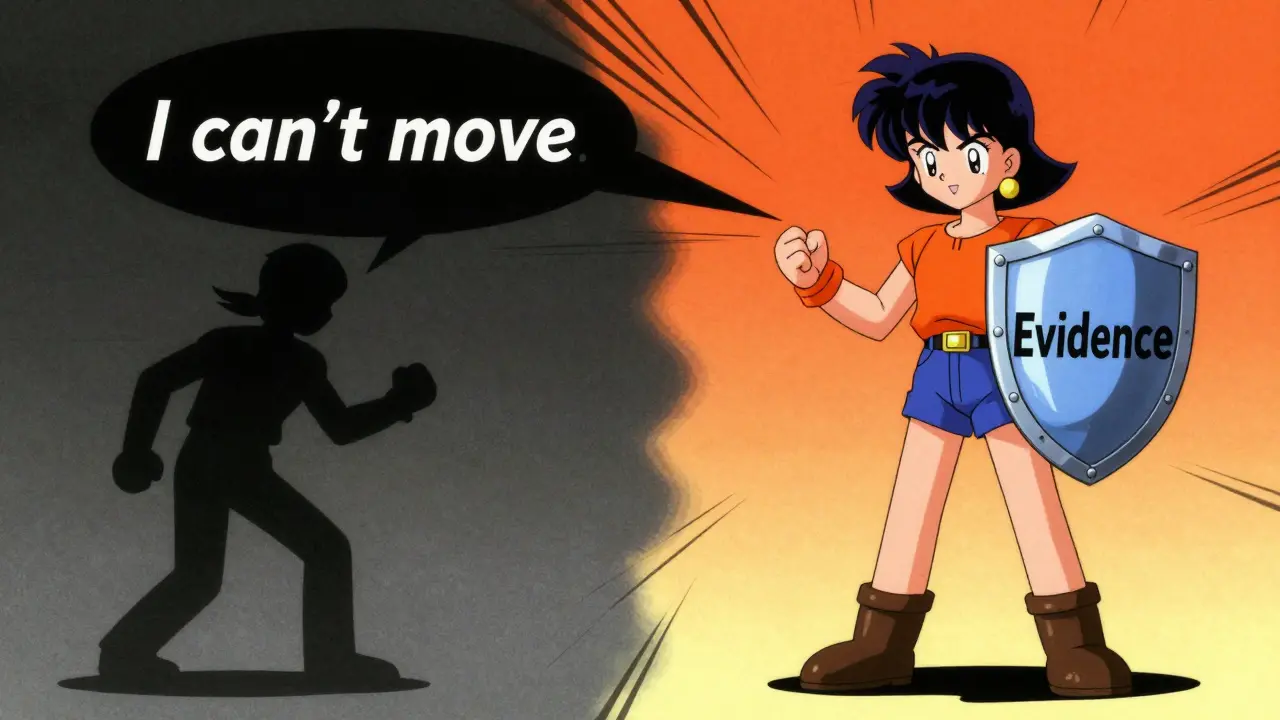
This is the process of challenging negative thoughts. Take a catastrophic thought, like "If I walk now, I’ll ruin my day," and put it on trial. Ask yourself:
- What is the evidence for this? Have I ruined my day every time I walked?
- What is the evidence against it? Did I recover after walking yesterday?
- What is a more balanced statement? "Walking might hurt for an hour, but I usually feel better afterward and get things done."
This isn't about lying to yourself. It's about accuracy. Catastrophizing is inaccurate because it assumes the worst-case scenario is the only possible outcome.
3. Behavioral Activation
Catastrophizing leads to avoidance. You stay in bed because moving hurts, but staying in bed deconditions your muscles, making movement hurt more later. This creates a vicious cycle. Behavioral activation means scheduling small, manageable activities regardless of pain levels. Start tiny. If you can't do housework, commit to washing one dish. Then two. The goal is to prove to your brain that you can cope, breaking the sense of helplessness.

The Reality Check: Challenges and Expectations
Let’s be honest: this work is hard. User data from chronic pain forums indicates that about 35% of people struggle with the "cognitive load" required during high-pain episodes. When your pain is at an 8 out of 10, finding the mental energy to restructure thoughts feels impossible. One user noted, "When my pain is at 8/10, I simply don't have the mental energy to implement CBT techniques."
This is a common pitfall. Don't expect mastery in week one. Research suggests it takes 3-4 weeks just to reliably identify catastrophic patterns, and 6-8 weeks to master restructuring. Dropout rates in clinical studies average around 22%, often because patients quit when they don't see immediate results. Remember, CBT is a skill, like learning a language. You won't be fluent after one lesson.
Also, education level plays a role. Studies show success rates are 37% higher among patients with some college education, likely due to familiarity with abstract reasoning. If you find the concepts difficult, look for digital CBT platforms or guided apps, which have seen a 200% increase in usage since 2020. Apps like Curable provide structured, bite-sized exercises that lower the barrier to entry.
Next Steps for Implementation
If you suspect you are catastrophizing, start by taking the Pain Catastrophizing Scale online. A score of 30 or higher indicates clinically significant catastrophizing. Use this as your baseline. Re-take it every four weeks to track progress. Case studies show patients can drop scores from 42 to 18 in just 12 weeks, often resulting in a 50% reduction in perceived pain intensity.
Consider combining these mental tools with gentle physical activity. The synergy between CBT and movement is powerful. And if you are struggling alone, seek a therapist specializing in pain psychology. The Veterans Health Administration reports 92% satisfaction with CBT for pain catastrophizing, proving that professional guidance accelerates the process.
Your pain is real. But your interpretation of it is malleable. By changing the narrative, you change the experience.
How long does it take for CBT to reduce pain catastrophizing?
Most patients begin to identify catastrophic thought patterns within 3 to 4 weeks. Significant reduction in distress and measurable changes in PCS scores typically occur after 8 to 12 weeks of consistent practice. Mastery of cognitive restructuring techniques usually takes 6 to 8 weeks.
What is a high score on the Pain Catastrophizing Scale?
The Pain Catastrophizing Scale (PCS) ranges from 0 to 52. A score of 30 or higher is considered clinically significant and indicates a high tendency toward pain catastrophizing. Scores above 40 suggest severe catastrophizing that strongly impacts daily functioning.
Can CBT cure chronic pain?
CBT does not necessarily eliminate the physical sensation of pain, but it significantly reduces the distress and disability associated with it. By lowering catastrophizing, patients often report a 30-50% reduction in pain intensity and improved ability to function in daily life.
Is pain catastrophizing the same as depression?
No, though they are closely linked. Depression is a mood disorder affecting overall well-being, while pain catastrophizing is a specific cognitive response to pain stimuli. However, catastrophizing can lead to depression, and treating underlying mood disorders may also help reduce catastrophic thinking.
Are there apps that help with pain catastrophizing?
Yes, digital CBT platforms like Curable and PainScale offer structured programs targeting pain catastrophizing. These apps use evidence-based techniques such as cognitive restructuring and graded exposure, making therapy accessible without weekly in-person sessions.



Write a comment