
Imagine waking up exhausted even after eight hours of sleep, your blood sugar spiking unpredictably, and your heart working overtime just to keep you going. For millions of people living with obesity, this isn't a hypothetical scenario-it's daily reality. Obesity is more than a number on the scale; it acts as a central driver for a cluster of serious health conditions known as the "obesity comorbidity triad." This trio includes Type 2 Diabetes, a chronic condition where the body becomes resistant to insulin or fails to produce enough of it, Cardiovascular Disease, a group of disorders affecting the heart and blood vessels, including heart attacks and strokes, and Obstructive Sleep Apnea, a sleep disorder where breathing repeatedly stops and starts during sleep. These conditions don't exist in isolation; they feed into one another, creating a cycle that significantly increases health risks if left unmanaged.
The Connection Between Weight and Health Risks
To understand why these three conditions often appear together, we have to look at how excess body fat affects the body. Obesity is clinically defined as having a Body Mass Index (BMI) of 30 kg/m² or higher. According to the Centers for Disease Control and Prevention, about 42.4% of adults in the United States fall into this category. But BMI is just a starting point. The real issue lies in how adipose tissue (body fat) functions. When you carry excess weight, particularly around the abdomen, your fat cells release inflammatory markers like C-reactive protein and interleukin-6. In obese individuals, levels of these markers can be 30-50% higher than in those with a healthy weight. This chronic, low-grade inflammation sets the stage for metabolic dysfunction, making it easier for diabetes and heart problems to take hold.
There is also a structural component. Extra fat deposits in the neck and throat can physically narrow the airway. Studies show that in obese individuals, upper airway diameter can be reduced by 20-30% compared to normal-weight counterparts. This narrowing makes it difficult to breathe freely during sleep, leading to Obstructive Sleep Apnea. So, the link isn't just chemical; it's mechanical. Your body is literally struggling to process fuel (glucose), pump blood efficiently, and get enough oxygen while you rest.
How the Triad Feeds Itself
Here is where it gets tricky: these conditions amplify each other. Think of it as a vicious cycle. Let's break down the flow:
- Obesity leads to Sleep Apnea: Each 1-unit increase in BMI is associated with a 14% higher risk of developing OSA. The extra soft tissue in the throat collapses when muscles relax during sleep, blocking airflow.
- Sleep Apnea worsens Diabetes: When you stop breathing repeatedly, your oxygen levels drop. This intermittent hypoxemia triggers stress responses that make your cells less sensitive to insulin. Research from the Sleep Heart Health Study found that severe OSA independently increases Type 2 Diabetes risk by 60%, even after adjusting for BMI.
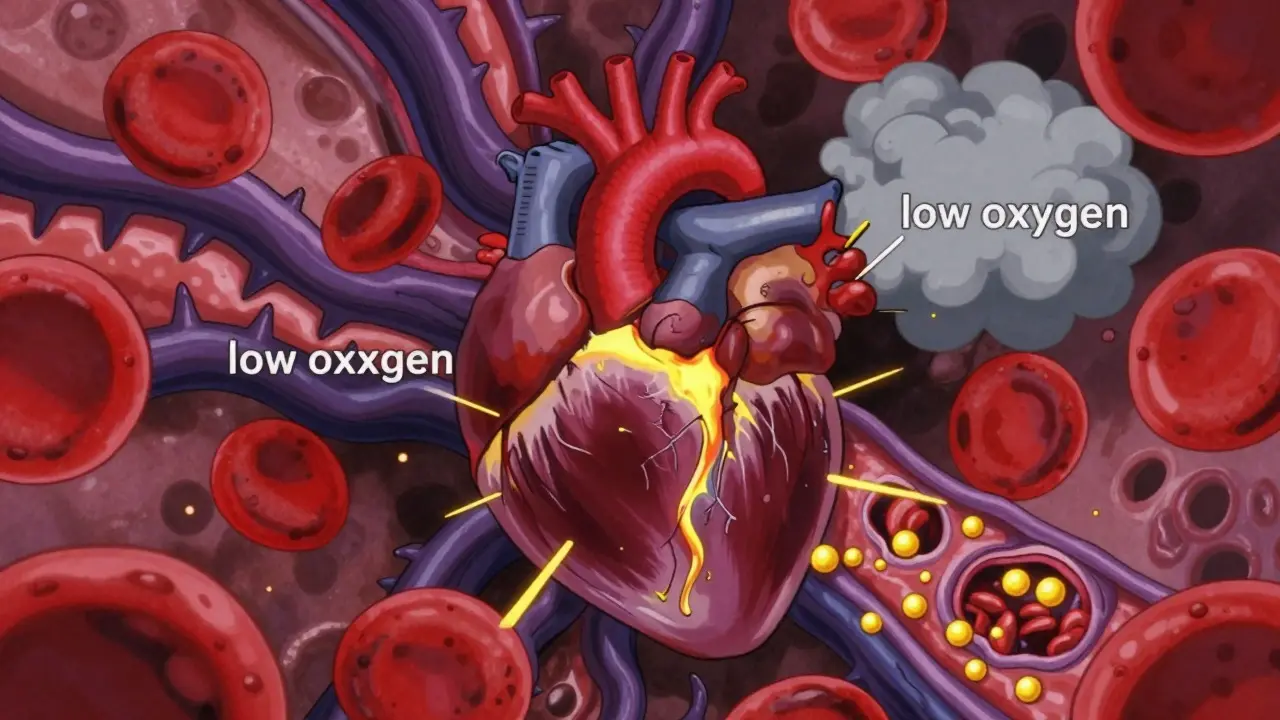
- Both strain the Heart: Low oxygen forces the heart to work harder. Meanwhile, high blood sugar damages blood vessels over time. Together, they accelerate atherosclerosis (hardening of the arteries). Individuals with all three conditions face a 3.2-fold higher risk of myocardial infarction (heart attack) compared to non-obese individuals without these comorbidities.
It’s not a straight line; it’s a web. If you treat only the diabetes but ignore the sleep apnea, your blood sugar control will remain stubbornly difficult. If you fix the sleep but don't address the weight, the underlying inflammation persists. This is why doctors now emphasize treating the whole picture, not just one symptom.
Diagnosing the Hidden Link
One of the biggest challenges is that these conditions are often diagnosed separately, sometimes years apart. Many patients see an endocrinologist for diabetes, a cardiologist for blood pressure, and finally a sleep specialist after complaining of fatigue. But because the symptoms overlap-fatigue, brain fog, irritability-they are easily missed. The American Diabetes Association recommends screening for OSA in all patients with Type 2 Diabetes, especially those with a BMI over 30. Why? Because 60-80% of diabetic patients have undiagnosed sleep apnea. A simple tool called the STOP-Bang questionnaire can help identify who needs a full sleep study (polysomnography). If you score 3 or higher, it’s a strong signal to get tested. Early detection changes everything. You can’t manage what you don’t measure, and sleep quality is a vital metric that often gets overlooked in standard check-ups.
Management Strategies That Work
So, how do you break the cycle? There is no single pill that fixes all three, but there are highly effective strategies that tackle them simultaneously. The goal is to reduce the burden on your body so it can heal itself.
- Weight Loss Interventions: Losing just 10-15% of your body weight can dramatically improve all three conditions. It reduces airway obstruction, improves insulin sensitivity, and lowers blood pressure. Intensive lifestyle programs combining diet (1,200-1,800 kcal/day) and exercise (175 minutes/week) have shown significant success. For some, bariatric surgery is an option, with studies showing 78% remission rates for OSA after gastric bypass.
- CPAP Therapy: For diagnosed OSA, Continuous Positive Airway Pressure (CPAP) is the gold standard. Using it for 4-6 hours a night can reduce cardiovascular events by 28%. While wearing a mask can feel awkward at first, modern devices are quieter and lighter. Consistency is key here.
- Medication Management: Newer medications like GLP-1 receptor agonists (e.g., semaglutide) offer a dual benefit. They promote weight loss and have been shown to directly improve OSA severity by reducing upper airway fat deposits, independent of the weight lost. This makes them a powerful tool in managing the triad.
Coordinated care is essential. Working with a team that includes an endocrinologist, a sleep specialist, and a cardiologist ensures that treatments don't conflict and that progress is tracked holistically. Electronic health records now allow these specialists to share data on HbA1c, blood pressure, and sleep metrics, creating a unified view of your health.
| Condition | Primary Risk Factor from Obesity | Key Diagnostic Metric | First-Line Treatment |
|---|---|---|---|
| Type 2 Diabetes | Insulin resistance due to inflammation | HbA1c > 6.5% | Lifestyle changes + Metformin/GLP-1s |
| Obstructive Sleep Apnea | Airway narrowing from fat deposits | Apnea-Hypopnea Index (AHI) ≥ 5 | CPAP Therapy |
| Cardiovascular Disease | Atherosclerosis + Hypertension | Blood Pressure / Cholesterol Levels | Statins / Antihypertensives + Lifestyle |

The Cost of Ignoring the Triad
Ignoring these connections has a price tag, both financially and personally. Obese patients with both Type 2 Diabetes and OSA incur $12,300 more in annual healthcare costs than those with obesity alone. Most of this cost comes from emergency visits and hospitalizations related to heart complications. Beyond the money, there is the impact on daily life. Excessive daytime sleepiness from untreated OSA leads to poor work performance and increased accident risk. One survey found that 42% of affected individuals reported near-miss traffic accidents due to drowsiness. Treating the triad isn't just about longevity; it's about reclaiming your energy and focus.
Future Directions and Hope
The landscape is changing rapidly. New technologies are making it easier to monitor these conditions at home. Smartphone-based sleep tracking combined with continuous glucose monitors can now predict OSA severity with 85% accuracy. This means you might catch issues before they become critical. Furthermore, the FDA has approved new devices like hypoglossal nerve stimulators for those who can't tolerate CPAP. As research continues, personalized treatment algorithms are emerging, recognizing that not everyone responds to the same protocol. The message is clear: early intervention, coordinated care, and a holistic approach to weight management can break the cycle of these comorbidities. You don't have to fight these battles alone, and you don't have to accept fatigue as your new normal.
Does losing weight cure sleep apnea?
Losing weight doesn't always "cure" OSA, but it significantly reduces its severity. Losing 10-15% of body weight can lower the Apnea-Hypopnea Index (AHI) by about 50%. For many, it may eliminate the need for CPAP, but regular monitoring is still recommended to ensure it stays under control.
Can I have sleep apnea if I'm not very overweight?
Yes. While obesity is the strongest risk factor, 25-30% of OSA cases occur in non-obese individuals. Factors like jaw structure, nasal congestion, or genetic predisposition can contribute. If you snore loudly or wake up gasping, get screened regardless of your weight.
Which should I treat first: diabetes or sleep apnea?
Ideally, both simultaneously. However, if forced to choose, addressing sleep apnea often yields quicker improvements in energy and blood sugar stability. Poor sleep makes insulin resistance worse, so improving sleep quality can make diabetes management easier. Consult your doctor to create a prioritized plan based on your specific severity levels.
Are GLP-1 medications good for heart health too?
Yes. Drugs like semaglutide have shown benefits beyond weight loss and blood sugar control. Recent trials indicate they can reduce major adverse cardiac events in patients with heart disease. They help reduce inflammation and improve lipid profiles, making them a valuable part of comprehensive care for the obesity comorbidity triad.
How long does it take to see results from CPAP therapy?
Many users report feeling more alert within the first week or two of consistent use. However, measurable improvements in blood pressure and cardiovascular risk factors typically take 3 to 6 months. Consistency is crucial; using the device for at least 4 hours a night, 70% of nights, is considered therapeutic adherence.




Write a comment