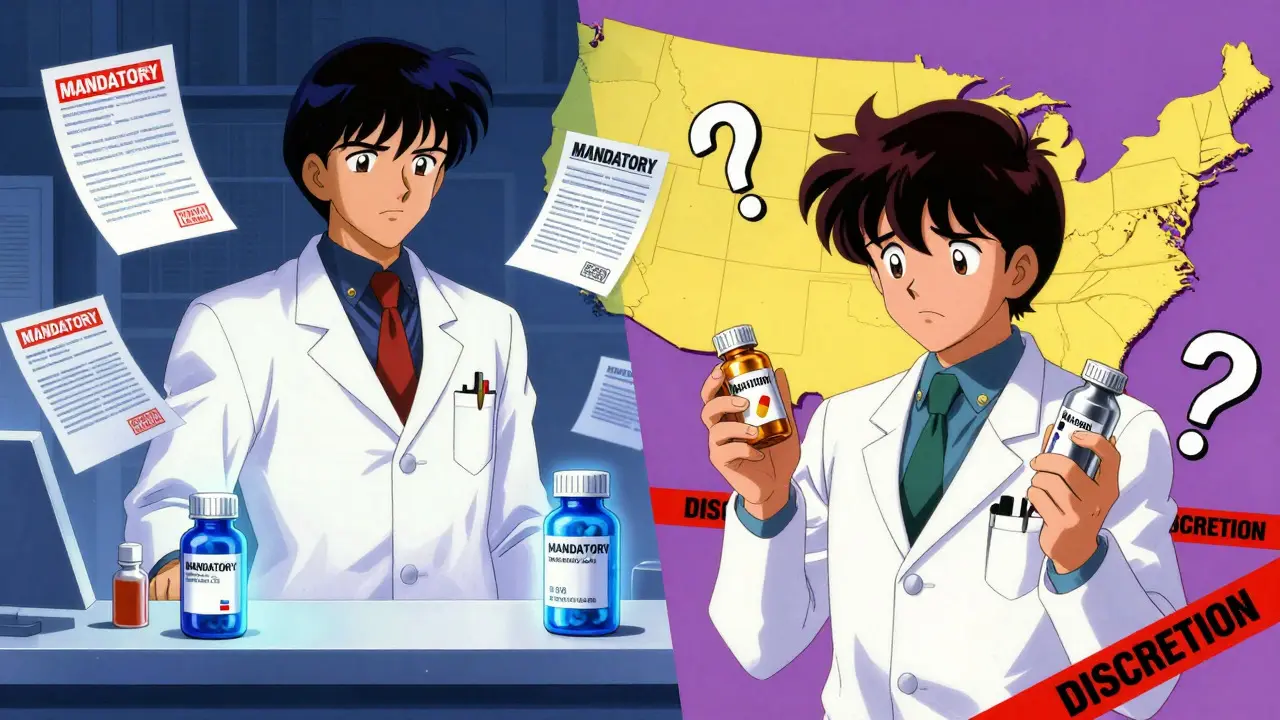
Have you ever filled a prescription and walked out with a different drug than the one your doctor wrote? You aren't alone. In fact, this happens millions of times a day across the United States. But here is the twist: whether that switch happens depends entirely on where you live. The rules governing when pharmacists can or must swap brand-name drugs for generic versions vary wildly from state to state. This isn't just a minor bureaucratic detail; it directly impacts what you pay at the pharmacy counter and which medication ends up in your pocket.
The core of this issue lies in the distinction between mandatory substitution and permissive substitution. These two legal frameworks dictate the default behavior of pharmacists when a generic equivalent exists. Understanding these differences is crucial for patients, prescribers, and healthcare providers navigating the complex landscape of pharmaceutical regulation.
How State Laws Define Generic Substitution
To understand why your state's laws matter, we first need to look at how the system was built. The modern framework for generic drugs stems from the Hatch-Waxman Act of 1984, which created the pathway for generic approval through the FDA but left the actual substitution rules to individual states. This decision resulted in a fragmented regulatory map that remains today.
In states with mandatory substitution laws, pharmacists are legally required to dispense a generic equivalent if one is available and therapeutically appropriate. It is not optional. If a patient walks in with a valid prescription for a brand-name drug and a generic exists, the pharmacist must offer the generic unless specific exceptions apply. As of recent analyses, 19 states operate under this strict mandate. These include Alabama, Alaska, Arizona, Arkansas, Colorado, Connecticut, Delaware, Idaho, Indiana, Kentucky, Louisiana, Maine, Maryland, Massachusetts, Mississippi, Montana, New Hampshire, North Dakota, and West Virginia.
Conversely, in states with permissive substitution laws, pharmacists are authorized-but not required-to make the switch. They exercise professional discretion. If they decide the generic is suitable, they may substitute it, but they are not compelled by law to do so. This approach gives pharmacists more flexibility but often results in lower rates of generic utilization compared to mandatory states.
The Four Pillars of Substitution Regulation
It’s not just about whether substitution is mandatory or permissive. A comprehensive analysis published in JAMA Internal Medicine identified four critical dimensions that define how restrictive or lenient a state’s environment is:
- Duty to Substitute: Is it mandatory (required) or permissive (allowed)?
- Notification Requirements: Must the pharmacist notify the patient independently of the drug packaging? Thirty-one states plus Washington, D.C., require this explicit notification.
- Consent Protocols: Does the patient need to give explicit consent before the switch? Seven states plus D.C. have this hurdle.
- Liability Protections: Are pharmacists protected from increased liability risks when substituting? Surprisingly, 24 states do not explicitly provide this protection, leaving practitioners exposed if an adverse event occurs post-substitution.
These elements combine to create a "substitution score." States with higher scores impose more barriers to generic use. For example, nine states and D.C. had scores of 3 or higher, indicating highly restrictive environments that hinder the automatic flow of generics.
Real-World Impact: The Cost of Consent
You might think the difference between mandatory and permissive is academic, but the data tells a starkly different story. Consider simvastatin, a common cholesterol medication. A study by Shrank et al. examined Medicaid data between 2006 and 2007 and found dramatic disparities based on state laws.
In states with mandatory substitution, 48.7% of prescriptions were filled with the generic version within six months of patent expiration. In permissive states, that number dropped to just 30.0%. That is an 18.7 percentage point gap driven solely by regulatory structure.
The impact becomes even more pronounced when patient consent requirements enter the picture. States that did not require patient consent achieved a 98.1% generic utilization rate for simvastatin. In contrast, states requiring explicit consent saw less than one-third (32.1%) of prescriptions filled with generics. Why? Because asking for consent introduces friction. Patients may decline due to fear, misunderstanding, or simple inertia, keeping them on expensive brand-name drugs unnecessarily.
| Factor | Mandatory Substitution States | Permissive Substitution States |
|---|---|---|
| Generic Utilization Rate (Simvastatin) | 48.7% | 30.0% |
| Patient Consent Requirement | Rarely Required | Frequently Required |
| Pharmacist Liability Protection | Varies by State | Varies by State |
| Impact on Healthcare Costs | Significant Reduction | Minimal Reduction |
Biosimilars: A More Complex Landscape
While small-molecule drugs (like aspirin or ibuprofen) have well-established substitution pathways, biologic medications present a new challenge. Biologics are complex proteins produced in living cells, making them harder to replicate exactly. Their generic equivalents are called biosimilars.
States have adopted a much more cautious approach here. According to the JAMA analysis, 45 states have stricter requirements for interchangeable biologic substitution than for traditional drugs. The most common additional barrier is mandatory physician notification. Only nine states and D.C. treat biologics with the same ease as small-molecule drugs.
This disparity reflects genuine medical concerns. Switching between biologic products can carry risks related to immunogenicity-the body’s immune response to the drug. Consequently, states often require explicit authorization, detailed recordkeeping, and direct communication between the pharmacist and the prescribing physician before a biosimilar can be substituted. This extra layer of scrutiny ensures safety but also slows down adoption and keeps costs higher for high-priced specialty medications.
Practical Challenges for Pharmacists and Prescribers
For the professionals on the front lines, these laws create daily operational hurdles. In mandatory states without consent requirements, pharmacists must actively identify substitution opportunities and execute the switch efficiently. In permissive states, they must weigh clinical judgment against potential pushback from patients or insurers.
Prescribers also play a pivotal role. Most states allow doctors to block substitution by writing "Dispense as Written" (DAW), "Brand Medically Necessary," or similar phrases on the prescription. However, some states require justification for these restrictions, adding another step to the process. Additionally, prescription formats vary. Some states mandate two-line pads where the physician signs specifically to approve substitution, while others rely on verbal or written directives.
Liability remains a shadow over these decisions. With 24 states lacking explicit liability protections, pharmacists may hesitate to substitute even when clinically appropriate, fearing legal repercussions if a patient experiences an adverse outcome. This defensive practice can inadvertently keep patients on costlier brand-name drugs.

Why This Matters for Your Wallet
Let’s talk money. Generic drugs typically cost 80-85% less than their brand-name counterparts. The Congressional Budget Office estimated that increasing generic drug use by just one percentage point would save Medicare Part D $160 million annually. When you scale that up, the financial implications of state substitution laws are massive.
In permissive states with strong consent requirements, brand manufacturers can maintain market share longer after patent expiration by marketing directly to patients and leveraging hesitation around switching. In mandatory states, the default path leads to savings. For individuals paying out-of-pocket or relying on insurance with high deductibles, living in a mandatory substitution state can mean thousands of dollars saved over a year for chronic conditions.
Looking Ahead: Evolution of Substitution Laws
The regulatory landscape is not static. The trend has shifted toward more aggressive generic promotion. The number of states with mandatory substitution laws increased from 14 in 2014 to 19 by 2020. However, the rise of biosimilars and complex combination products is introducing nuance. Policymakers are trying to balance cost containment with patient safety, especially for high-cost specialty drugs where the risk-benefit calculus differs significantly from traditional medications.
As biologics account for an increasing share of pharmaceutical expenditures-representing 42% of net drug costs in Medicare Part D in 2020 despite being only 2% of prescriptions-the stringent substitution requirements in 45 states will become increasingly significant. Expect continued refinement of these laws to optimize both affordability and clinical outcomes.
What is the main difference between mandatory and permissive substitution?
Mandatory substitution requires pharmacists to dispense a generic equivalent if one is available, unless specific exceptions apply. Permissive substitution allows pharmacists to make the switch at their discretion but does not require them to do so.
Which states have mandatory generic substitution laws?
As of recent data, 19 states have mandatory substitution laws, including Alabama, Alaska, Arizona, Arkansas, Colorado, Connecticut, Delaware, Idaho, Indiana, Kentucky, Louisiana, Maine, Maryland, Massachusetts, Mississippi, Montana, New Hampshire, North Dakota, and West Virginia.
Do I need to consent to generic substitution?
It depends on your state. Seven states plus Washington, D.C., require explicit patient consent for generic substitution. In other states, notification may be required, but active consent is not always necessary.
How do biosimilar substitution laws differ from generic drug laws?
Biosimilar substitution is generally more restricted. Forty-five states have stricter requirements for biosimilars than for small-molecule generics, often requiring mandatory physician notification and explicit authorization due to the complexity and cost of biologic medications.
Can my doctor prevent generic substitution?
Yes. In all states, prescribers can restrict substitution by writing "Dispense as Written" (DAW), "Brand Medically Necessary," or similar phrases on the prescription. Some states may require justification for this restriction.
Are pharmacists liable if a generic substitution causes an issue?
Liability protections vary by state. Twenty-four states do not explicitly protect pharmacists from greater liability when substituting generics, which can influence their willingness to make the switch.



Write a comment