Why the WHO Model List Matters for Your Medicine Cabinet
You might not see the World Health Organization (WHO) on your pharmacy receipt, but its decisions shape what drugs are available to you. The WHO Model List of Essential Medicines (EML) is a comprehensive guide developed by the World Health Organization that identifies medicines satisfying priority health care needs of populations globally. It acts as the global benchmark for which medicines-especially affordable generics-should be accessible in any functioning health system.
First established in 1977, this list isn't just a suggestion; it's a rigorous standard used by over 150 countries to build their own national medicine policies. If you've ever wondered why certain generic antibiotics or heart medications are widely available while newer, pricier alternatives are harder to find, the answer often lies in this document. As of the 23rd edition published in July 2023, the list includes 591 medicines covering 369 disease indications. Crucially, nearly half of these are generics, reflecting a core mission: ensuring quality and affordability without compromising safety.
The Core vs. Complementary Split: Understanding the Structure
The EML isn't a single flat list. It is divided into two distinct sections, each serving a different role in healthcare delivery. Understanding this split helps explain why some drugs are found in every village clinic while others require a specialist hospital.
- The Core List: These are the minimum medicine needs for a basic healthcare system. They include the most efficacious, safe, and cost-effective options for priority conditions. Think of common treatments for hypertension, diabetes, or childhood infections. These must be available at all times, in appropriate dosage forms, and at prices individuals can afford.
- The Complementary List: This section includes medicines that address priority health conditions but require specialized diagnostic or monitoring facilities, specialist medical care, or specialist training. Examples might include complex cancer therapies or advanced antiviral regimens. While essential, they are not expected to be available in primary care settings everywhere due to higher costs or complexity.
This structure ensures that resources are allocated efficiently. A rural clinic doesn't need to stock expensive oncology drugs if they don't have the infrastructure to administer them safely. Instead, they focus on the Core List, ensuring high-impact, low-cost interventions reach the most people.
How Generics Get the Green Light: Rigorous Selection Criteria
A common misconception is that "generic" means "cheap and low quality." The WHO Model List fights this narrative with strict evidence-based selection criteria. For a medicine to make the cut, it must pass a multi-step evaluation by the WHO Expert Committee on Selection and Use of Essential Medicines.
In March 2023, during the committee's 23rd meeting, 25 independent experts from 18 countries reviewed 217 applications. They didn't just look at price. They used a standardized scoring system across four domains:
- Public Health Relevance (30% weight): Does the drug address a significant burden of disease? The threshold is typically a minimum prevalence of 100 cases per 100,000 population.
- Efficacy and Safety (30% weight): Is there robust proof it works? The WHO requires evidence level 1a or 1b, meaning data from randomized controlled trials.
- Comparative Cost-Effectiveness (25% weight): Is it good value? The drug usually needs a cost per quality-adjusted life year (QALY) below three times the GDP per capita of the target country.
- Programmatic Feasibility (15% weight): Can it actually be delivered? This includes storage requirements, ease of administration, and supply chain stability.
To be included, a medicine must score at least 7 out of 10 in each domain and 7.5 out of 10 overall. This rigorous process ensures that when a generic makes the list, it’s not just cheap-it’s proven.

Quality Assurance: The Prequalification Standard
One of the biggest challenges with generic medicines globally is variability in quality. To combat this, the WHO Model List mandates stringent quality assurance. As of the 2023 update, 92% of generic medicines on the list require WHO Prequalification or approval from an equivalent stringent regulatory authority like the FDA (USA), EMA (Europe), or PMDA (Japan).
What does prequalification mean for you? It means the generic has undergone a thorough assessment of its manufacturing processes, quality control, and clinical performance. Specifically, generics must demonstrate bioequivalence to the reference product. This involves studies showing that the confidence intervals for Area Under the Curve (AUC) and Maximum Concentration (Cmax) ratios fall within 80-125%. For narrow therapeutic index drugs-where small changes in dose can cause serious side effects-the limits are even tighter, at 90-111%.
This standardization is critical. In 2022, WHO surveillance identified substandard or falsified medicines in 10.5% of essential medicine samples in low- and middle-income countries. By tying the Model List to prequalification, the WHO pushes markets toward higher quality benchmarks, reducing the risk of patients receiving ineffective or harmful pills.
| Feature | WHO Model List | US Commercial/Medicare Formularies |
|---|---|---|
| Primary Goal | Global public health impact & equity | Cost containment & managed care |
| Selection Basis | Evidence-based efficacy, safety, cost-effectiveness | Negotiated pricing, tiered cost-sharing |
| Generic Focus | High (46% of list); emphasizes prequalification | Variable; often driven by rebate agreements |
| Implementation | Guides national policy (NEMLs) | Directly dictates patient copays & coverage |
| Update Frequency | Biennial (every 2 years) | Annual (often more frequent changes) |
Real-World Impact: From Ghana to Nigeria
The theory looks good, but how does it work in practice? The impact varies significantly depending on local implementation capacity.
In Ghana, the National Health Insurance Authority adopted WHO Model List principles between 2018 and 2022. The result was a 29% reduction in out-of-pocket medicine expenditures for citizens. Pharmacists reported improved availability of quality-assured generics for chronic conditions like hypertension and diabetes. Here, the list acted as a shield against unnecessary spending, directing funds toward proven, effective treatments.
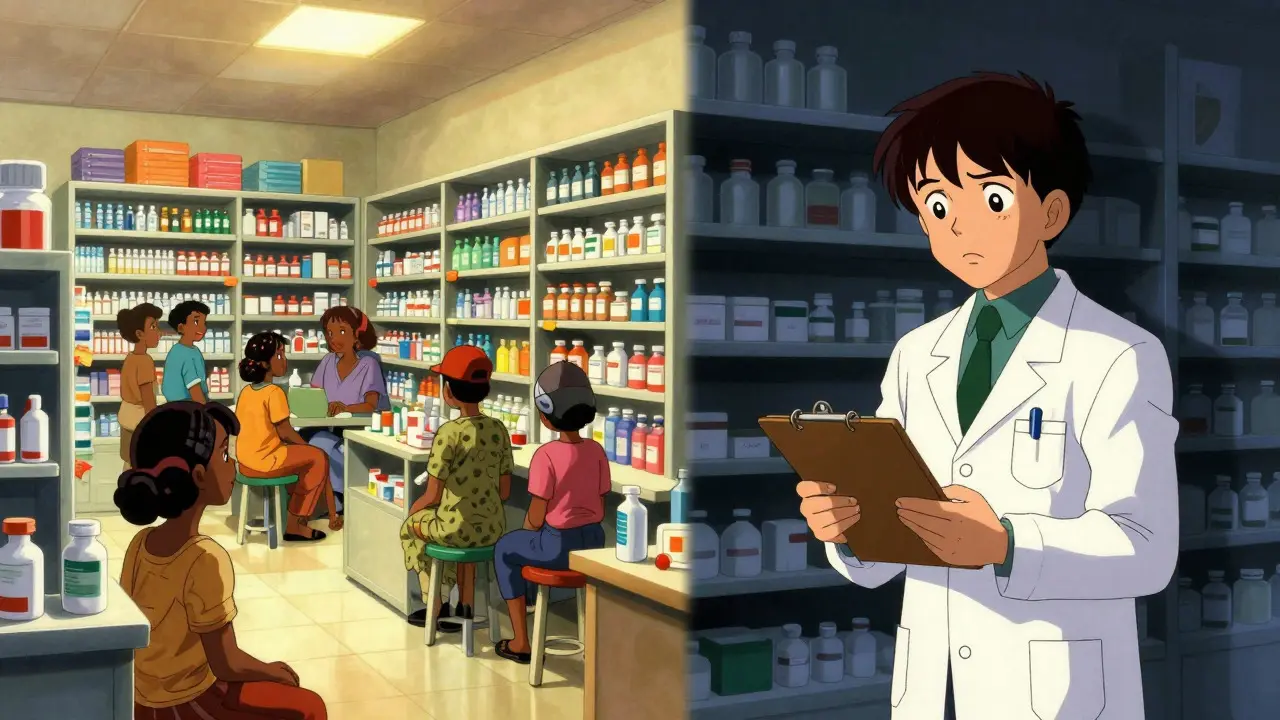
Contrast this with Nigeria, where a 2022 survey of 1,250 healthcare facilities revealed a stark reality: only 41% of essential medicines on the national list were consistently available. Stockouts averaged 58 days per medicine annually. Importantly, the issue wasn't the list itself-it was the supply chain. The WHO Model List correctly identified what *should* be available, but local logistics failed to deliver it. This highlights a key limitation: the list is a technical reference, not a logistical solution.
In India, where the National List of Essential Medicines aligns closely with the WHO model, hospitals have seen a 35% cost reduction in antimicrobial expenditures after implementing tiered antibiotic formularies. However, Indian pharmacists still report challenges with substandard generics entering the supply chain despite prequalification requirements, showing that vigilance is constant.
Criticisms and Challenges: Industry Influence and Access Gaps
No global standard is perfect. The WHO Model List faces valid criticisms that affect its credibility and utility.
One major concern is industry influence. Dr. Joel Lexchin, a professor at York University, noted in the Journal of Medical Ethics (2023) that the WHO's reliance on industry-funded clinical trials has increased from 28% in 2015 to 45% in 2023. While the WHO has implemented stricter conflict-of-interest policies-with 100% compliance reported for the 2023 review cycle-the perception of bias remains a hurdle. Advocacy pressure can also sway decisions; for instance, the inclusion of tranexamic acid for postpartum hemorrhage faced scrutiny due to weaker comparative evidence than other candidates.
Another gap is the slow adoption of novel therapeutics. Only 12% of new medicines approved between 2018 and 2022 made it onto the 2023 list. Compare this to high-income country formularies, which include 35-45% of new approvals. For patients with rare diseases or those needing cutting-edge cancer treatments, the WHO list can feel outdated. It prioritizes breadth and equity over innovation, which is a deliberate trade-off but one that frustrates some specialists.
Finally, implementation guidance for resource-constrained settings is lacking. A 2022 WHO survey found that 68% of low-income countries struggle to adapt the Model List locally due to insufficient technical capacity. Healthcare workers rated the list's usefulness at 4.2/5 for selection but only 2.8/5 for addressing practical challenges like pediatric dosing or supply chain disruptions.
The Future: Biosimilars, Digital Tools, and UHC
The WHO Model List is evolving. The 2023 update introduced specific criteria for biosimilars, including seven monoclonal antibodies that now require 85-115% bioequivalence ranges. It also expanded pediatric formulations, with 42% of listed medicines now having age-appropriate versions, up from 29% in 2019.
Digital integration is another frontier. The WHO launched the Essential Medicines App in September 2023, which has already been downloaded 127,000 times across 158 countries. This tool aims to bridge the gap between policy and practice, providing real-time access to formulary information for healthcare providers in remote areas.
Looking ahead, the WHO plans to link the Model List more closely with Universal Health Coverage (UHC) indicators. The goal is to increase essential medicine availability in primary care facilities from 65% to 80% by 2030. Achieving this will require not just better lists, but sustainable financing. Currently, only 31% of low-income countries dedicate more than 15% of their health expenditure to pharmaceuticals, the threshold recommended for effective programs.
Key Takeaways for Patients and Professionals
If you are a patient, understanding the WHO Model List empowers you to ask informed questions. When prescribed a generic, you can ask if it meets WHO Prequalification standards or equivalent national rigor. If you are a healthcare provider or policymaker, the list offers a roadmap for cost-effective care. It reminds us that the best medicine isn't always the newest-it's the one that is safe, effective, affordable, and actually available when needed.
The WHO Model List remains the gold standard for defining essential medicines. While it faces challenges in implementation and industry influence, its commitment to evidence-based, equitable access continues to drive global health progress. As we move toward 2030, its success will depend on balancing scientific rigor with pragmatic solutions for the world's most vulnerable populations.
Is the WHO Model List legally binding for countries?
No, the WHO Model List is not legally binding. It serves as a technical reference and recommendation. Countries use it to develop their own National Essential Medicines Lists (NEMLs), which may vary based on local disease burdens, economic constraints, and cultural practices. Over 150 countries have adopted NEMLs inspired by the WHO model, but implementation is voluntary.
How often is the WHO Model List updated?
The list is updated biennially, meaning every two years. The 23rd edition was published in July 2023. Each update involves a rigorous review process by the WHO Expert Committee, evaluating new medicines and removing those that no longer meet efficacy, safety, or cost-effectiveness criteria.
What is the difference between a generic drug and a biosimilar?
Generic drugs are chemical copies of small-molecule original drugs, requiring demonstration of bioequivalence (typically 80-125% confidence intervals). Biosimilars are highly similar biological products to an already approved reference biological medicine. Due to the complexity of biological molecules, biosimilars cannot be exact copies and require more extensive clinical testing to prove similarity in safety and efficacy. The 2023 WHO list introduced specific criteria for biosimilars, including tighter bioequivalence ranges (85-115%).
Why are so few new medicines included in the WHO list?
The WHO Model List prioritizes medicines that address high-burden diseases and offer significant cost-effectiveness. Newer medicines are often expensive and treat rarer conditions, making them less suitable for the Core List, which focuses on basic healthcare needs for large populations. Additionally, the evidence base for very new drugs may not yet be robust enough to meet the WHO's stringent safety and efficacy standards. Only 12% of novel therapeutics approved between 2018-2022 were included in the 2023 list.
How does the WHO ensure the quality of generic medicines?
The WHO ensures quality through its Prequalification Programme. Manufacturers must undergo rigorous assessments of their manufacturing processes, quality control systems, and clinical data. Generic medicines on the WHO list typically require WHO Prequalification or approval from stringent regulatory authorities like the FDA or EMA. This includes demonstrating bioequivalence through standardized studies. Despite these efforts, surveillance still finds substandard medicines in about 10.5% of samples in low- and middle-income countries, highlighting ongoing challenges.


Write a comment