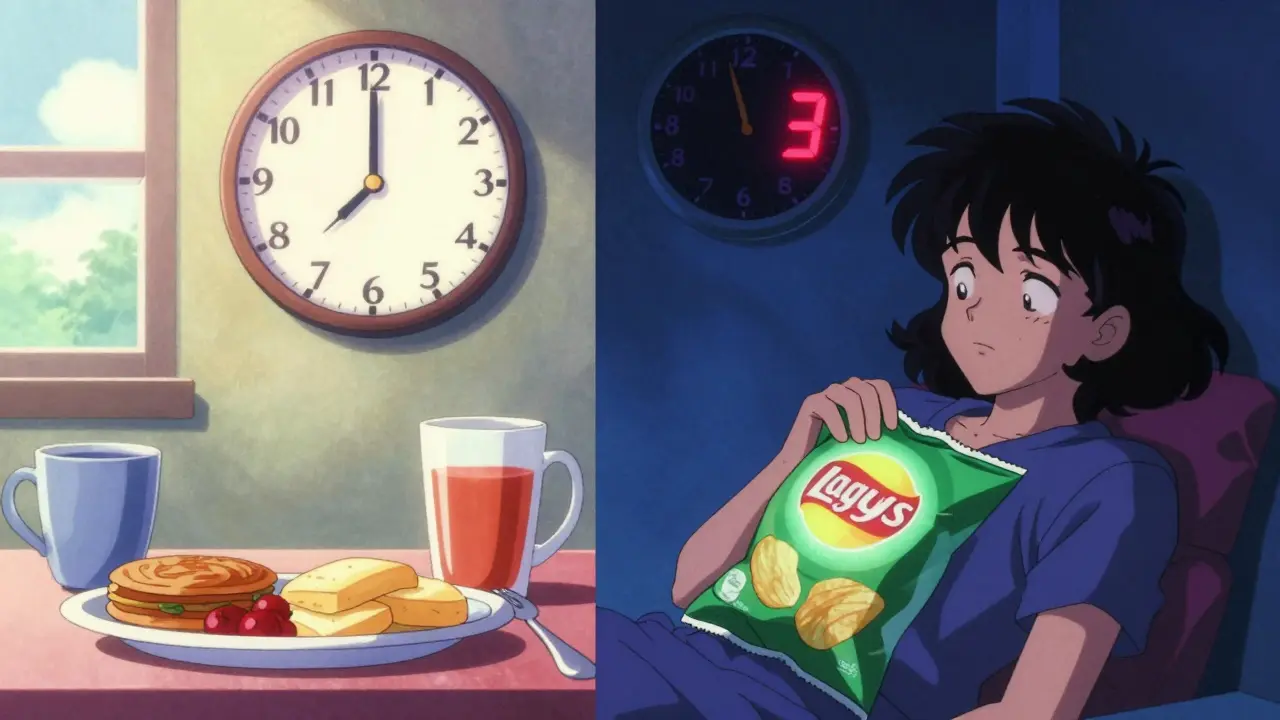
The Hidden Metabolic Cost of a Broken Clock
When your lifestyle doesn't match your internal clock-something called circadian misalignment-your body stops processing energy efficiently. This is incredibly common for the roughly 20% of the global workforce engaged in shift work. It's not just about feeling tired; it's about a measurable drop in how much energy you burn. Research shows that nightshift work can reduce your total daily energy expenditure by about 3%. While 55 calories a day might sound tiny, it adds up. More importantly, the "thermic effect of feeding"-the energy your body uses to digest food-drops by about 17% if you eat a heavy dinner late at night during a shift. Essentially, your body isn't equipped to handle calories during the biological night, leading to easier fat storage.| Factor | Effect on Energy Expenditure | Effect on Caloric Intake | Metabolic Outcome |
|---|---|---|---|
| Circadian Misalignment | Decreases by ~3% (55 kcal/day) | Variable | Reduced fat burning efficiency |
| Sleep Restriction | Increases by ~100 kcal/day | Increases by 250+ kcal/day | Net gain of 150+ kcal/day |
| Night Eating | Lower thermic effect (-17%) | Higher cravings for carbs | Impaired glucose tolerance |
Why You Crave Junk Food When Tired
If you've ever noticed that a bad night's sleep makes you crave donuts instead of apples, you're not imagining it. When you are sleep-deprived, your brain's reward centers become hyper-reactive. In one study, people restricted to four hours of sleep for a few nights saw their appetite jump by 22%, with a specific 33% increase in the desire for high-carb foods. This happens because the brain is searching for a quick energy hit to compensate for the lack of rest. At the same time, your insulin sensitivity drops by 20-25% during the biological night. This means that if you eat a high-carb snack at 2 AM, your blood sugar spikes much higher and stays elevated longer than if you ate that same snack at 2 PM. This hormonal chaos is a direct path to insulin resistance and weight gain.
The Genetics of the Biological Clock
It's not just about habits; there's a molecular engine driving this. Core clock genes like CLOCK, BMAL1, PER, and CRY act as the switches for your metabolism. These genes control enzymes that manage glucose and lipid metabolism. To illustrate how powerful this is, scientists looked at "CLOCK mutant" mice. These mice had a glitch in their timing genes and ended up 15-20% heavier than normal mice, even when they didn't eat more. This proves that the timing of the metabolic process is just as important as the amount of food consumed.Practical Strategies to Sync Your Metabolism
Since we can't all quit our jobs or live in a cave, how do we fix this? The most effective tool currently available is Time-Restricted Eating (TRE), which is the practice of limiting food consumption to a specific window of time during the day. By restricting your eating to an 8-10 hour daylight window, you align your food intake with the period when your metabolism is most efficient. If you want to try this, don't jump into a strict fast immediately. Start by narrowing your eating window by 30 to 60 minutes each week. For example, if you currently eat from 7 AM to 11 PM, move toward a window of 8 AM to 6 PM. It's also vital to consider your chronotype. If you're a "morning lark," an early window (like 8 AM to 6 PM) usually works best. If you're a "night owl," a slightly later window (10 AM to 8 PM) might be more sustainable and effective. People who align their eating window with their natural type have seen significantly better weight loss results.
Dealing with the Shift Work Struggle
For those working nights, the challenge is steeper, but not impossible. The goal is to minimize the "metabolic shock" of eating when the body thinks it should be asleep. Strategic light exposure is your best friend here. Using bright lights during the start of your shift and wearing blue-light-blocking glasses on the way home helps trick your SCN into a more stable pattern. Many shift workers find success by focusing on high-protein, low-carb meals during the night. Since insulin sensitivity is at its lowest, avoiding heavy sugars at 3 AM prevents the massive glucose spikes that lead to weight gain. Some healthcare systems have seen weight gain reduce by as much as 42% just by implementing these light and meal timing protocols.Will I gain weight if I only sleep 5 hours but eat the right calories?
Likely, yes. Sleep restriction creates a "double whammy." While your energy expenditure might actually increase slightly (around 100 kcal), your appetite typically increases by 250 calories or more. This creates a net positive energy balance, which can theoretically lead to significant weight gain over a year even if you feel like you're eating "normally."
What is the best eating window for weight loss?
The best window depends on your chronotype. Morning types generally thrive with an 8 AM to 6 PM window. Evening types often do better with a 10 AM to 8 PM window. The key is consistency-keeping your eating and sleeping times within a 30-minute window every day helps stabilize your metabolism.
Can I fix my metabolism if I've worked night shifts for years?
Yes, the body is adaptable. Implementing Time-Restricted Eating and using strategic light exposure can help resynchronize your peripheral clocks in the liver and gut. Many people report reduced nighttime hunger and better weight control within 2-4 weeks of adopting a consistent circadian-aligned schedule.
Why do I specifically crave carbs when I'm tired?
Sleep deprivation increases activity in the brain's reward centers, making high-calorie, high-carb foods more appealing. Additionally, your body is struggling for energy, and glucose (from carbs) is the fastest source of fuel, which is why your brain pushes you toward sugar and flour when you're exhausted.
Does the time of day I exercise matter for weight loss?
Yes. Exercising in alignment with your circadian peak (usually late afternoon or early evening for most) can maximize metabolic efficiency. However, the most important factor is consistency. The worst thing for your metabolism is a volatile schedule where you exercise and eat at completely different times every day.




12 Comments
This is such a helpful breakdown of why our bodies react the way they do to late-night snacking. It's really encouraging to know that small adjustments in our routines can make such a big difference in how we feel and manage our health!
Oh wow, a tiny region in the hypothalamus is the "master clock" and suddenly everything makes sense. I'm sure the pharmaceutical companies are just thrilled we're discovering how to fix our metabolism with "light exposure" and "eating windows" instead of their latest pill. Truly groundbreaking stuff if you've never read a biology textbook before.
The mention of the CLOCK and BMAL1 genes is really interesting. From what I've read, these proteins operate in a feedback loop that's incredibly sensitive to external cues. Aligning your diet with these molecular rhythms is basically like giving your body a manual for how to process nutrients efficiently.
Totally agree on the TRE approach! 🤩 Basically optimizing the metabolic flux by syncing with the SCN really mitigates the postprandial glucose spikes! It's all about that glycemic variability control 📈✨
I've always been a night owl and it's so nice to feel validated in that! 🌙✨ Just shifting my eating window a bit makes a world of difference. Thanks for sharing this! 🌸
honestly it just sounds like a lot of work to track every single minute of your life just to avoid a few calories here and there when most of us are just trying to survive the work week without collapsing and the idea that a 3 percent drop in energy expenditure is the real culprit for weight gain is just so dramatic when we all know the real issue is just the sheer lack of quality food available in most cities these days anyway
the gov wants us to think its genes but really they just want us on a schedule so we are easier to control
For those struggling with shift work, focusing on the peripheral oscillators is key. When you eat during the biological night, you're essentially creating a conflict between your central master clock in the brain and the metabolic clocks in your liver. This desynchronization is what leads to that systemic insulin resistance mentioned in the post.
i tried the eating window thing and it realy helped with my energy levels throughout the day tho it was hard to start at first!!
Consistency is paramount. One must adhere strictly to the wake-up window to ensure metabolic stability.
I just can't believe how much this hits home because I've spent years feeling like a failure for craving sweets at midnight while my whole life is just one giant chaotic mess and now I find out my brain is literally hyper-reactive because I can't sleep 😭 it's just so overwhelming to think about how my body is fighting me every single night while I'm just trying to find a moment of peace in this exhausting world 💔✨
It is a matter of discipline and cultural fortitude. In many traditional societies, eating was naturally aligned with the sun, and it is only the decadent lack of structure in modern Western lifestyles that has led to such metabolic degradation.